Varasova
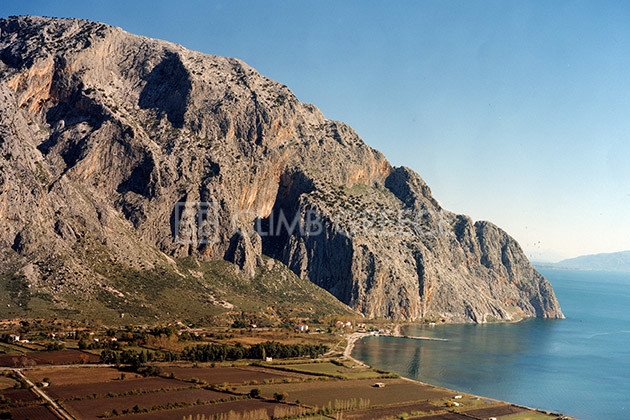
Sign in to saveVarasova () is a limestone mountain in the southern part of Aetolia-Acarnania in western Greece. It was known as Chalcis () in antiquity, and there was an ancient Aetolian town at its foot named Chalcis, Hypochalcis or Chalceia (hence the name of the current administrative unit Chalkeia). It rises steeply from the coast of the Gulf of Patras to 917 m elevation. It is situated just east of the mouth of the river Evinos, 3 km east of Galatas, 14 km east of Missolonghi and 18 km northwest of Patras. 8 km to its east is the mountain Klokova. There are several rock climbing rout
Key facts
- Mountain.name
- Varasova
- Mountain.photo
- File:Barasova.jpg
- Mountain.photo_caption
- Varasova from Kryoneri
- Mountain.elevation_m
- 917
- Mountain.map
- Greece
- Mountain.location
- southern Aetolia-Acarnania
via Wikipedia infobox
Described at
Climb Greece | Varasova
Home of the Greece Sport Climbing Guidebook: discover climbing in Leonidio, Kyparissi, Nafplio, Frygani, Zobolo, Kalogria and other crags in the Peloponnese and climbing in the Patras area; Varasova, Meteora, Pyli/Mouzaki, and more.
climbgreece.com →Crags by name AlepochoriAlmyrosAnafiChaosChatzouriFryganiKardamyliKleisouraKyparissiLagadaLeonidioLerosMavrosouvalaMeteoraMouzakiMt. HymettusMt. ParnithaMytikasNafplioNedousaPlakiasPyliSpartiaSymiTersanas CaveVarasovaVoulismeno AloniZobolo Crags by Area Aegean Islands– Anafi– Leros– SymiAthens Area– Chaos– Mavrosouvala– Mt. Hymettus– Mt. ParnithaCrete– Plakias– Tersanas Cave– Voulismeno AloniPatras Area– Alepochori– Chatzouri– Kleisoura– Spartia– VarasovaPeloponnese– Frygani– Kardamyli– Kyparissi– Lagada– Leonidio– Nafplio– Nedousa– ZoboloThessaly– Almyros– Meteora– Mouzaki– PyliWestern Greece– Mytikas Accommodation : The majority of climbers in Varasova prefer free camping beneath the cliffs, as the road ends at a small grassy clearing between the cliffs and the sea. If you pitch a tent, keep a safe distance from the cliffs to avoid potential stonefall. Also, know that it can get very windy. Food/shopping : The nearest village, Galatas (3km), has a few small shops, a gas station and some tavernas. For everything else there is Messolonghi (10km). And Captain del Mar, the seaside restaurant near the crag, is very good. If you like fish, try petáli paired with wild mountain greens. Varasova (pronounced va-RA-so-va) is a solid limestone massif rising to 917m on the west coast of Greece, across the water from the city of Patras. Its south and southwest faces form an impressive promontory the end of which drops directly into the sea. Greek climbing took its first steps here in 1958, so Varasova has a special place in the hearts of Greek climbers. Coupled with Meteora, it is one of the most popular and historic climbing venues in the country, especially when it comes to multi-pitch routes. But don’t worry, you won’t run into any crowds. Varasova is mainly a weekend venue, so if you are here mid-week you are very likely to have the crag to yourself. Climbing : The three peaks of Varasova rise to nearly identical elevation. The rock is very solid, relatively sharp, mostly gray or yellow limestone of outstanding quality. It is generously featured and teeming with variety: compact walls, steep slabs, corners and vertical cracks, jugs, flakes, chickenheads, incut edges, and a surplus of hidden holds and footholds which make for sublime climbing over a remarkably blue sea. The approximately 200 routes of Varasova include single- and multi-pitch sport routes. There are also several mixed-character ‘adventure’ routes with as many as 18 pitches and, although these usually have a few bolts per pitch (mainly on solid sections of rock) plus fixed belay anchors, they will also require placement of nuts or other trad gear (usually in cracks). In spring, many features are obscured by vegetation, so be prepared to do some ‘gardening’. Some parts of the multipitch routes are runout, but most anchors are bolted and set up for rappelling. There is still vast potential for new routes in Varasova, especially for bolted sport lines. Grades range from very easy to very hard, the majority being in the mid-grades (5c-6b). Gear : The standard rack is 12-16 quickdraws, a few single carabiners, some slings and thin cords for tying off big chickenheads or threading holes. Bring two 60m ropes (half-weight) for climbing and abseiling. Alternatively, you can climb with one single 70m or 80m rope on the single pitch routes (or the longer routes if there aren’t too many traverses, or if double-rope technique isn’t required, or if the length of rappels does not exceed 35m.) For routes with cracks requiring trad gear, you will also need a selection of wired nuts and cams. Lastly, helmets are absolutely necessary – not only to protect you against stonefall, but also in case you take a big fall head-first. Kids : Very good. Approaches are short and the terrain beneath the cliffs is nice and level. Sector Batman is especially suitable, as the road comes to the foot of the routes and there is a grassy area for playing.
Excerpt from a page describing this subject · 15,645 chars · not written by Vinony
Wikidata facts
- Instance of
- mountain
- Country
- Greece
- Located in
- Nafpaktia Municipality
- Elevation
- 917
- Image
- Barasova.jpg
Show 3 more facts
- native label
- Βαράσοβα
- Commons category
- Varasova
- described at URL
- climbgreece.com/varasova
via Wikidata · CC0
~2 min read
Encyclopedic overview
3 sectionsContents
- Gallery
- References
- External links
Varasova () is a limestone mountain in the southern part of Aetolia-Acarnania in western Greece. It was known as Chalcis () in antiquity, and there was an ancient Aetolian town at its foot named Chalcis, Hypochalcis or Chalceia (hence the name of the current administrative unit Chalkeia). It rises steeply from the coast of the Gulf of Patras to 917 m elevation. It is situated just east of the mouth of the river Evinos, 3 km east of Galatas, 14 km east of Missolonghi and 18 km northwest of Patras. 8 km to its east is the mountain Klokova. There are several rock climbing routes on the steep south and southwest faces of the Varasova.
It is referred to as the Mount Athos of Rumelia or Western Greece, due to the large number of churches and monasteries (around 72) built in the Byzantine and the Ottoman period. Several still exist today, including the 9th-18th century cave monastery of Agios Nikolaos near Kryoneri, which is only accessible by boat. It is an important natural site, notable as the only place in the world where the plant Centaurea heldreichii grows.
Excerpted from Wikipedia’s “Varasova” article, available under the CC BY-SA 4.0 licence.
On the map
2 mapped locations