
velomobile
Sign in to saveAlso known as bicycle car, velocar, velomobiel, velo
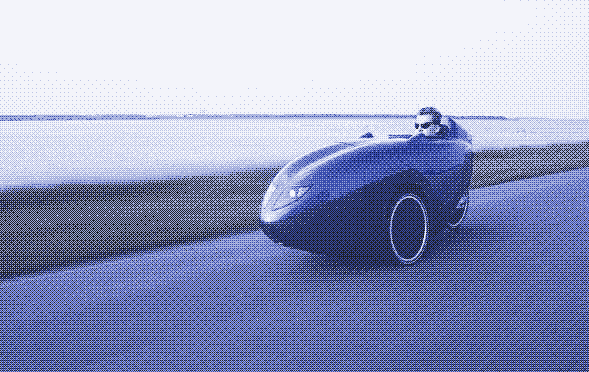
A velomobile (), velomobiel, velo, or bicycle car is a human-powered vehicle (HPV) enclosed for aerodynamic advantage and/or protection from weather and collisions. Velomobiles are similar to recumbent bicycles, pedal go-karts and tricycles, but with a full fairing (aerodynamic or weather protective shell) and are not to be confused with purpose-built mobiles for speed records. Fully faired vehicles with two wheels are generally called Streamliners and have set many speed and distance records.
Key facts
- Machine.name
- Velomobile
- Machine.image
- Red 3-wheel Velomobile.jpg
- Machine.caption
- Three-wheeled velomobile
- Machine.classification
- Vehicle
- Machine.application
- Transportation
- Machine.fuel_source
- Human power, Electricity
- Machine.wheels
- 3–4
- Machine.components
- Wheels, Seat, Handlebar, Fairing, Chain, Derailleur
- Machine.invented
- 1930s
- Machine.examples
- Velocar, Fantom, Leitra, Waw, People Powered Vehicle, , QuattroVelo, Sinclair C5, Frikar
via Wikipedia infobox
Described at
The Velomobile: High-tech Bike or Low-tech Car? | LOW←TECH MAGAZINE
This is a solar-powered website, which means it sometimes goes offline
lowtechmagazine.com →Recumbent bikes with bodywork evoke a curious effect. They look as fast as a racing car or a jet fighter, but of course, they’re not. Nevertheless, thanks to the recumbent position, the minimal weight and the outstanding aerodynamics, pedalling a “velomobile” requires three to four times less energy than pedalling a normal bicycle. Basically, a velomobile is a recumbent bike with the addition of a bodywork. Recumbent bikes are considered a bit weird, but they have some interesting advantages over normal bicycles. For example, a recumbent bike has no saddle but a comfortable seat with back support, so that you sit or lie more comfortably and can keep pedalling for longer. Because of their superior aerodynamic capabilities, pedalling on a recumbent takes less effort, allowing you to travel more quickly and further than on a normal bicycle. Recumbent bikes can have two, three or four wheels. Trikes (3 wheels) and quads (4 wheels) offer the additional benefit of stability. A velomobile - almost always a trike - offers two extra advantages over normal recumbent tricycles. The bodywork protects the rider (and mechanical parts) from the weather, so that the vehicle can be used in any season or climate. Furthermore, the aerodynamic shape of the bodywork further improves the efficiency of the vehicle, with spectacular results. Source: "The velomobile as a vehicle for more sustainable transportation " (pdf). NASA rates the average long-term power output for a male adult at 75 watts, while fit individuals might easily sustain more than 100 watts for several hours, from 200 to 300 watts for one hour, and between 300 and 400 watts for at least 10 minutes. Lance Armstrong is said to have averaged between 475 and 500 watts for 38 minutes during an uphill climb in the 2001 Tour de France. (Source: The human powered home ). By definition, velomobiles are built for speed. The bodywork offers a distinct advantage at higher speeds, starting at 20 to 25 km/h (12.4 to 15.5 mph). Above those speeds, almost all energy produced by a cyclist is channelled toward combating air resistance. Because of the upright position, the aerodynamics of a cyclist on a normal bicycle are disappointing. A velomobile, on the other hand, suffers less air resistance than even the most aerodynamic sports car. At lower speeds, however, the relatively heavy (25 to 40 kilograms) velomobile becomes a disadvantage. It accelerates slower than a normal bicycle, and has considerably more difficulty climbing a hill. An electric assist motor can solve this problem in hilly regions. The motor can help the velomobile climb, while energy can be recovered from the brakes during the descent. Of course, an electric assist can also be considered on flat terrain, an option that is gaining a lot of popularity these days . Dries Callebaut and Brecht Vandeputte, the Belgian designers of the WAW-velomobile , calculated how the efficiency of a velomobile relates to the efficiency of an electric automobile (using their own data and this source ). During an eco-marathon earlier this year they equipped their velomobile with an electric motor, a complete substitution for pedal power. This is not really what the vehicle is intended for, but the advantage of the experiment is that it allows for an unequivocal comparison. The energy consumption of the WAW was measured at 0.7 kWh per 100 kms (62 miles). This makes the velomobile in excess of 20 times more efficient than electric cars currently on the market. For example, the Nissan Leaf requires 15 kWh per 100 kms. The enormous difference is of course due to the enormous difference in weight. Without the battery, the Nissan weighs just over a ton, while the WAW weighs less than 30 kgs. For a human powered velomobile the comparison is a bit more complicated and open to interpretation, because a human does not run (primarily) on electricity, but on biomass. The efficiency of a human powered velomobile thus depends on what the cyclist eats (the e
Excerpt from a page describing this subject · 40,000 chars · not written by Vinony
Wikidata facts
- Instance of
- vehicle
- Subclass of
- recumbent bicycle
- Part of
- road transport
- Has part
- bicycle chain
- Image
- Doorzich1.jpg
- Has use
- human-powered transport
Show 7 more facts
- used by
- cyclist
- Commons category
- Velomobiles
- topic's main category
- Category:Velomobiles
- has effect
- travel
- physically interacts with
- road
- IPA transcription
- ˈvɛloʊmoʊˌbil
via Wikidata · CC0
~27 min read
Encyclopedic overview
13 sectionsContents
- History
- Modern/contemporary velomobiles
- World records
- Comparison to other cycle types
- Aerodynamic fairing
- Weather protection
- Wheel configurations
- Electric assisted velomobiles
- DIY (do it yourself) velomobiles
- Velomobile and recumbent Internet communities
- See also
- References
- External links
A velomobile (), velomobiel, velo, or bicycle car is a human-powered vehicle (HPV) enclosed for aerodynamic advantage and/or protection from weather and collisions. Velomobiles are similar to recumbent bicycles, pedal go-karts and tricycles, but with a full fairing (aerodynamic or weather protective shell) and are not to be confused with purpose-built mobiles for speed records. Fully faired vehicles with two wheels are generally called Streamliners and have set many speed and distance records.
Though fast in their own right, velomobiles are considered much more suitable for the street than two-wheeled streamliners. Using three or more wheels can have advantages for everyday use, including the ability to stop and start unaided, better stability, cross-wind handling, etc., though there are arguments made that the multiple track machines (three or more wheels) have aerodynamic disadvantages due to the drag of the extra wheels and the surface contact points. In practice though, velomobiles continue to be close to their two-wheel cousins in performance.
Excerpted from Wikipedia’s “velomobile” article, available under the CC BY-SA 4.0 licence.