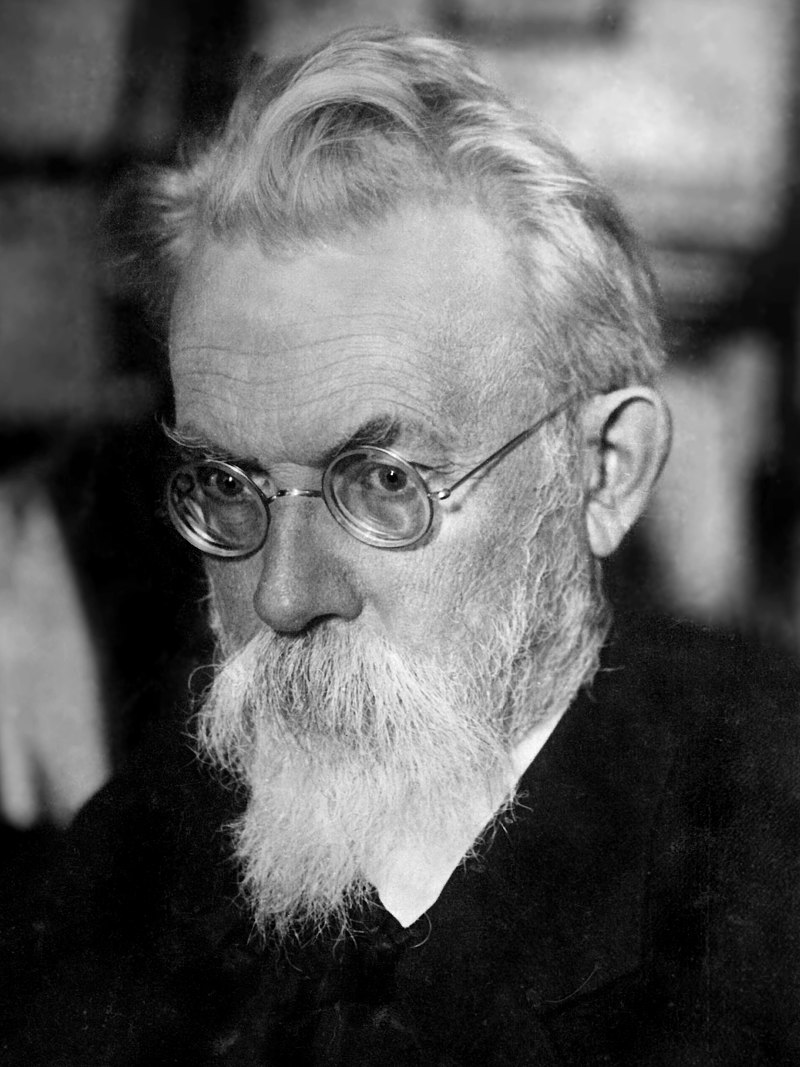
Vladimir Vernadsky
Also known as V. I. Vernadsky, Vernadsky V I, Volodymyr Ivanovych Vernadsky, Vladimir Ivanovich Vernadsky
Russian and Soviet mineralogist and geochemist, one of the founders of geochemistry, biogeochemistry, and of radiogeology
AI overview
Vladimir Vernadsky was a Russian and Soviet scientist who made foundational contributions to the study of minerals, chemical elements in the Earth, and radioactive materials. His work established entire new fields of scientific study—geochemistry, biogeochemistry, and radiogeology—that help us understand how chemicals cycle through rocks, soil, water, and living organisms on our planet.
AI-generated from the Wikipedia summary — may contain errors.
Person · Open Library
- Works
- 2
Top works
- 150 Years of Vernadsky
- Economics of the Noösphere
via Open Library + Wikidata
Listeners · Last.fm
- Listeners
- 87
- Total plays
- 543
<a href="https://www.last.fm/music/Vladimir+Vernadsky">Read more on Last.fm</a>
Article
Vladimir Ivanovich Vernadsky (Russian: Владимир Иванович Вернадский), also spelt Volodymyr Ivanovych Vernadsky (Ukrainian: Володимир Іванович Вернадський; 12 March [O.S. 28 February] 1863 – 6 January 1945), was a Russian, Ukrainian, and Soviet mineralogist and geochemist who is considered one of the founders of geochemistry, biogeochemistry, and radiogeology. He was one of the founders and the first president of the Ukrainian Academy of Sciences (now National Academy of Sciences of Ukraine). Vladimir Vernadsky is most noted for his 1926 book The Biosphere in which he inadvertently worked to popularize Eduard Suess's 1875 term biosphere, by hypothesizing that life is the geological force that shapes the earth. In 1943 he was awarded the Stalin Prize. Vernadsky's portrait is depicted on the Ukrainian ₴1,000 hryvnia banknote.
Early life
Gallery (6)
Connections
Categories
1863 births1945 deathsBiologists from the Russian EmpireBurials at Novodevichy CemeteryCosmistsEmigrants from the Russian Empire to SwitzerlandFull Members of the All-Ukrainian Academy of SciencesFull Members of the Russian Academy of Sciences (1917–1925)Full members of the Saint Petersburg Academy of SciencesFull Members of the USSR Academy of SciencesGeologists from the Russian Empire