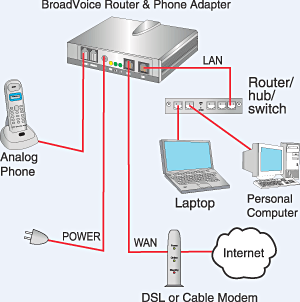
File:Voip-typical.gif · Wikimedia Commons · See Wikimedia Commons
Voice over IP
Sign in to saveAlso known as Voice over Internet Protocol, IP telephony, Internet Protocol telephony, broadband telephony, broadband phone service
technology for transmitting voice and other data over IP networks
Voice over IP is a technology that lets you make phone calls by sending your voice and other data through the same internet networks that carry regular data traffic, rather than through traditional telephone lines. It matters because it can be cheaper and more flexible than conventional phone service, while allowing voice communication to work wherever you have internet access.
AI-generated from the Wikipedia summary — may contain errors.
Official website

KrispCall: AI-Powered Communication Platform for Growing Businesses
Manage calls, SMS, and customer conversations across 100+ countries with AI-powered tools and CRM integrations. Trusted by 9,000+ businesses worldwide.
krispcall.com →Link to the official site · 28,243 chars · not written by Vinony
Wikidata facts
- Instance of
- technology
- Subclass of
- service on Internet
- Official website
- krispcall.com
- Image
- Voip-typical.gif
Show 5 more facts
- Commons category
- VoIP
- topic's main category
- Category:Voice over IP
- Stack Exchange tag
- stackoverflow.com/tags/voip
- short name
- VOIP
- has characteristic
- quality of service
via Wikidata · CC0
~40 min read
Encyclopedic overview
Voice over Internet Protocol (VoIP), also known as IP telephony, is a set of technologies used primarily for voice communication sessions over Internet Protocol (IP) networks, such as the Internet. VoIP enables voice calls to be transmitted as data packets, facilitating various methods of voice communication, including traditional applications like Skype, Microsoft Teams, Google Voice, and VoIP phones. Regular telephones can also be used for VoIP by connecting them to the Internet via analog telephone adapters (ATAs), which convert traditional telephone signals into digital data packets that can be transmitted over IP networks.
The broader terms Internet telephony, broadband telephony, and broadband phone service specifically refer to the delivery of voice and other communication services, such as fax, SMS, and voice messaging, over the Internet, in contrast to the traditional public switched telephone network (PSTN), commonly known as plain old telephone service (POTS).
Excerpted from Wikipedia’s “Voice over IP” article, available under the CC BY-SA 4.0 licence.
Gallery (3)
Available in 74 languages
- Español
- Français
- Deutsch
- 中文
- 日本語
- Русский
- Português
- Italiano
- العربية
- हिन्दी
- Afrikaans
- Albanian
- Asturian
- Azerbaijani
- Bahasa Indonesia
- Bangla
- Bashkir
- Basque
Show 55 more
- Belarusian
- Bosnian
- Bulgarian
- Burmese
- Catalan
- Croatian
- Czech
- Danish
- Esperanto
- Estonian
- Finnish
- Galician
- Greek
- Hebrew
- Hungarian
- Ido
- Irish
- Kannada
- Kazakh
- Lao
- Latvian
- Lithuanian
- Lombard
- Macedonian
- Malay
- Malayalam
- Nederlands
- Norwegian Nynorsk
- Piedmontese
- Polski
- Quechua
- Romanian
- Serbian
- simple
- Sinhala
- Slovak
- Slovenian
- Somali
- Sundanese
- Svenska
- Tajik
- Tamil
- Tiếng Việt
- Türkçe
- Ukrainian
- Urdu
- Venetian
- Walloon
- Wu Chinese
- Xhosa
- Yiddish
- zh_min_nan
- فارسی
- ไทย
- 한국어
via Wikidata sitelinks · CC0