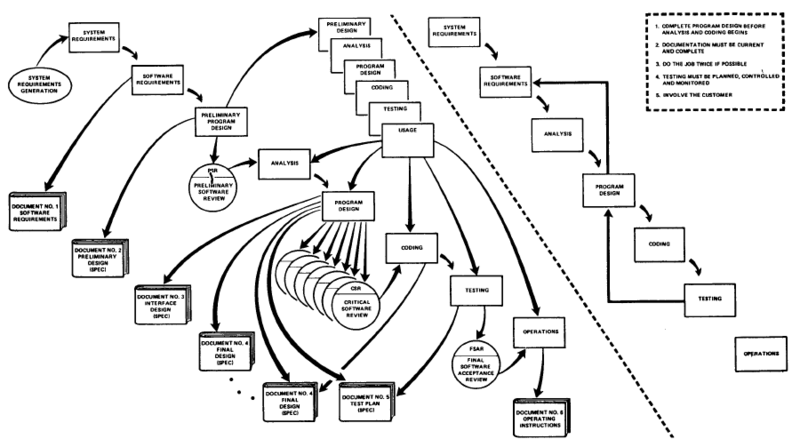
File:1970_Royce_Managing_the_Development_of_Large_Software_Systems_Fig10.PNG · Wikimedia Commons · See Wikimedia Commons
waterfall model
Sign in to saveBreakdown of projects into sequential phases, where each phase depends on the previous one
Wikidata facts
- Instance of
- software development methodology
- Subclass of
- software development process
- Image
- Waterfall model.png
Show 2 more facts
- Commons category
- Waterfall models
- derivative work
- V-model
Sources (2)
via Wikidata · CC0
~10 min read
Encyclopedic overview
The waterfall model is the process of performing the typical software development life cycle (SDLC) phases in sequential order. Each phase is completed before the next is started, and the result of each phase drives subsequent phases. Compared to alternative SDLC methodologies such as Agile, it is among the least iterative and flexible, as progress flows largely in one direction (like a waterfall) through the phases of conception, requirements analysis, design, construction, testing, deployment, and maintenance.
The waterfall model is the earliest SDLC methodology.
Excerpted from Wikipedia’s “waterfall model” article, available under the CC BY-SA 4.0 licence.