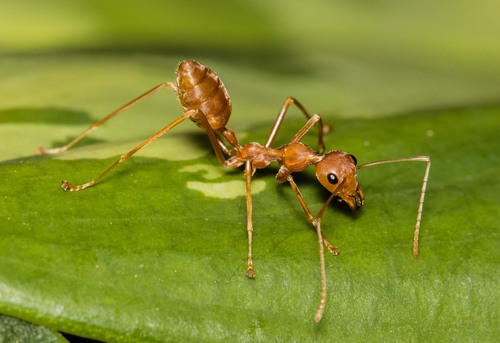
(c) Thomas Job, some rights reserved (CC BY-NC), uploaded by Thomas Job · cc-by-nc
OverviewAI-generated
Oecophylla is a genus of insects belonging to the class Insecta. The taxon has existed since the Eocene epoch, with a start time of about 47 million years ago. One species within this group is commonly known as the Asian Weaver Ant.
The genus is documented in various taxonomic databases and media categories. The Asian Weaver Ant has recorded 31,130 observations. The subject is referenced by 74 other encyclopedia articles.
Synthesized by Vinony from 14 facts across 3 sources: Wikidata, iNaturalist, Vinony graph. Generated from structured data (not the Wikipedia text) and checked against those facts — may still contain errors.
Species
Asian Weaver Ant
species
Oecophylla est un genre d'insectes de la famille des Formicidae, sous-famille des Formicinae, de la tribu des Oecophyllini. Ces fourmis vivent dans les arbres et tissent des nids à partir de feuilles d'arbres encore attachées à leur branche, qu'elles attachent entre elles avec des fils de soie produits par leurs larves.
via
Wikidata facts
- Instance of
- taxon
- Image
- Oecophylla smaragdina MHNT reine.jpg
Show 7 more facts
- taxon rank
- genus
- taxon name
- Oecophylla
- Commons category
- Oecophylla
- topic's main category
- Category:Oecophylla
- Commons gallery
- Oecophylla
- start time
- 47000000-0
- temporal range start
- Eocene
Sources (2)
via Wikidata · CC0
~14 min read
Encyclopedic overview
Weaver ants or green ants are eusocial insects of the ant family (Formicidae) belonging to the tribe Oecophyllini. Weaver ants live in trees (they are obligately arboreal) and are known for their unique nest building behaviour where workers construct nests by weaving together leaves using larval silk. Colonies can be extremely large consisting of more than a hundred nests spanning numerous trees and containing more than half a million workers. Like many other ant species, weaver ants prey on small insects and supplement their diet with carbohydrate-rich honeydew excreted by scale insects (Hemiptera). Weaver ant workers exhibit a clear bimodal size distribution, with almost no overlap between the size of the minor and major workers. The major workers are approximately 8–10 mm (0.31–0.39 in) in length and the minors approximately half the length of the majors. Major workers forage, defend, maintain, and expand the colony whereas minor workers tend to stay within the nests where they care for the brood and 'milk' scale insects in or close to the nests.
Dead weaver ant queen carried by a worker ant
Excerpted from Wikipedia’s “weaver ant” article, available under the CC BY-SA 4.0 licence.