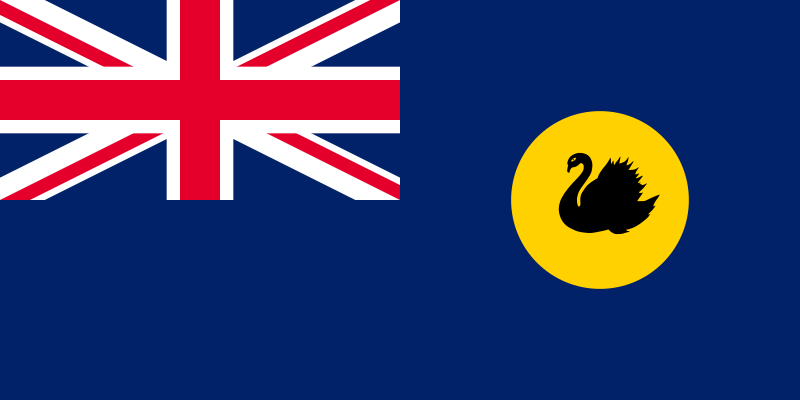
File:Flag_of_Western_Australia.svg · Wikimedia Commons · See Wikimedia Commons
Western Australia
Sign in to saveAlso known as WA, W.A., State of Western Australia, State of WA, W. Aust., Western Oz
state of Australia
Western Australia is the largest state in Australia, covering an enormous area on the country's western coast. It matters because it is a major economic powerhouse, particularly for mining and agriculture, and is home to significant natural resources and a substantial population.
AI-generated from the Wikipedia summary — may contain errors.
Research
128,553 papers- Western Australia.The lancet. Psychiatry · 2021Gardiner FW, Coleman MDOI: 10.1016/S2215-0366(20)30520-4
- Recent brachiopods from north-western Australia.Zootaxa · 2025Bitner MADOI: 10.11646/zootaxa.5631.3.4
- Western Australia.Australian endodontic journal : the journal of the Australian Society of Endodontology Inc · 2010Castro JDOI: 10.1111/j.1747-4477.2010.00247.x
- Serpentoviruses in Free-Ranging Shingleback Skinks (Tiliqua rugosa) in Western Australia and South Australia, Australia.Journal of wildlife diseases · 2024O'Reilly RL, Jones TC, Hyndman TH et al.DOI: 10.7589/JWD-D-23-00198
- Successful Control of an Onboard COVID-19 Outbreak Using the Cruise Ship as a Quarantine Facility, Western Australia, Australia.ReviewEmerging infectious diseases · 2021Codreanu TA, Ngeh S, Trewin A et al.DOI: 10.3201/eid2705.204142
- Incidence of the mucopolysaccharidoses in Western Australia.ReviewAmerican journal of medical genetics. Part A · 2003Nelson J, Crowhurst J, Carey B et al.DOI: 10.1002/ajmg.a.20314
- Sebaceous carcinoma in Western Australia: A registry-based study of site-related outcomes.The Australasian journal of dermatology · 2023Hillan A, Korbl J, Wood BA et al.DOI: 10.1111/ajd.14127
- Organisations welcome first smoke-free prison in Western Australia.The Lancet. Oncology · 2023Das MDOI: 10.1016/S1470-2045(22)00748-3
via PubMed
Official website
Home | Western Australian Government
Find and access WA Government online services and information quickly and easily.
wa.gov.au →Link to the official site · 4,190 chars · not written by Vinony
Wikidata facts
- Named after
- west
- Country
- Australia
- Located in
- Australia
- Contains
- Shire of Northampton
- Continent
- Oceania
- Capital
- Perth
- Population
- 3008700
- Area
- 2527013
- Elevation
- 536
- Body of water
- Timor Sea
- Head of government
- Roger Cook
- Legislature
- Parliament of Western Australia
- Shares border with
- Northern Territory
- Highest point
- Mount Meharry
- Official website
- www.wa.gov.au
- Image
- Western Australia - November 10, 2013.jpg
- Dialing code
- 08
Show 18 more facts
- language used
- Worora
- topic's main Wikimedia portal
- Portal:Western Australia
- Commons category
- Western Australia
- public holiday
- Western Australia Day
- topic's main category
- Category:Western Australia
- inception
- 1901-01-01
- category for people born here
- Category:Births in Western Australia
- category for people who died here
- Category:Deaths in Western Australia
- category of associated people
- Category:People from Western Australia
- Commons gallery
- Western Australia
- age of consent
- 16
- office held by head of government
- Premier of Western Australia
- history of topic
- history of Western Australia
- twinned administrative body
- Hyōgo Prefecture
- native label
- Western Australia
- name
- West Australia
- executive body
- Government of Western Australia
Sources (8)
via Wikidata · CC0
~40 min read
Encyclopedic overview
Western Australia (WA) is the westernmost state of Australia. It is bounded by the Indian Ocean to the north and west, the Southern Ocean to the south, the Northern Territory to the north-east, and South Australia to the south-east. Western Australia is Australia's largest state, with a land area of 2,527,013 square kilometres (975,685 sq mi), and is also the second-largest subdivision of any country on Earth.
The state has a diverse range of climates, including tropical conditions in the Kimberley, deserts in the interior (including the Great Sandy Desert, Little Sandy Desert, Gibson Desert, and Great Victoria Desert) and a Mediterranean climate on the south-west and southern coastal areas. As of June 2024, the state has 2.965 million inhabitants—10.9 percent of the national total. Over 90 percent of the state's population live in the south-west corner and around 80 percent live in the state capital Perth, leaving the remainder of the state sparsely populated. The Trans-Australian Railway and the Eyre Highway traverse the Nullarbor Plain in the state's south-east, providing the principal connection between Western Australia and the population centres in the eastern states.
Excerpted from Wikipedia’s “Western Australia” article, available under the CC BY-SA 4.0 licence.
Gallery (13)
On the map
Available in 129 languages
- Español
- Français
- Deutsch
- 中文
- 日本語
- Русский
- Português
- Italiano
- العربية
- हिन्दी
- Afrikaans
- Albanian
- Aragonese
- Armenian
- Asturian
- azb
- Azerbaijani
- Bahasa Indonesia
Show 110 more
- Balinese
- Bangla
- Basque
- be_x_old
- Belarusian
- Betawi
- Bosnian
- Breton
- Bulgarian
- Burmese
- Catalan
- cdo
- Cebuano
- Central Kurdish
- Chuvash
- Croatian
- Czech
- Danish
- Egyptian Arabic
- Esperanto
- Estonian
- Faroese
- Fiji Hindi
- Fijian
- Filipino
- Finnish
- Galician
- Georgian
- Greek
- Hawaiian
- Hebrew
- Hungarian
- Icelandic
- Iloko
- Irish
- Javanese
- Kabyle
- Karachay-Balkar
- Kyrgyz
- Latin
- Latvian
- Ligurian
- Limburgish
- Lithuanian
- Lombard
- Luxembourgish
- Macedonian
- Malagasy
- Malay
- Malayalam
- Manx
- Māori
- Marathi
- Mazanderani
- Minangkabau
- Mingrelian
- Mongolian
- Moroccan Arabic
- Nederlands
- Nepali
- Northern Frisian
- Norwegian
- Norwegian Nynorsk
- Occitan
- Old English
- Ossetic
- Pampanga
- Pashto
- Piedmontese
- Polski
- Punjabi
- Romanian
- Samoan
- Sardinian
- Saterland Frisian
- Scots
- Scottish Gaelic
- Serbian
- Serbian (Latin)
- Sicilian
- simple
- Sindhi
- Sinhala
- Slovak
- Slovenian
- Somali
- Svenska
- Swahili
- Tamil
- Tiếng Việt
- Tok Pisin
- Toki Pona
- Tongan
- Türkçe
- Ukrainian
- Urdu
- Uzbek
- Venetian
- Waray
- Welsh
- West Flemish
- Western Frisian
- Western Panjabi
- Wu Chinese
- Zaza
- zh_min_nan
- zh_yue
- فارسی
- ไทย
- 한국어
via Wikidata sitelinks · CC0