Xanthoceras · Kew POWO · Kew Plants of the World Online
Xanthoceras
Sign in to saveXanthoceras sorbifolium, the yellowhorn, shiny leaf yellowhorn, goldenhorn, or Chinese flowering chestnut, is a woody oil tree species in the family Sapindaceae, and the only species in the genus Xanthoceras. It is native to northern China in the provinces of Gansu, Hebei, Henan, Liaoning, Nei Monggol, Ningxia, Shaanxi, and Shandong. It is also cultivated in Russia, having been imported there since the 19th Century. The genus name Xanthoceras (which translates as "yellow horn") is considered to be the most basal member of the family Sapindaceae. The specific epithet sorbifolium refers to the l
Species
GENUS
- KingdomPlantae
- PhylumTracheophyta
- ClassMagnoliopsida
- OrderSapindales
- FamilySapindaceae
via GBIF · Kew POWO
Museum specimens
- Specimen records
- 8
- With media
- 3
- Family
- Sapindaceae
- Collections
- US, A, BRIT, UCONN
- Recorded in
- United States, China
Wikidata facts
- Instance of
- taxon
- Image
- Xanthoceras sorbifolium2.jpg
Show 7 more facts
- taxon rank
- genus
- taxon name
- Xanthoceras
- taxon common name
- 文冠果属
- Commons category
- Xanthoceras
- has fruit type
- capsule
- topic's main category
- Category:Xanthoceras
Sources (2)
via Wikidata · CC0
~8 min read
Encyclopedic overview
4 sectionsContents
- Description
- Uses
- "One thousand flowers one fruit"
- References
Xanthoceras sorbifolium, the yellowhorn, shiny leaf yellowhorn, goldenhorn, or Chinese flowering chestnut, is a woody oil tree species in the family Sapindaceae, and the only species in the genus Xanthoceras. It is native to northern China in the provinces of Gansu, Hebei, Henan, Liaoning, Nei Monggol, Ningxia, Shaanxi, and Shandong. It is also cultivated in Russia, having been imported there since the 19th Century. The genus name Xanthoceras (which translates as "yellow horn") is considered to be the most basal member of the family Sapindaceae. The specific epithet sorbifolium refers to the leaves, which resemble those of the distantly related rowans (Sorbus). It was originally spelled sorbifolia, but this is a grammatical error that was corrected to sorbifolium under the ICBN. X. sorbifolium is an ancient tree species. It is said it can live up to 2,000 years. It is a sacred tree planted in temples in northern China, because there is no Ficus religiosa in the north. It is also used in traditional Chinese, Mongolian and Tibetan medicine. In Bencao Gangmu, it is called '天仙果 (Heavenly Fairy Fruit)'. Tenacious X. sorbifolium can grow in snow and drought like in the Gobi Desert. It has very high alimentaire value, medicinal value, ornamental value and ecological value. In cultivation in the UK, X. sorbifolium has gained the Royal Horticultural Society's Award of Garden Merit.
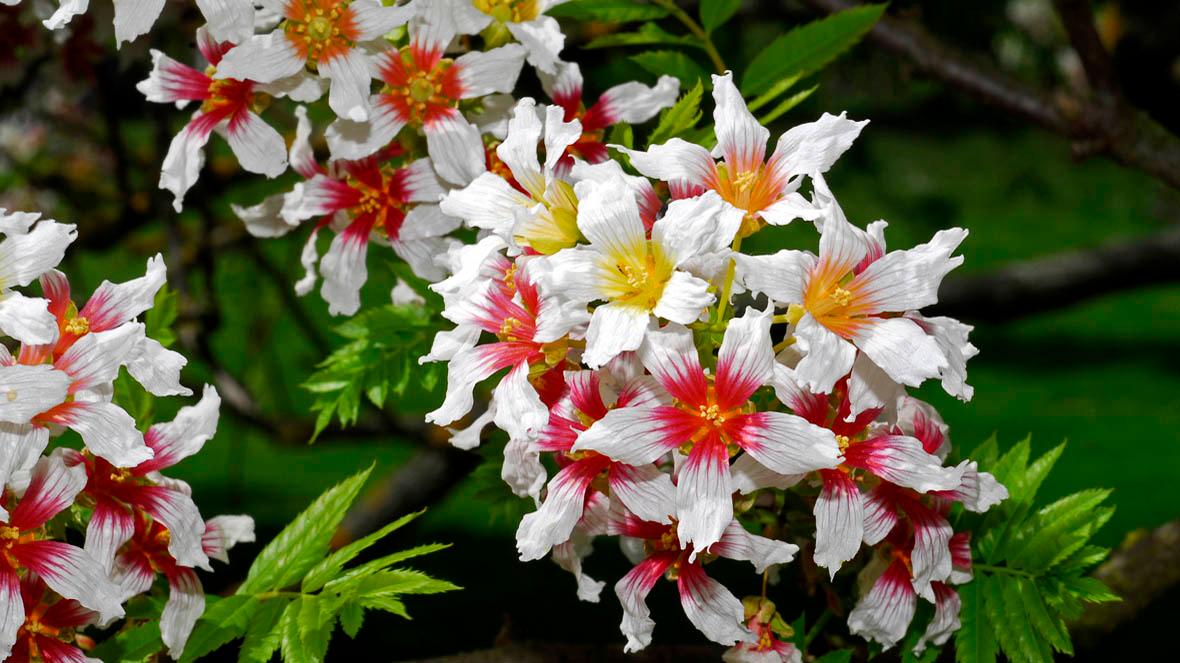
== Description == It is a large deciduous shrub or small tree growing to 8 m tall. The leaves are arranged alternately, 12–30 cm long, and are pinnate, with 9–17 leaflets, the leaflets 3–6 cm long, with a sharply serrated margin. The flowers are 2–3 cm in diameter, with five white petals, and are produced in erect panicles 10–20 cm long in mid spring. The fruit is an oval leathery capsule 5–6 cm diameter, which splits into three sections at maturity to release the 6–18 seeds; the seeds are black, 1.5 cm in diameter, resembling a small horse chestnut seed. The shells of the fruits and seeds are very hard, so that they are best protected during the growth process. Generally, X. sorbifolium only blooms white flowers. In the process of multiple crosses performed by the '西北文冠果基地/Northwest X. sorbifolium base' ("using 56 seeds of X.sorbifolium from all over the country to make them natural hybrids, in order to increase fruit yield"), unexpectedly, the flower color also changed from single to multiple.
Excerpted from Wikipedia’s “Xanthoceras” article, available under the CC BY-SA 4.0 licence.