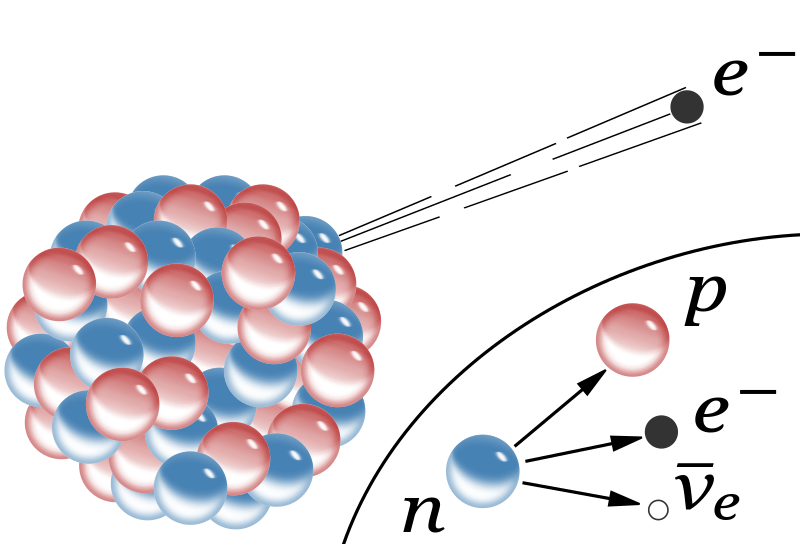
File:Beta-minus_Decay.svg · Wikimedia Commons · See Wikimedia Commons
Z boson
Sign in to saveAlso known as boson Z, Z particle
electrically neutral elementary particle that mediate the weak interaction Z boson
Key facts
- Composition
- Elementary particle
- Statistics
- Bose–Einstein statistics
- Family
- Gauge boson
- Interactions
- W: Weak , electromagnetic , Z: Weak
- Theorized
- Glashow , Weinberg , Salam (1968)
- Discovered
- UA1 and UA2 collaborations, CERN , 1983
- Mass
- W: 80.3692 ± 0.0133 GeV (2024) , Z: 91.1880 ± 0.0020 GeV
- Decay width
- W: 2.085 ± 0.042 GeV , Z: 2.4955 ± 0.0023 GeV
- Electric charge
- W: ±1 e , Z: 0 e
- Spin
- 1 ħ
- Weak isospin
- W: ±1, Z: 0
via Wikipedia infobox
Wikidata facts
- Subclass of
- elementary particle
- Mass
- 91.1876
- Image
- Z boson.svg
Show 7 more facts
Sources (2)
via Wikidata · CC0
~17 min read
Encyclopedic overview
In particle physics, the W and Z bosons are vector bosons that are together known as the weak bosons or more generally as the intermediate vector bosons. These elementary particles mediate the weak interaction; the respective symbols are W , W , and Z . The W bosons have either a positive or negative electric charge of 1 elementary charge and are each other's antiparticles. The Z boson is electrically neutral and is its own antiparticle. The three particles each have a spin of 1. The W bosons have a magnetic moment, but the Z has none. All three of these particles are very short-lived, with a half-life of about 3×10 s. Their experimental discovery was pivotal in establishing what is now called the Standard Model of particle physics.
The W bosons are named after the weak force. The physicist Steven Weinberg named the additional particle the "Z particle", and later gave the explanation that it was the last additional particle needed by the model. The W bosons had already been named, and the Z bosons were named for having zero electric charge.
Excerpted from Wikipedia’s “Z boson” article, available under the CC BY-SA 4.0 licence.