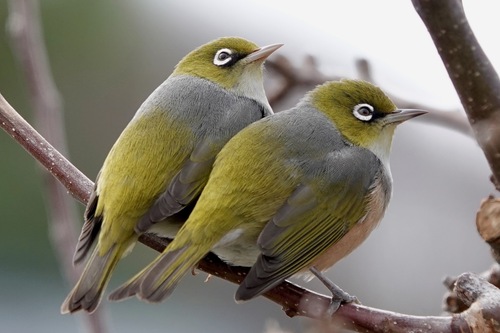
(c) BIHNZ, some rights reserved (CC BY), uploaded by BIHNZ · cc-by
Zosterops lateralis
Sign in to saveAlso known as wax-eye, Silvereye
thumb|upright|Subspecies flaviceps from Fiji|right The silvereye or wax-eye (Zosterops lateralis), also known by its Māori name tauhou, is a very small omnivorous passerine bird of the south-west Pacific. In Australia and New Zealand its common name is sometimes white-eye, but this name is more commonly used to refer to all members of the genus Zosterops, or the entire family Zosteropidae.
OverviewAI-generated
Zosterops lateralis, commonly known as the Silvereye, is a species of bird within the family Zosteropidae. It belongs to the order Passeriformes, class Aves, phylum Chordata, and kingdom Animalia. The taxon was originally described by Latham in 1802.
This organism has a mass of 1.3 and an egg incubation period of 10. Records indicate its presence in New Zealand, Australia, and New Caledonia. The IUCN Red List assessed its status as Least Concern in 2024. Various institutions, including RBINS-SCIENTIFIC HERITAGE, ANWC, UWBM, ROM, and DMNH, hold records of this species.
Synthesized by Vinony from 27 facts across 7 sources: Wikidata, iDigBio, GBIF, iNaturalist, Gbif Occ, IUCN Red List, Vinony graph. Generated from structured data (not the Wikipedia text) and checked against those facts — may still contain errors.
Species
Least ConcernSilvereye
SPECIES
- KingdomAnimalia
- PhylumChordata
- ClassAves
- OrderPasseriformes
- FamilyZosteropidae
via GBIF · IUCN
Museum specimens
- Specimen records
- 3,239
- With media
- 120
- Family
- Zosteropidae
- Collections
- RBINS-SCIENTIFIC HERITAGE, ANWC, UWBM, ROM, DMNH
- Recorded in
- New Zealand, Australia, New Caledonia
Bird sounds
- song· Australia· quality A
- call· Australia· quality A
- call· Australia· quality A
- call· Australia· quality A
via Xeno-canto
Wikidata facts
Show 8 more facts
- egg incubation period
- 10
- taxon rank
- species
- IUCN conservation status
- Least Concern
- Commons category
- Zosterops lateralis
- taxon name
- Zosterops lateralis
- taxon author citation
- (Latham, 1802)
- Commons gallery
- Zosterops lateralis
- taxon common name
- australska bjelooka
Sources (2)
via Wikidata · CC0
~7 min read
Encyclopedic overview
11 sectionsContents
- Taxonomy
- Description
- Distribution and habitat
- Feeding
- Behaviour
- Relationship with humans
- Horticulture
- In literature
- Notes
- Sources
- External links
thumb|upright|Subspecies flaviceps from Fiji|right The silvereye or wax-eye (Zosterops lateralis), also known by its Māori name tauhou, is a very small omnivorous passerine bird of the south-west Pacific. In Australia and New Zealand its common name is sometimes white-eye, but this name is more commonly used to refer to all members of the genus Zosterops, or the entire family Zosteropidae.
In New Zealand, the silvereye was first recorded in 1832. It arrived in greater numbers in 1856, and it is assumed that a migrating flock was swept eastwards by a storm. As an apparently self-introduced bird it is protected as a native New Zealand species. Its Māori name, , means "stranger" or more literally, "new arrival".
Excerpted from Wikipedia’s “Zosterops lateralis” article, available under the CC BY-SA 4.0 licence.