Category
page 11840s neologisms

folklore
thumb|A German folk tale, Hansel and Gretel; illustration by [[Arthur Rackham, 1909]]
Folklore is the body of expressive culture shared by a particular group of people, culture or subculture. This includes oral traditions such as tales, legends, proverbs, poems, jokes, and other oral traditions. This also includes material culture, such as traditional building styles common to the group. Folklore also encompasses customary lore, taking actions for folk beliefs, including folk religion, and the forms and rituals of celebrations such as festivals, weddings, folk dances, and initiation rites.

psychosis

Cenozoic
The Cenozoic Era (also known as the Caenozoic, Kainozoic, or Neozoic Era; ; ; ) is Earth's current geological era, representing the last 66million years of Earth's history. It is characterized by the dominance of mammals, insects, birds and angiosperms (flowering plants). It is the latest of three geological eras of the Phanerozoic Eon, preceded by the Mesozoic and Paleozoic. The Cenozoic started with the Cretaceous–Paleogene extinction event, when many species, including the non-avian dinosaurs, became extinct in an event attributed by most experts to the impact of a large asteroid or other c

Workers of the world, unite!
political slogan that is the rallying cry of communism

psychopathy
Psychopathy, or psychopathic personality, is a personality construct characterized by impaired empathy and remorse, persistent antisocial behavior, along with bold, disinhibited, and egocentric traits. These traits are often masked by superficial charm and immunity to stress, which create an outward appearance of normality.
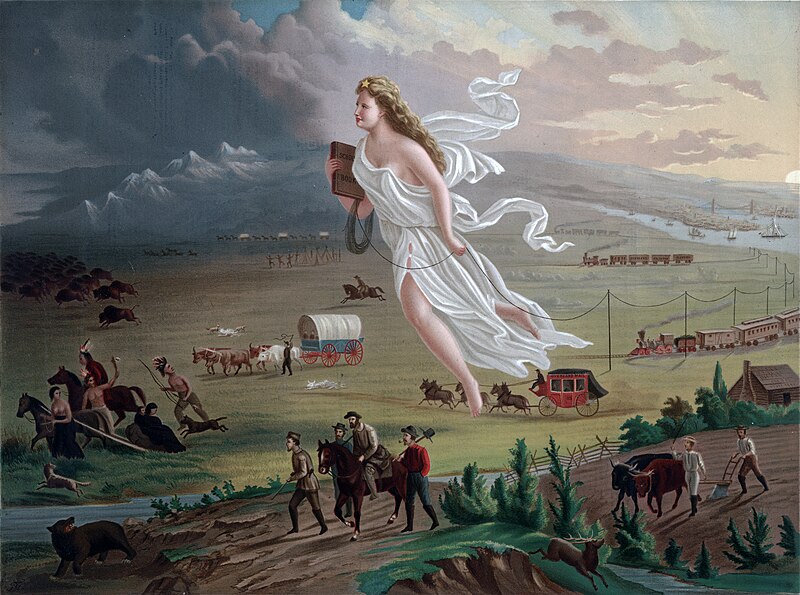
manifest destiny
cultural belief of 19th-century American expansionists

Lumpenproletariat
In Marxist theory, the Lumpenproletariat (; ) is the underclass devoid of class consciousness. Karl Marx and Friedrich Engels coined the word in the 1840s and used it to refer to the unthinking lower strata of society exploited by reactionary and counter-revolutionary forces, particularly in the context of the revolutions of 1848. They dismissed the revolutionary potential of the Lumpenproletariat and contrasted it with the proletariat. Among other groups, criminals, vagabonds, and prostitutes are usually included in this category.
Drang nach Osten
German Eastward expansionism, later associated with Nazi Germany
right to work
concept that newly hired employees may violate closed shop agreements between employee unions and employers
Opium of the people
Karl Marx's description of religion: “Religion is the sigh of the oppressed creature, the heart of a heartless world, and the soul of soulless conditions. It is the opium of the people.”
women and children first
unofficial maritime code of conduct
Why did the chicken cross the road?
common joke or riddle
Greek Revival architecture
architectural movement of the late 18th and early 19th centuries
might makes right
the view that morality is, or ought to be, determined by those in power
Kōka
was a after Tenpō and before Kaei. This period spanned the years from December 1844 through February 1848. The reigning emperors were and .
Kaei
was a after Kōka and before Ansei. This period spanned the years from February 1848 through November 1854. The reigning emperor was .
Russian soul
cultural concept describing the collective characteristics and values of the Russian people

Lisztomania
thumb|272x272px|In The Concert Hall by Theodor Hosemann, 1842, caricaturing Liszt and his fans
Lisztomania or Liszt fever was the intense fan frenzy directed toward Hungarian composer Franz Liszt during his performances. This frenzy first occurred in Berlin in 1841 and the term was later coined by Heinrich Heine in a feuilleton he wrote on 25 April 1844, discussing the 1844 Parisian concert season. Lisztomania was characterized by intense levels of hysteria demonstrated by fans, akin to the treatment of some celebrity musicians starting in the second half of the 20th century – but in a time no

dumbwaiter
thumb|right|180px|A dumbwaiter also known as a lazy waiter (') in the oldest restaurant in Munich, the [[Hundskugel, with the hand-pulled cart in the "UP" position and only the rope visible]]
A dumbwaiter''' is a small freight elevator or lift intended to carry food. Dumbwaiters found within modern structures, including both commercial, public and private buildings, are often connected between multiple floors. When installed in restaurants, schools, hospitals, retirement homes or private homes, they generally terminate in a kitchen.
The rich get richer and the poor get poorer
aphorism due to Percy Bysshe Shelley
tramp
thumb|A romanticized tramp depicted in an 1899 U.S. poster
a land without a people for a people without a land
phrase associated with Zionism
social murder
unnatural death caused by economic factors
Tippecanoe and Tyler Too
campaign song of the Whig Party's Log Cabin Campaign