File:American_Progress_(John_Gast_painting).jpg · Wikimedia Commons · See Wikimedia Commons
manifest destiny
Sign in to savecultural belief of 19th-century American expansionists
Wikidata facts
- Instance of
- ideology
- Subclass of
- expansionism
- Main subject
- United States territorial acquisitions
- Image
- American Progress (John Gast painting).jpg
Show 6 more facts
- Commons category
- Manifest Destiny
- applies to jurisdiction
- United States
- different from
- intelligent design
- contributing factor of
- Mexican-American War
- significant person
- William McKinley
via Wikidata · CC0
~40 min read
Encyclopedic overview
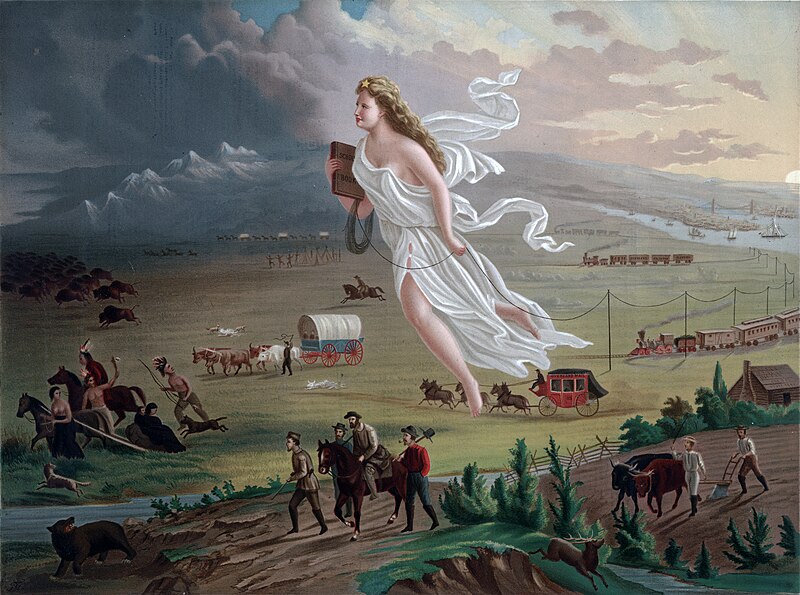
American Progress (1872) by John Gast is an allegorical representation of the modernization of the new west. Columbia, a personification of the United States, is shown leading civilization westward with the American settlers. She is shown bringing light from east to west, stringing telegraph wire, holding a school book, and highlighting different stages of economic activity and evolving forms of transportation. On the left, Indigenous Americans are displaced from their ancestral homeland.
Manifest destiny was the expansionist belief in the 19th-century United States that American settlers were destined to expand westward across North America, and that this belief was both obvious ("manifest") and certain ("destiny"). The belief is rooted in American exceptionalism, romantic nationalism, and nascent ideas of white chauvinism, implying the inevitable spread of republicanism and the American way. It is one of the earliest expressions of American imperialism. According to historian William Earl Weeks, there were three basic tenets behind the concept:
Excerpted from Wikipedia’s “manifest destiny” article, available under the CC BY-SA 4.0 licence.