Category
page 15th-century Romans

Jerome
Jerome (; ; ; – 30 September 420), also known as Jerome of Stridon, was an early Christian priest, confessor, theologian, translator, and historian; he is commonly known as Saint Jerome.
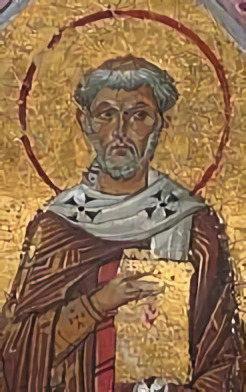
Leo I
Pope from 440 to 461 (390–461)
%20th%C3%A9odosienne%20de%20la%20villa%20romaine%20de%20Chiragan%20-%20Mus%C3%A9e%20Saint-Raymond%20Ra%2082.jpg)
Majorian
Majorian (; 7 August 461) was Western Roman emperor from 457 to 461. A prominent commander in the Western military, Majorian deposed Avitus in 457 with the aid of his ally Ricimer at the Battle of Placentia. Possessing little more than Italy and Dalmatia, as well as some territory in Hispania and northern Gaul, Majorian campaigned vigorously for three years against the Empire's enemies. In 461, he was murdered at Dertona in a conspiracy, and his successors until the fall of the Empire in 476 were puppets either of barbarian generals or the Eastern Roman court.

Claudian
Claudius Claudianus, known in English as Claudian (Greek: Κλαυδιανός; ), was a Latin poet associated with the court of the Roman emperor Honorius at Mediolanum (Milan), and particularly with the general Stilicho. His work, written almost entirely in hexameters or elegiac couplets, falls into three main categories: poems for Honorius, poems for Stilicho, and mythological epic.

Vegetius
thumb|300px|Mulomedicina (1250-1375 ca., Biblioteca Medicea Laurenziana, pluteo 45.19)
Publius (or Flavius) Vegetius Renatus, known as Vegetius (), was a writer of the Later Roman Empire (late 4th century). Nothing is known of his life or station beyond what is contained in his two surviving works: Epitoma rei militaris (also referred to as De re militari), and the lesser-known Digesta Artis Mulomedicinae, a guide to veterinary medicine. He identifies himself in the opening of his work Epitoma rei militaris as a Christian.

Orosius
Paulus Orosius (; born 375/385 – 420 AD), less often Paul Orosius in English, was a Roman priest, historian and theologian, and a student of Augustine of Hippo. It is possible that he was born in Bracara Augusta (now Braga, Portugal), then capital of the Roman province of Gallaecia, which would have been the capital of the Kingdom of the Suebi by his death. Although there are some questions regarding his biography, such as his exact date of birth, it is known that he was a person of some prestige from a cultural point of view, as he had contact with the greatest figures of his time such as Aug

Prudentius
thumb|
Aurelius Prudentius Clemens ( ) was a Roman Christian poet, born in the Roman province of Tarraconensis (now Northern Spain) in 348. He probably died in the Iberian Peninsula some time after 405, possibly around 413. The place of his birth is uncertain, but it may have been Caesaraugusta (Zaragoza), Tarraco (Tarragona), or Calagurris (Calahorra).

Martianus Capella
Latin prose writer of Late Antiquity

Theon of Alexandria
ancient Greek scholar
Orestes
Roman politician and general (420-476)
Tyrannius Rufinus
monk, historian, and theologian

Justa Grata Honoria
older sister of the Western Roman Emperor Valentinian III
Antipope Eulalius
Antipope
Gundobad
Gundobad (; ; 452 – 516) was King of the Burgundians (473–516), succeeding his father Gundioc of Burgundy. Previous to this, he had been a patrician of the moribund Western Roman Empire in 472–473, three years before its collapse, succeeding his uncle Ricimer. He is perhaps best known today as the probable issuer of the Lex Burgundionum legal codes, which synthesized Roman law with ancient Germanic customs. He was the husband of Caretene.
Coelius Sedulius
5th-century Roman poet

Bonifatius
thumb|300px|Coin of Bonifatius Comes Africae (422-431 AD).
Severinus of Noricum
Italian Roman Catholic saint
Rutilius Taurus Aemilianus Palladius
4th/5th century Greco-Roman writer
Saint Telemachus
Roman saint and martyr
Nonius Marcellus
4th-century Roman grammarian
Dracontius
Blossius Aemilius Dracontius () of Carthage was a Christian poet who flourished in Roman Africa during the latter part of the 5th century. He belonged to a family of landowners, and practiced as a lawyer in his native place. After the conquest of the country by the Vandals, Dracontius was at first allowed to retain possession of his estates, but was subsequently despoiled of his property and thrown into prison by the Vandal king Gaiseric, whose triumphs he had omitted to celebrate, while he had written a panegyric on a foreign and hostile ruler. He subsequently addressed an elegiac poem to the
Julia of Corsica
Carthaginian martyr
Vibius Sequester
4th or 5th century Roman writer
Saint Aurelius
Bishop of Carthage
Abundius of Como
Abundius (also Abondius, Abundias, or Abbondio; early fifth century – 469), venerated in the Catholic Church as Saint Abundius, was a bishop of Como, Northern Italy.
Marcellinus
Roman general (5th c.)
Mallius Theodorus
4th century Roman consul, scholar and author
Anthemiolus
Anthemiolus (died c. 471 AD) was the son of the Western Roman Emperor Anthemius (467–472) and Marcia Euphemia, daughter of the Eastern Roman emperor Marcian.

Onoulphus
Onoulphus, also Onoulf, Unulf and Hunulf (died 493) was a military leader in the 5th century. His origins lay in the non Roman tribal groups led by Attila the Hun (died 453) in the Middle Danube region, but his career as a soldier brought him into the violent internal politics of the Roman empire during the period when the last Western Roman emperors lived and died.
Ecdicius
Ecdicius Avitus ( – after 475) was an Arverni aristocrat, senator, and magister militum praesentalis from 474 until 475.
Gerontius
Roman general
Marius Mercator
Christian writer
Aurelianus
Roman consul 400 AD
Flavius Lucius Dexter
fictious Roman historian
Paulinus the Deacon
Roman hagiographer and writer
Renatus Profuturus Frigeridus
Roman historian

Rufius Antonius Agrypnius Volusianus
Roman noble
Alypia
noblewoman of the Western Roman Empire
Aignan of Orleans
French priest
Nepotianus
later Roman general (magister militum)
Asterius
Roman general, comes Hispaniarum
Heraclius of Edessa
east Roman general
Nicomachus Flavianus
5th-century Roman civil servant
Olympius
Olympius (died 410/411) was a minister of the Western Roman Empire, in the court of the emperor Honorius (reigned 393–423). Olympius orchestrated the fall and execution of the capable general Stilicho, who had effectively been ruling the Western Roman Empire as regent of Honorius for over twelve years.
Sebastianus
general of the Western Roman Empire, son-in-law of Bonifacius
Quintus Fabius Memmius Symmachus
4th-century Roman politician
Censorius
Censorius (died 448) was a count (comes) of the Western Roman Empire from 432 until his death. He is mentioned in the Chronicle of Hydatius under the years 432 and 440.
Masties
Masties (reigned 484–494?) was the Dux and later self proclaimed emperor of the Kingdom of the Aures, a Romano-Berber polity in the former Roman province of Numidia.
Papianilla
daughter of Roman emperor Avitus and wife of Sidonius Apollinaris
Amantius of Como
third Bishop of Como
Paulus
400s Roman military commander
Gaudentius
son of Flavius Aetius
Appius Nicomachus Dexter
politician
Procopius
general and politician in the Eastern Roman Empire, father of emperor Anthemius
Eucherius
ancient Roman politician, son of Stilicho
Bathanarius
Bathanarius (died 408) was a politician of the Western Roman Empire, comes Africae and brother-in-law of Stilicho.
Iustinianus
Roman military commander
Agricola
Gallo-Roman aristocrat, son of Avitus
Nebiogastes
Nebiogastes (Greek: Νεοβιγάστης or Νεβιγάστιος; died 407 AD) was a Roman military commander that supported the usurper Constantine III.