Category
page 17th-century births

Sergius I
pope

John VII
pope

John VI
pope

Sisinnius
pope

Tariq ibn Ziyad
8th-century Muslim general
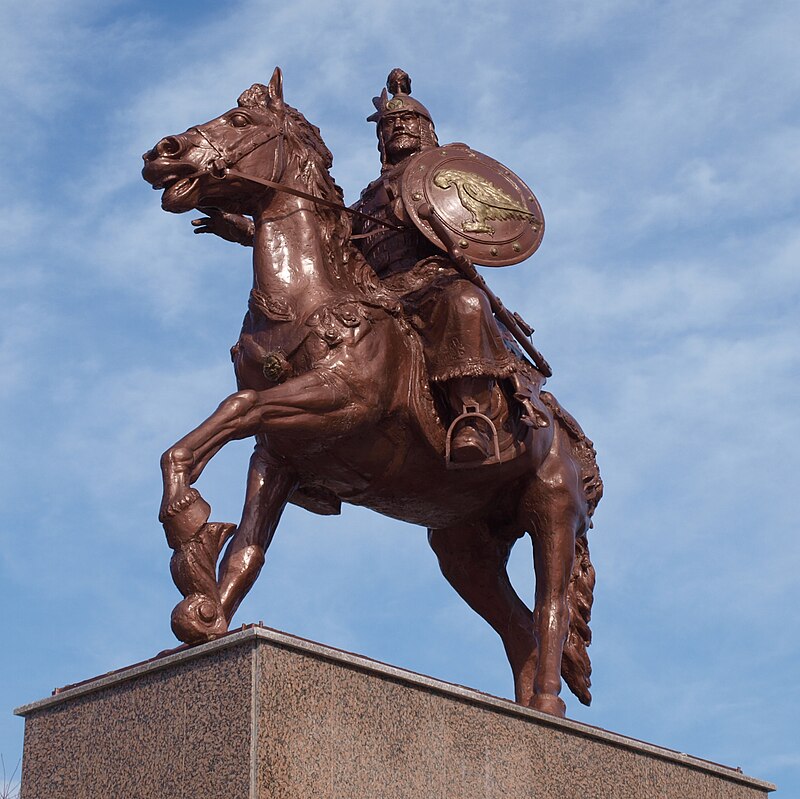
Asparuh of Bulgaria
Bulgarian ruler

Tiberios III
Byzantine emperor from 698 to 705

Philippikos Bardanes
Philippicus (; ), born Bardanes (; ) was Byzantine emperor from 711 to 713. He took power in a coup against the unpopular emperor Justinian II, and was deposed in a similarly violent manner nineteen months later. During his brief reign, Philippicus supported monothelitism in Byzantine theological disputes, and saw conflict with the First Bulgarian Empire and the Umayyad Caliphate.

Saint Boniface
missionary who propagated Christianity in the Frankish Empire

Theodosios III
Byzantine Emperor

Anastasios II
Byzantine Emperor

Childebert III
King of the Franks

Songtsän Gampo
Tibetan emperor (604-650)

Dihya
Al-Kahina (), also known as Dihya, was a Berber warrior-queen of the Aurès (present-day Algeria) and a religious and military leader who lived during the 7th century.
Shantideva
Shantideva (Sanskrit: Śāntideva; ; ; ; ) was an 8th-century CE Indian philosopher, Buddhist monk, poet, and scholar at the mahavihara of Nalanda. He was an adherent of the Mādhyamaka philosophy of Nāgārjuna. Abhayadatta Sri also lists Shantideva as one of the eighty-four mahasiddhas and is known as Bhusuku Pa (布苏固巴).
Tervel of Bulgaria
Bulgarian ruler

Charibert II
Frankish king

Meng Haoran
poet from the Tang Dynasty
Giles
Christian hermit

Plectrude
thumb|upright|Plectrude
Æthelred of Mercia
King of Mercia
Raginpert
Raginpert (also Raghinpert or Reginbert) was the Duke of Turin and then King of the Lombards briefly in 701. He was the son of Godepert and grandson of Aripert I. He usurped the throne in 701 and removed Liutpert, his grandnephew, putting his son Aripert in line for the succession. He and his Neustrians (men of Piedmont) went out to meet the regent, Ansprand, in battle and defeated him at Novara, but died shortly after. His son Aripert did not succeed in taking the throne right away.
== Notes ==

Liutpert
thumb|
Liutpert (or Liutbert) (died 702) was the Lombard king of Italy between 700 and 702, with interruption. Upon succeeding his father, King Cunincpert, at a young age, he ruled together with his tutor, Ansprand, the duke of Asti. After eight months, he was deposed by Raginpert, the duke of Turin and son of Godepert, Liutpert's great-uncle, but succeeded in returning to the throne several months later upon Raginpert's death, only to be deposed again, taken captive from Pavia, and drowned by Aripert II, Raginpert's son.
He was buried in the Basilica of Santissimo Salvatore in Pavia.
Ansegisel
Ansegisel (c. 602 or 610 – murdered before 679 or 662) was the younger son of Saint Arnulf, bishop of Metz.
Theudoald
Theudoald (or Theodald; c. 708 – 741) was the Frankish mayor of the palace, briefly unopposed in 714 after the death of his grandfather, Pepin of Herstal. In 715, the nobility acclaimed Ragenfrid mayor of Neustria and Charles Martel mayor of Austrasia.
Peada of Mercia
King of Mercia
Chad of Mercia
Archbishop of York; Bishop of Lichfield
Fiacre
Irish saint
Coenred of Mercia
English king
Theodora of Khazaria
Byzantine empress
Aldfrith
King of Northumbria
Go of Balhae
King of Balhae
Maria, wife of Leo III
Byzantine empress
Mohamed bin Salman
Arab military leader and chieftain of the Khazraj tribe (died 631)
Julian, Count of Ceuta
Byzantinian Governor of Ceuta

Bhrikuti
Bhrikuti Devi (), known to the Tibetans as ', Bhelsa Tritsun ("Besa" Nepal ) or simply ' (), was a Nepali princess from the Licchavi dynasty, and the first queen of King Songtsen Gampo, King of Tibet from 622. Bhrikuti was seen as an incarnation of Green Tara, credited for bringing Buddhism to Tibet, together with the Jowo Mikyo Dorje statue for which the Jokhang in Lhasa was built.
thumb|220px|Jowo (statue)|Jowo Mikyo Dorje moved to the Ramoche Temple
Bridei III
7th-century king of the Picts

Gudula
Gudula of Brabant, also known as Saint Gudula (ca. 646–712), was a Christian saint who is venerated in Catholic and Orthodox churches. In Brabant, she is usually called Goedele or Goule; (, later ''''; ; ). Her name is connected to several places: Moorsel (where she lived), Brussels (where a chapter in her honour was founded in 1047) and Eibingen (where the relic of her skull is conserved).

Fructuosus of Braga
Bishop of Dumio
Ilterish Qaghan
Goturk ruler
Ecgberht of Kent
Kentish King

Gregoria
Gregoria (; fl. 641) was the Byzantine empress as the wife of Constantine III. She participated in the minority regency government of her son, Constans II, in 641–650.
Qapaghan Qaghan
Ruler of the Gokturk
Rotrude of Trier
690-725

Camadevi
Camadevi (also spelt Jamadevi, ; ; , ; , ; 7th-century – 8th-century) was the first monarch and queen of Haripuñjaya, which was an ancient Mon kingdom in present-day Northern Thailand before it was conquered by the Kingdom of Lan Na.
Abd al-Aziz ibn Marwan
Umayyad prince and Governor of Egypt (died 705)
Irmina of Oeren
Frankish noble
Sîrîn bint Sham'ûn
The wife of Hassan ibn Thabit
Princess Taiping
Chinese princess (665-713)
Sigeheard of Essex
King of Essex
Abd al-Rahman ibn Muhammad ibn al-Ash'ath
Umayyad Arab nobleman and military commander (died 704)
Mangsong Mangtsen
Tibetan emperor
Seaxburh of Ely
queen of King Eorcenberht of Kent, abbess, and saint of the Christian Church (640-699)
Amalberga of Maubeuge
saint
Swæfred of Essex
Joint king of Essex
Óengus I
8th century King of the Picts
Eudokia
Byzantine empress

Waltrude
Saint Waltrude (; ; ; ; died April 9, 688 AD) is the patron saint of Mons, Belgium, where she is known in French as Sainte Waudru, and of Herentals, Belgium, where she is known in Dutch as Sint-Waldetrudis or -Waltrudis. Both cities boast a large medieval church that bears her name.
Thrasimund I of Spoleto
Italian noble
Me Agtsom
Tibetan emperor