Category
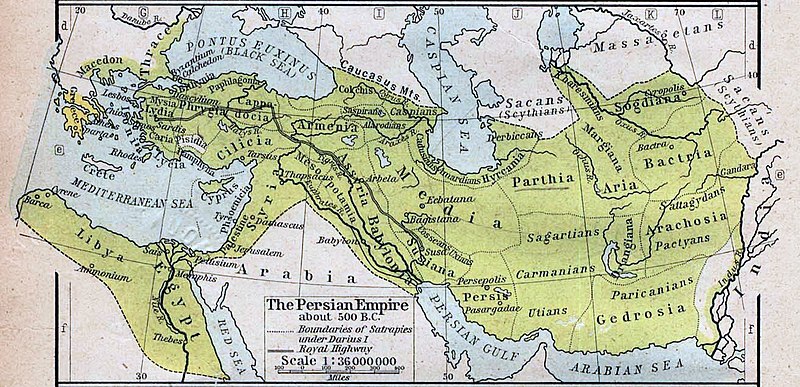
page 1Achaemenid satrapies

Babylonia
Babylonia (; , ) was an ancient Akkadian-speaking state and cultural area based on the city of Babylon in central-southern Mesopotamia (present-day Iraq and parts of Syria). It emerged as an Akkadian-populated but Amorite-ruled state . During the reign of Hammurabi and afterwards, Babylonia was retrospectively called "the country of Akkad" ( in Akkadian), a deliberate archaism in reference to the previous glory of the Akkadian Empire. It was often involved in rivalry with the linguistically related state of Assyria in Upper Mesopotamia, and with Elam to the east. Babylonia briefly became the m

Cilicia
Cilicia (, ) is a geographical region of southern Anatolia in West Asia, extending inland from the northeastern coasts of the Mediterranean Sea. Cilicia borders Pamphylia to the west, Lycaonia and Cappadocia to the north, Commagene to the north-east, Syria to the east and the Mediterranean Sea to the south. Cilicia has a population ranging over six million, concentrated mostly at the Cilician plain (). The region includes the provinces of Mersin, Adana, Osmaniye and Hatay.

Sogdia
Sogdia () or Sogdiana was an ancient Iranian civilization between the Amu Darya and the Syr Darya rivers, and in present-day Uzbekistan, Turkmenistan, Tajikistan, Kazakhstan, and Kyrgyzstan. Sogdiana was also a province of the Achaemenid Empire, and listed on the Behistun Inscription of Darius the Great. Sogdiana was first conquered by Cyrus the Great, the founder of the Achaemenid Empire, and then was annexed by the Macedonian ruler Alexander the Great in 328 BC. It would continue to change hands under the Seleucid Empire, the Greco-Bactrian Kingdom, the Kushan Empire, the Sasanian Empire, th

Gandhara
Gandhara () was an ancient Indo-Aryan civilisation in the Indian subcontinent located in present-day northwestern Pakistan and eastern Afghanistan. The core of the region of Gandhara was the Valley of Peshawar, though the cultural influence of "Greater Gandhara" extended across the Indus River to Taxila and westwards into the Kabul Valley as far as Bamyan, and northwards up to the Karakoram range, including Swat, Bajaur and other valleys.

Media
Ancient region of north-western Iran

Parthia
Parthia ( Parθava; Parθaw; Pahlaw) is a historical region located in northeastern Greater Iran. It was conquered and subjugated by the empire of the Medes during the 7th century BC, was incorporated into the subsequent Achaemenid Empire under Cyrus the Great in the 6th century BC, and formed part of the Hellenistic Seleucid Empire after the 4th-century BC conquests of Alexander the Great. The region later served as the political and cultural base of the Eastern Iranian Parni people and Arsacid dynasty, rulers of the Parthian Empire (247 BC – 224 AD). The Sasanian Empire, the last state of pre-
Hyrcania
Hyrcania (; Hyrkanía, Old Persian: 𐎺𐎼𐎣𐎠𐎴 Varkâna, Middle Persian: 𐭢𐭥𐭫𐭢𐭠𐭭 Gurgān, Akkadian: Urqananu) is a historical region composed of the land south-east of the Caspian Sea in modern-day Iran and Turkmenistan, bound in the south by the Alborz mountain range and the Kopet Dag in the east.

Arachosia
thumb|Depiction of Arachosian magi carrying various gifts and animals for ritual sacrifice at [[Persepolis]]
Twenty-seventh Dynasty of Egypt
first Achaemenid rule on Egypt (525–404 BC)
Thirty-first Dynasty of Egypt
second and last Achaemenid rule on Egypt (343–332 BC)

Drangiana Satrapy
thumb|upright=.5|
Drangiana or Zarangiana (, Drangianē; also attested in Old Western Iranian as 𐏀𐎼𐎣, Zraka or Zranka, was a historical region and administrative division of the Achaemenid Empire. This region comprised territory around Hamun Lake, wetlands in endorheic Sistan Basin on the Iran-Afghan border, and its primary watershed Helmand river in what is nowadays southwestern region of Afghanistan. The historic Drangiana roughly corresponds with the modern Sistan region.
Aria Satrapy
ancient region of the Persian Empire
Satrapy of Armenia
period of Yervanduni kingdom

Eber-Nari
Eber-Nari (Akkadian), also called Abar-Nahara (Aramaic) or Aber Nahra (Syriac), was a region of the ancient Near East. Translated as "Beyond the River" or "Across the River" in both the Akkadian and Aramaic languages, it referred to the land on the opposite side of the Euphrates from the perspective of Mesopotamia and Persia. In this context, the region is further known to modern scholars as Transeuphratea (New Latin: ; or more rarely ; ). Functioning as a satrapy, it was originally administered by the Neo-Assyrian Empire before being absorbed by the Neo-Babylonian Empire and then by the Achae
.jpg)
Paropamisadae
Paropamisadae or Parapamisadae () was a satrapy of the Alexandrian Empire in modern Pakistan, which largely coincided with the Achaemenid province of Parupraesanna. It consisted of the districts of Sattagydia (Bannu basin), Gandhara (Kabul, Peshawar, and Taxila), and Oddiyana (Swat Valley). Paruparaesanna is mentioned in the Akkadian language and Elamite language versions of the Behistun Inscription of Darius the Great, whereas in the Old Persian version it is called Gandāra. The entire satrapy was subsequently ceded by Seleucus I Nicator to Chandragupta Maurya after Mauryan Victory in Selucid
%20(4686499402).jpg)
Skudra
Skudra () was a province (satrapy) of the Persian Achaemenid Empire in Europe between 510s BC and 479 BC. Its name is attested in Persian and Egyptian inscriptions (an Egyptian record of c. 498–497 BC, and a list on the tomb of Darius the Great at Naqsh-e Rustam, c. 486 BC. It is believed to have comprised the lands now known as Thrace and Macedon.
Maka Satrapy
Province of the Persian Empires
Arabia Satrapy
satrapy (province) of the Achaemenid Empire
Susiana
Susiana (; ) was an ancient cultural and geographical region located in southwestern Iran.
It broadly corresponds to the alluvial lowlands surrounding the city of Susa, forming the core area of the early Elamite civilization, which today make up most of modern Khuzestan Province.

Sattagydia Satrapy
thumb|The name for Sattagydia (:Wikt:𐎰𐎫𐎦𐎢𐏁|𐎰𐎫𐎦𐎢𐏁, Thataguš) in the [[DNa inscription of Darius I.]]
Sattagydia or Thatagush (Old Persian: 𐎰𐎫𐎦𐎢𐏁 Thataguš, country of the "hundred cows") was one of the easternmost regions of the Achaemenid Empire, part of its Seventh tax district according to Herodotus, along with Gandārae, Dadicae and Aparytae. It was situated east of the Sulaiman Mountains up to the Indus in the Kurram River basin around Bannu in modern day's southern Khyber Pakhtunkhwa, Pakistan. Sattagydia was no longer mentioned by the third century BC, probably having been a
Carmania Satrapy
Persian region
Hindush
Hindush ( ) was an administrative division of the Achaemenid Empire in the lower Indus Valley. Established through the Persian conquest of the Indus Valley in the 6th century BCE, it is believed to have continued as a province for approximately two centuries, ending when it fell to the Macedonian Empire during the Indian campaign of Alexander the Great. According to the Greek historian Herodotus, it was the "easternmost province" governed by the Achaemenid dynasty.
Libya Satrapy
Province of the Persian Empire
Achaemenid Assyria
aspect of history
Chorasmia Satrapy
Bactria Satrapy
territory of the Achaemenid Empire
Cappadocia Satrapy
Achaemenid satrapy in Anatolia
Lydia Satrapy
Province of the Achaemenid Empire (546-334 BC)
Gandāra
Gandāra, or Gadāra in Achaemenid inscriptions (Old Persian cuneiform: 𐎥𐎭𐎠𐎼, , also transliterated as since the nasal "n" before consonants was omitted in the Old Persian script, and simplified as or sometimes ) was one of the easternmost provinces of the Achaemenid Empire in South Asia, following the Achaemenid invasion of the Indus Valley. It appears in various Achaemenid inscriptions such as the Behistun Inscription, or the DNa inscription of Darius the Great.
districts of the Achaemenid Empire
Wikimedia list article