Category
page 1Akbar
.jpg)
Akbar
Akbar (Jalal-ud-Din Muhammad Akbar, – ), also known as Akbar the Great, was the third Mughal emperor, who reigned from 1556 to 1605. Akbar succeeded his father, Humayun, under a regent, Bairam Khan, who helped the young emperor expand and consolidate Mughal domains in the Indian subcontinent. He is generally considered one of the greatest emperors in Indian history and led a successful campaign to unify the various kingdoms of Hindūstān or India proper.
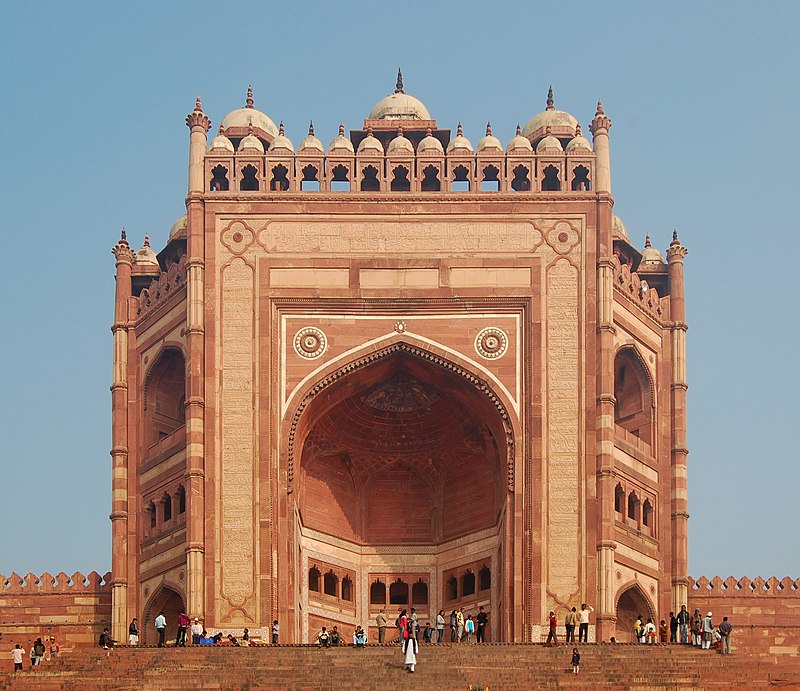
Fatehpur Sikri
town in Agra District, Uttar Pradesh, India
%20Humayun%20detail.jpg)
Humayun
Nasir al-Din Muhammad (, 6 March 1508 – 27 January 1556), commonly known by his regnal name Humayun (, ), was the second Mughal emperor, who ruled over territory in what is now eastern Afghanistan, Bangladesh, Northern India, and Pakistan from 1530 to 1540 and again from 1555 to his death in 1556. At the time of his death, the Mughal Empire spanned almost one million square kilometers.

Agra Fort
UNESCO World Heritage Site

Humayun's Tomb
tomb of the Mughal Emperor Humayun in Delhi, India

Abu'l-Fazl ibn Mubarak
Grand vizier of Mughal emperor Akbar from 1579 to 1602
Din-e Ilahi
syncretic religion propounded by Mughal emperor Akbar in 1582
Hamida Banu Begum
Mughal Empress
Akbar's Tomb
mughal emperor Akbar's tomb in Sikandra, Agra

Tansen
Rāmtanu Panday ( – 26 April 1589), popularly referred to as Mian Tānsen (), or Sangeet Samrāt (), was a Hindustani classical musician. Born into a Hindu Gaur Brahmin family in Gwalior, he learnt and perfected his art in the northwest region of modern Madhya Pradesh. He got his first break as musician and composer in the court of Raja Man Singh Tomar of Gwalior and spent most of his adult life in the court and patronage of the Hindu king of Rewa, Raja Ramchandra Singh Baghel (r. 1555–1592), where Tānsen's musical abilities and studies gained widespread fame. This reputation brought him to

Akbarnama
The Akbarnama () is the official chronicle of the reign of Akbar, the third Mughal Emperor (), commissioned by Akbar himself and written by his court historian and biographer, Abul Fazl. It was written in Persian, which was the literary language of the Mughals, and includes vivid and detailed descriptions of his life and times. It followed the Baburnama, the more personal memoir by his grandfather, Babur, founder of the dynasty. It was produced in the form of lavishly illustrated manuscripts.

Ain-i-Akbari
thumb|200px|The Court of Akbar, an illustration from a manuscript of the Akbarnama
The Ain-i-Akbari (), or the "Administration of Akbar", is a detailed document regarding the administration of the Mughal Empire under Emperor Akbar, written by his court historian, Abu'l Fazl, in the Persian language between 1589 and 1596. It forms Volume III and the final part of the much larger document, the Akbarnama (Account of Akbar), also by Abu'l-Fazl, and is itself in three volumes.
Salim Chishti
Sufi saint of the Chishti Order during the Mughal Empire in India
`Abd al-Qadir Bada'uni
Grand Mufti of India and historian (1540–1615)
Mirza Muhammad Hakim
Mughal Empire prince

Razmnama
The Razmnāma (Book of War) (رزم نامہ) is a Persian translation of the Sanskrit epic Mahabharata, commissioned by the Mughal Emperor Akbar. In 1574, Akbar started a Maktab Khana or "House of Translation" in his new capital at Fatehpur Sikri. He assigned a group to translate the Sanskrit books Rajatarangini, Ramayana, and Mahabharata into the Persian language, the literary language of the Mughal court.
Ibadat Khana
meeting house built in 1575 by Mughal Emperor Akbar for interfaith dialogue
Mah Chuchak Begum
Mughal empress
Tomb of Mariam-uz-Zamani
tomb of Mughal Empress Mariam-uz-Zamani, favorite wife of Emperor Akbar.
Nizamuddin Ahmad
historian
Chronicle of the Descendants of Timur
16th-century Mughal manuscript
Allopanishad
Allah Upanishad, or Allopanishad, is a book of uncertain origin written during Muslim rule in India during 15th to 16th century in the time of Mughal Emperor Akbar's reign.
Anthony de Montserrat
Spanish presbyter and cartographer
Mullah Do Piaza
advisor and Vizier of the Mughal emperor Akbar