Category
page 1Albert Einstein

Albert Einstein
Albert Einstein was a German-born theoretical physicist best known for developing the theory of relativity. Einstein also made important contributions to quantum theory. His mass–energy equivalence formula E = mc2, which arises from special relativity, has been called "the world's most famous equation". He received the 1921 Nobel Prize in Physics for "his services to theoretical physics, and especially for his discovery of the law of the photoelectric effect".

theory of relativity
two interrelated physics theories by Albert Einstein

einsteinium
Einsteinium is a synthetic chemical element; it has symbol Es and atomic number 99 and is a member of the actinide series and the seventh transuranium element.
general relativity
standard and classical physics theory of gravity and space

special relativity
physical theory of measurement in an inertial frame of reference proposed in 1905 by Albert Einstein

photoelectric effect
emission of electrons when light hits a material

mass–energy equivalence
physical law relating mass to energy

Brownian motion
the random motion of particles suspended in a fluid resulting from their collision with the quick atoms or molecules in the gas or liquid

wormhole
thumb|upright=1.3|A wormhole visualized as a two-dimensional surface. Route (a) is the shortest path through normal space between points 1 and 2; route (b) is a shorter path through a wormhole.

Bose–Einstein condensate
state of matter of a dilute gas of bosons cooled to temperatures very near absolute zero

twin paradox
thought experiment in special relativity

cosmological constant
constant representing stress-energy density of the vacuum in Einstein's equation, which accounts for the rate of expansion of the universe
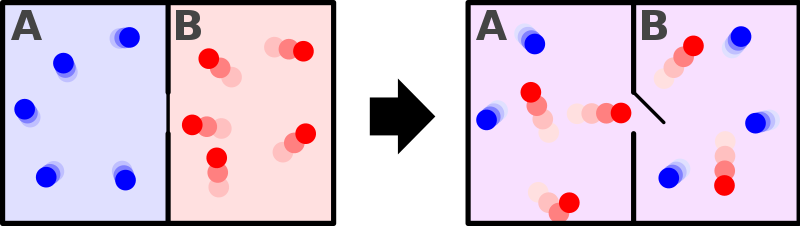
Bose-Einstein statistics
statistical description for the behaviour of bosons
Einstein field equations
field equations in general relativity

equivalence principle
hypothesis that inertial and gravitational masses are equivalent

2001 Einstein
Inner main belt asteroid

EPR paradox
early and influential critique leveled against quantum mechanics
Einstein–Szilárd letter
letter by Leó Szilárd and Albert Einstein to US President Roosevelt in August 1939
Einstein Cross
image of a quasar
Einstein notation
shorthand notation for tensor operations
Einstein ring
an image of a distant light source (such as a galaxy or star) which has been distorted into a ring through gravitational lensing caused by an object with an extremely large mass (such as another galaxy or a black hole)
gravitational redshift
the shift of the wavelength of a photon to a longer wavelength when traveling out of a gravitational well
Albert Einstein Medal
science award
Mach's principle
principle that inertia is determined by the large-scale distribution of matter
Albert Einstein Award
American science award for achievements in the natural sciences (1951–1979)
Albert Einstein's brain
preserved brain of scientist Albert Einstein
annus mirabilis
year during which events of major importance occurred, often referring to a specific year
World Year of Physics 2005
world year
Zebra Puzzle
well-known logic puzzle
Einstein tensor
covariantly conserved rank-2 tensor field on a Riemannian manifold, defined in terms of the Ricci curvature
Albert Einstein World Award of Science
Recognition and encouragement for scientific and technological research and development.
tea leaf paradox
physical phenomenon in which tea leaves in a stirred cup of tea migrate to the center and bottom of the cup
einstein
obsolete unit measuring either one mole of photons or the energy of one mole of photons
Einstein solid
model of a crystalline solid that contains a large number of independent three-dimensional quantum harmonic oscillators of the same frequency
static universe
model of the universe that is not expanding or contracting, e.g. one in which the cosmological constant exactly balances things
Hafele–Keating experiment
test of the theory of relativity in October 1971
Albert Einstein College of Medicine
private medical school in New York City, NY
Einstein Prize
award of the American Physical Society for gravitational physics (2003–)
religious views of Albert Einstein
Einstein–De Haas effect
physical phenomenon in which a change in the magnetic moment of a free body causes this body to rotate
Einstein relation
equation in Brownian motion
Bohr–Einstein debates
Series of public disputes between physicists Niels Bohr and Albert Einstein
history of general relativity
history of the general theory of relativity with contributions from Albert Einstein, Marcel Grossmann, David Hilbert and others
Einstein refrigerator
Absorption refrigerator invented in 1930
Einstein–Hilbert action
Action that yields the Einstein field equations through the principle of least action
Einstein–Cartan theory
classical theory of gravitation
Einstein synchronisation
convention for synchronising clocks at different places by means of signal exchanges
Albert Einstein Memorial
artwork by Robert Berks

Einsteinhaus
thumb|upright=0.9|Façade
thumb|upright=0.9|The living room
Einstein radius
measurement of light ray bending from a gravitational lens
Emergency Committee of Atomic Scientists
Einstein's committee of atomic scientists (1946-1951)
Operculum
cover the insula as the opercula of insula
photoelectrochemical process
electrochemical processes involving photons and the emission or absorption of light
Albert Einstein Peace Prize
peace prize awarded annually since 1980 by the Albert Einstein Peace Prize Foundation
Einstein family
notable European family
Albert Einstein Square
public square in Jerusalem
Solutions of the Einstein field equations
Wikimedia list article
Einstein's Sink
sink used by the Leiden University physics faculty since 1920
Einstein manifold
Riemannian or pseudo-Riemannian differentiable manifold whose Ricci tensor is proportional to the metric
Albert Einstein's political views
German physicist