Category
page 1Ancient Egyptian technology

fork
thumb|From left to right: pastry fork, relish fork, [[salad fork, dinner fork, cold cuts fork, serving fork, carving fork]]
In cutlery or kitchenware, a fork (from 'pitchfork') is a utensil, now usually made of metal, whose long handle terminates in a head that branches into several narrow and often slightly curved tines with which one can spear foods either to hold them to cut with a knife or to lift them to the mouth.

weighing scale
instrument used in measuring the weight or mass of an object

sail
A sail is a tensile structure, which is made from fabric or other membrane materials, that uses wind power to propel sailing craft, including sailing ships, sailboats, windsurfers, ice boats, and even sail-powered land vehicles. Sails may be made from a combination of woven materials—including canvas or polyester cloth, laminated membranes or bonded filaments, usually in a three- or four-sided shape.

air conditioning
cooling of air in buildings or vehicles
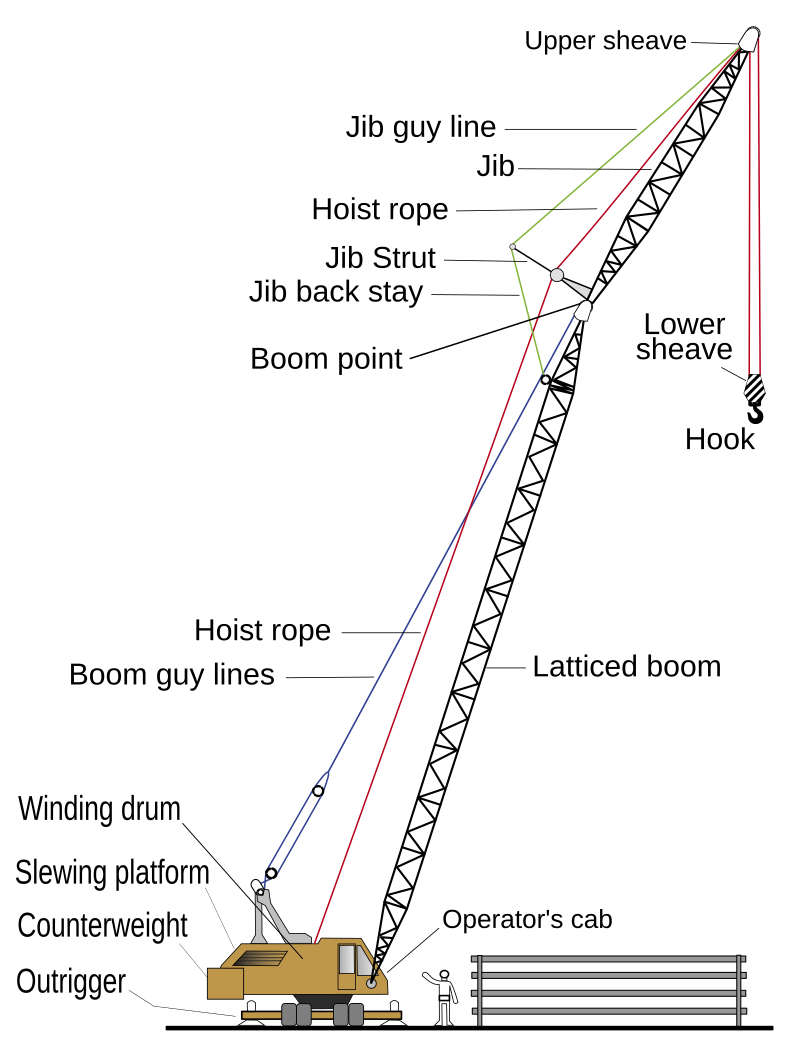
crane
type of machine specialised in lifting objects
.jpg)
obelisk
thumb|One of the two Luxor Obelisks, on the [[Place de la Concorde in Paris; a red granite monolithic column, high, including the base, which weighs over .]]
thumb|Lateran Obelisk in Piazza San Giovanni in Laterano, [[Rome. With its height of (with the base and the cross it reaches 45.70 m) it is the largest standing ancient monolithic obelisk in the world.]]
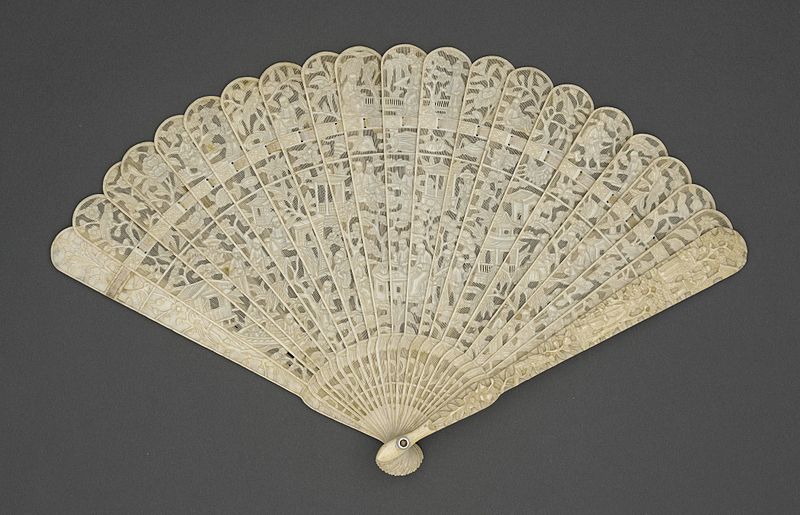
hand fan
device used to cool oneself, usually made of folded paper
%20crop.jpg)
surveying
thumb|alt= A woman holding a notebook crouches next to a theodolite on a tripod. The instrument is set up on a bank in a forest.|A surveyor using a total station
thumb|upright|A student using a theodolite in field

rudder
thumb|Modern ship rudder (the tall red rectangle behind the propeller (marine)|propeller)
thumbnail|right|'s rudder turned
.svg)
bellows
thumb|Diagram of fireplace hand-bellows
Bellows are a device constructed to expel a controlled blast of air. The simplest type consists of a flexible bag comprising a pair of rigid boards with handles joined by flexible leather sides enclosing an approximately airtight cavity which can be expanded and contracted by operating the handles, and fitted with a valve allowing air to fill the cavity when expanded, and with a tube through which the air is forced out in a stream when the cavity is compressed. It has many applications, in particular blowing on a fire to supply it with air.

vending machine
machine which automatically dispenses beverages, food or non-food products to customers after a payment
ancient Egyptian architecture
aspect of architecture

dock
thumb|Dock for cruise ships in Sint Maarten in the [[Caribbean]]
thumb|right|Docks in Saint Petersburg|St. Petersburg, Russia
thumb|Partially backfilled dry dock of the former Valmet Vuosaari Shipyard in Vuosaari, [[Helsinki, Finland]]
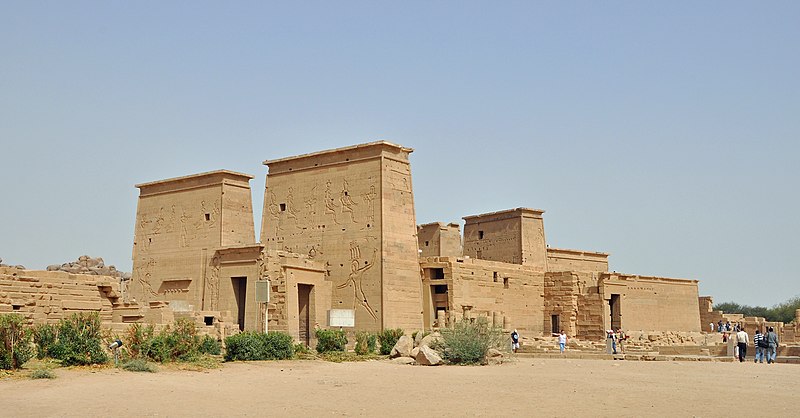
Egyptian temple
structures for official worship of the gods and commemoration of pharaohs in Ancient Egypt

pig iron
iron alloy with a high carbon content

shadoof
thumb|Well pole in central Anatolia, Turkey
A shadoof or shaduf, well pole, well sweep, sweep, swape, or simply a lift is a tool that is used to lift water from a well or another water source onto land or into another waterway or basin. It is highly efficient, and has been known since 3000 BCE.

aeolipile
thumb|An illustration of Hero's aeolipile
An aeolipile, aeolipyle, or eolipile, also known as a '''Hero's (or Heron's) engine', is a simple, bladeless radial steam turbine which spins when the central water container is heated. Torque is produced by steam jets exiting the turbine. The Greek-Egyptian mathematician and engineer Hero of Alexandria described the device in the 1st century AD, and many sources give him the credit for its invention. However, Vitruvius was the first to describe this appliance in his De architectura'' ().

ostracon
[[Image:AGMA Ostrakon Cimon.jpg|right|thumb|Ostrakon inscribed with "Kimon [son] of Miltiades", for Cimon, an Athenian statesman.]]
thumb|Ostrakon of Megacles, son of Hippocrates (inscription: ΜΕΓΑΚΛΕΣ ΗΙΠΠΟΚΡΑΤΟΣ), 487 BC. On display in the Ancient Agora Museum in Athens, housed in the [[Stoa of Attalus]]
right|thumb|Ancient Greek ostraca voting for the ostracism|ostracization of [[Themistocles in 472/471 BC.]]

noria
thumb|The norias of Hama on the [[Orontes River in Syria (video).]]
Ancient Egyptian medicine
remedies from ancient Egypt

Sakia
thumb|The Saqiyah, c. 1905
thumb|alt=taken at Sikandra, India c1917 and titled near the time as 'A Punjabi Wheel'; from photo album of Robert Victor Soper, Private, Hampshire Regiment, in India 1916-19|'Punjab Wheel', India c.1917
A sāqiyah or saqiya (), also spelled sakia or saqia) is a mechanical water lifting device. It is also called a Persian wheel, tablia, rehat, and in Latin tympanum. It is similar in function to a scoop wheel, which uses buckets, jars, or scoops fastened either directly to a vertical wheel, or to an endless belt activated by such a wheel. The vertical wheel is itself a
core drill
drill specifically designed to remove a cylinder of material
Egyptian pyramid construction techniques
overview about the Egyptian pyramid construction techniques
Egyptian medical papyri
Ancient Egyptian text
Egyptian technology
devices and technologies invented or used in Egypt
Ancient Egyptian pottery
mural instrument
angle-measuring device used for astronomical purposes
chain pump
type of water pump
baris
ancient Egyptian type of ship
Treetrunk coffin
coffin type
Rope stretcher
Chariotry in ancient Egypt
history of timekeeping devices in Egypt
aspect of history