Category
page 1Ancient Greek mathematics

Pythagorean theorem
relation in Euclidean geometry among the three sides of a right triangle

abacus
thumb|Bi-quinary coded decimal-like abacus representing

golden ratio
ratio between two quantities whose sum is at the same ratio to the larger one
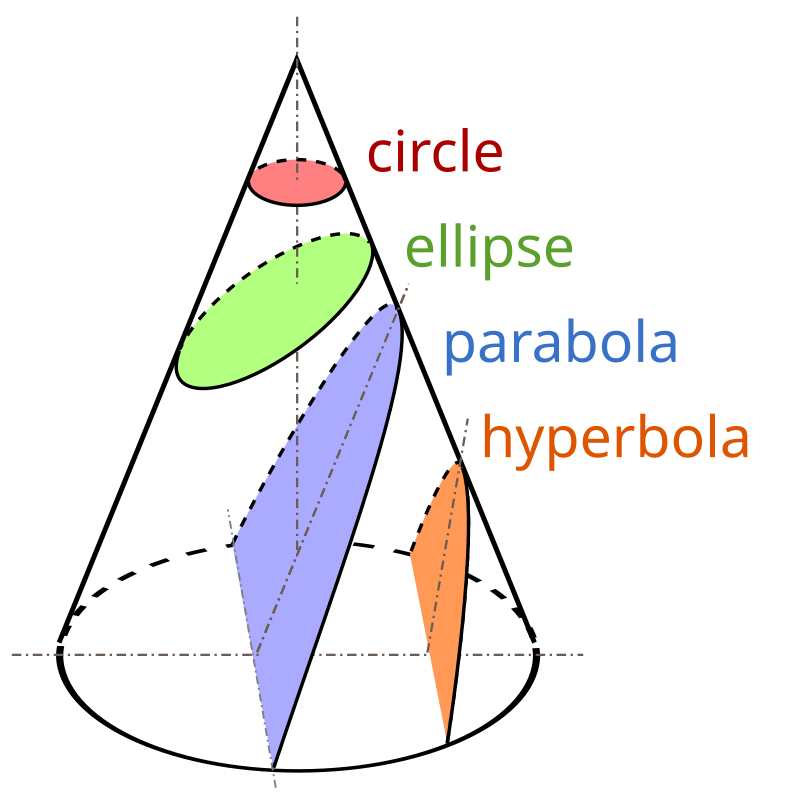
conic section
curve obtained by intersecting a cone and a plane

Heron's formula
formula for calculating the area of a triangle

Antikythera mechanism
ancient analog computer designed to calculate astronomical positions

squaring the circle
geometric problem

Greek numerals
numeration system used by the Koine Greek and earlier

Archimedean spiral
spiral with constant width between its turnings; in polar coordinates, distance from the origin is linearly proportional to angle

Thales' theorem
theorem

parallel postulate
axiom in Euclidean geometry

Menelaus' theorem
theorem

Ptolemy's theorem
theorem

spherical geometry
geometry of the two-dimensional surface of a sphere

compass and straightedge construction
way of drawing geometric objects using only an idealized compass and straightedge

doubling the cube
geometric problem of constructing a cube with twice the volume of a given cube
angle trisection
construction of an angle equal to one third a given angle
Greek mathematics
mathematics texts and advances written in Greek
myriad
In the context of numeric naming systems for powers of ten, myriad is the quantity ten thousand (10,000). Idiomatically, in English, myriad is an adjective used to mean that a group of things has indefinitely large quantity.
method of exhaustion
primitive way of calculating area
Problem of Apollonius
construct circles that are tangent to three given circles in a plane
conchoid
geometric location
lune of Hippocrates
shape bounded by arcs of two circles whose area is a rational multiple of the circles' radii
Pappus's hexagon theorem
theorem that, if the vertices of a hexagon lie alternately on two lines, then the three pairs of opposite sides meet in three collinear points
Pappus's centroid theorem
theorem that, for a solid of revolution of a planar figure, the surface area equals the figure’s perimeter times the distance the perimeter’s centroid travels, and the volume equals the figure’s area times the distance the figure’s centroid travels
neusis construction
geometric construction used in Ancient Greek mathematics
circles of Apollonius
a family of circles where every one intersects every circle in a second family of circles orthogonally
quadrature
mathematical term in the context of differential equations

tetractys
thumb|200px| The tetractys
The tetractys (), or tetrad, or the tetractys of the decad is a triangular figure consisting of ten points arranged in four rows: one, two, three, and four points in each row, which is the geometrical representation of the fourth triangular number. As a mystical symbol, it was very important to the secret worship of Pythagoreanism. There were four seasons, and the number was also associated with planetary motions and music.
cissoid of Diocles
mathematical curve
spiral of Theodorus
spiral composed of right triangles, placed edge-to-edge
commensurability
when two functions have co-rational periods, i.e. n T1 = m T2
geometric mean theorem
theorem that, in a right triangle, the altitude equals the geometric mean of the the two line segments on the hypotenuse created by the altitude
Attic numerals
symbolic number notation used by the ancient Greeks

arbelos
right|thumb|320px|An arbelos (grey region)
thumb|Arbelos sculpture in Kaatsheuvel, Netherlands
Pythagorean mean
classical average
Archimedes' twin circles
two congruent circles within an arbelos, tangent to a segment perpendicular to the base
constructible polygon
regular polygon that can be constructed with compass and straightedge
Pappus' area theorem
Relates areas of three parallelograms attached to three sides of an arbitrary triangle
Pappus chain
chain of tangent circles within an arbelos
Ptolemy's inequality
inequality relating the six distances between four points on a plane
Kampyle of Eudoxus
algebraic curve
Archimedean circle
circle in the arbelos congruent to the twin circles
spiric section
quartic plane curve; bicircular quartic curves that are symmetric with respect to the x and y-axes. Spiric sections are included in the family of toric sections and include the family of hippopedes and the family of Cassini ovals
sand table
table using constrained sand for modelling or educational purposes
Salamis Tablet
Abacus found in Salamina
quadratrix of Hippias
type of curve
Plato's number
unspecified value mentioned by Plato
Ptolemy's table of chords
2nd century CE trigonometric table
Philo line
line segment defined from an angle and a point: given a point P that lies inside an angle with edges d and e, the shortest line segment that passes through P and has its endpoints on d and e