Category
page 1Ancient Greeks in Rome

Anacletus
3rd pope and bishop of Rome from c. 79 to c. 92 AD

Ammianus Marcellinus
4th-century Roman historian and soldier

Dionysius of Halicarnassus
1st-century BC Greek historian and teacher
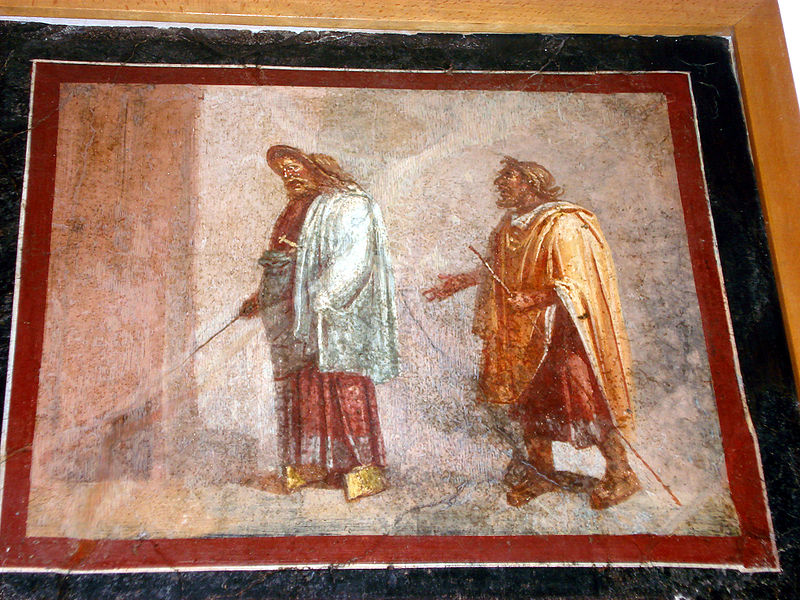
Livius Andronicus
3rd-century BC Greco-Roman dramatist and epic poet

Carneades
Carneades (; , Karneadēs, "of Carnea"; 214/3–129/8 BC) was a Greek philosopher, perhaps the most prominent head of the Skeptical Academy in Ancient Greece. He was born in Cyrene. By the year 159 BC, he had begun to attack many previous dogmatic doctrines, especially Stoicism and even the Epicureans, whom previous skeptics had spared.

Dio Chrysostom
Greek orator, writer, philosopher and historian (c. 40 – c. 115)

Herodian
Herodian or Herodianus (), sometimes referred to as Herodian of Antioch (c. 170 – c. 240), was a minor Roman civil servant who wrote a colourful history in Greek titled History of the Empire from Marcus onwards (τῆς μετὰ Μάρκον βασιλείας ἱστορία) in eight books covering the years 180 to 238. His work is not considered entirely reliable, although his less biased account of Elagabalus may be more useful than that of Cassius Dio. The origin of Herodian is contested in scholarship, popular hypotheses being Syria, Alexandria in Egypt and Asia Minor. However, he appears to have lived for a considera
Priscus Attalus
prefect of Rome and usurper 409-411 CE
Alexandros Polyhistor
1st-century BC Greek scholar
Demaratus the Corinthian
father of Tarquin the Elder
Hermogenes of Tarsus
2nd century Greek rhetorician

Mesomedes
Mesomedes of Crete () was a Greek citharode and lyric poet and composer of the early 2nd century AD in Roman Greece. Prior to the discovery of the Seikilos epitaph in the late 19th century, the hymns of Mesomedes were the only surviving written music from the ancient world. Three were published by Vincenzo Galilei in his Dialogo della musica antica e della moderna (Florence, 1581), during a period of intense investigation into music of the ancient Greeks. These hymns had been preserved through the Byzantine tradition (Anthol. pal. xiv. 63, xvi. 323), and were presented to Vincenzo by Girolamo

Pasiteles
thumb|So-called "Atalanta": statue of a young girl; the palm branch on the trunk is a symbol of victory. Marble, Greek artwork, 1st century BC (Vatican Inv. 2784)
Pasiteles (; sometimes called Pasiteles the Younger) was a Neo-Attic school sculptor from Ancient Rome at the time of Julius Caesar. Pasiteles is said by Pliny to have been a native of Magna Graecia, and to have been granted Roman citizenship. He worked during a period where there was a demand for copies of, or variations on, noted works of Greek sculpture; the demand was met by the workshops of Pasiteles and his pupils Stephanus and
Crinagoras of Mytilene
Greek epigrammatist and ambassador in Rome

Theophanes of Mytilene
1st century BC Greek historian and friend of Pompey
Apsines
Apsines of Gadara (; fl. 3rd century AD) was a Greek rhetorician. He was a native of the Hellenised city of Gadara, whose ruins stand today at the border of Jordan with Syria and Israel. Apsines went on to study at Smyrna and taught at Athens, gaining such a reputation that he was raised to the consulship by the emperor Maximinus. He was a rival of Fronto of Emesa, and a friend of Philostratus, the author of the Lives of the Sophists, who praises his wonderful memory and accuracy.
Gaius Stertinius Xenophon
Roman physician
Philippus
2nd-century Prince of Macedon
Alexander
son of Perseus of Macedon
Dositheus Magister
ancient Greek grammarian
Philoxenus of Alexandria
ancient Greek grammarian
Alexander of Cotiaeum
Greek grammarian