
Pasiteles
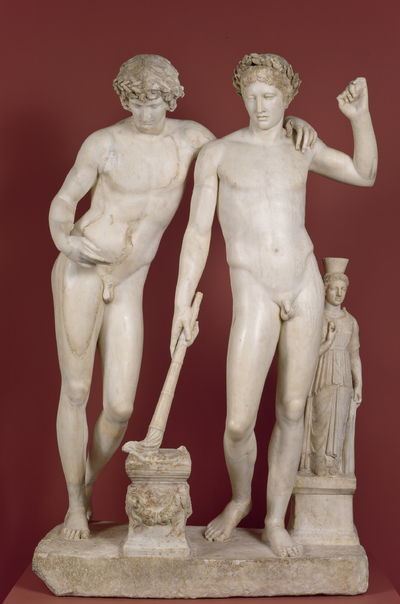
Sign in to savethumb|So-called "Atalanta": statue of a young girl; the palm branch on the trunk is a symbol of victory. Marble, Greek artwork, 1st century BC (Vatican Inv. 2784) Pasiteles (; sometimes called Pasiteles the Younger) was a Neo-Attic school sculptor from Ancient Rome at the time of Julius Caesar. Pasiteles is said by Pliny to have been a native of Magna Graecia, and to have been granted Roman citizenship. He worked during a period where there was a demand for copies of, or variations on, noted works of Greek sculpture; the demand was met by the workshops of Pasiteles and his pupils Stephanus and
Wikidata facts
- Instance of
- human
- Gender
- male
- Citizenship
- Ancient Rome
- Place of birth
- Magna Graecia
- Occupation
- writer
- Languages spoken
- Ancient Greek
- Movement
- Hellenistic art
Show 5 more facts
- Commons category
- Pasiteles
- date of birth
- 0200-01-01
- date of death
- 0100-01-01
- time period
- classical antiquity
- described by source
- Brockhaus and Efron Encyclopedic Dictionary
Sources (1)
via Wikidata · CC0
Works in European collections
1 object attributed to Pasiteles, held across European museums, libraries & archives · via Europeana
~2 min read
Encyclopedic overview
3 sectionsContents
- Pasiteles the Elder
- Notes
- References
thumb|So-called "Atalanta": statue of a young girl; the palm branch on the trunk is a symbol of victory. Marble, Greek artwork, 1st century BC (Vatican Inv. 2784) Pasiteles (; sometimes called Pasiteles the Younger) was a Neo-Attic school sculptor from Ancient Rome at the time of Julius Caesar. Pasiteles is said by Pliny to have been a native of Magna Graecia, and to have been granted Roman citizenship. He worked during a period where there was a demand for copies of, or variations on, noted works of Greek sculpture; the demand was met by the workshops of Pasiteles and his pupils Stephanus and Menelaus and others, several of whose statues are extant. According to Pliny, Pasiteles made an ivory statue of Jupiter for the temple of Metellus and made statues for the temple of Juno in the portico of Octavia.
Pliny states that Pasiteles worked in marble, silver, ivory, and bronze and, according to his contemporary Varro, never made a statue without first making a clay model. Pasiteles was the author of five books upon celebrated works of sculpture and chasing in the whole world (quinque volumina nobilium operum in toto), which Pliny calls mirabilia opera, stating that Pasiteles is a better guide to chased silver than Xenocrates or the other authorities. In Pliny there is some alternation of the spelling "Paxiteles" with the spelling "Pasiteles."
Excerpted from Wikipedia’s “Pasiteles” article, available under the CC BY-SA 4.0 licence.