Category
page 1Ancient occultists

Pythagoras
Pythagoras of Samos (; BC) was an ancient Ionian Greek philosopher, polymath, and the eponymous founder of Pythagoreanism. His political and religious teachings were well known in Magna Graecia and influenced the philosophies of Plato, Aristotle, and, through them, Western philosophy. Modern scholars disagree regarding Pythagoras's education and influences, but most agree that he travelled to Croton in southern Italy around 530 BC, where he founded a school in which initiates were allegedly sworn to secrecy and lived a communal, ascetic lifestyle.

Julian
last Pagan Roman emperor, reigned 361 to 363

Vyāsa
Vyasa (; , ) is a rishi (sage) with a prominent role in most Hindu traditions. He is also known as Veda Vyasa (, ) or Krishna Dvaipayana (, ). Traditionally regarded as the author of the epic Mahābhārata, Vyasa also plays a prominent role as a character. He is also regarded by the Hindu traditions to be the compiler of the mantras of the Vedas into four texts, as well as the author of the eighteen Purāṇas and the Brahma Sutras.

Hermes Trismegistus
purported author of the Hermetic Corpus
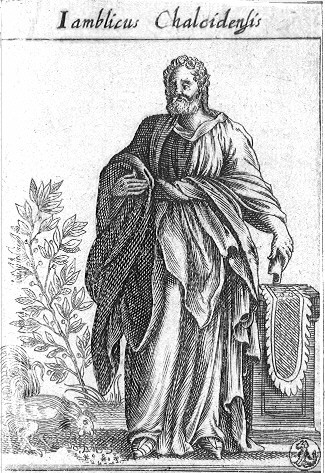
Iamblichus
Iamblichus ( ; ; ; ) was a Syrian Arab Neoplatonist philosopher who determined a direction later taken by Neoplatonism. Iamblichus was also the biographer of the Greek mystic, philosopher, and mathematician Pythagoras. In addition to his philosophical contributions, his is important for the study of the sophists because it preserved about ten pages of an otherwise unknown sophist known as the Anonymus Iamblichi.

Simon Magus
religious figure who confronted Peter

Mary the Jewess
alchemist who lived between the 1st and 3rd centuries CE in Alexandria

Aglaonike
thumb|right|Greek vase from the collection of William Hamilton (diplomat)|William Hamilton, apparently showing two women drawing down the moon.
Aglaonice (, Aglaoníkē, compound of αγλαὸς (aglaòs) "luminous" and νίκη (nikē) "victory") was an ancient Thessalian witch, known from a scholion on the Argonautica and two references in Plutarch's Moralia. She was the daughter of Hegetor or Hegemon. Her date is uncertain, but she may have been active some time between the mid-third century BC and the late-first century AD. However, Richard Stothers suggests that Aglaonice might have been mythical, or a
Nigidius Figulus
Roman philosopher and writer (0098-0045)
Zosimos of Panopolis
Egyptian alchemist
Witch of Endor
biblical character (First Book of Samuel)
Xu Fu
Chinese alchemist and explorer in the Qin Dynasty
Elymas
Elymas (; ; ), also known as Bar-Jesus (, , ), is a figure described in the Acts of the Apostles, chapter 13, where he is referred to as a mágos (μάγος), which the King James Bible translates as "sorcerer" and false prophet (ψευδοπροφήτης).
Cyprian and Justina
pair of Christians martyred in 304
Jannes and Jambres
Magicians who opposed Moses in ''Exodus''
Menander
1st-century Samaritan gnostic
Theoris of Lemnos
executed for witchcraft