Category
page 1Ancient Roman adoptees

Augustus
Augustus (born Gaius Octavius; 23 September 63 BC – 19 August AD 14), also known as Octavian (), was the founder of the Roman Empire and the first Roman emperor from 27 BC until his death in AD 14. The reign of Augustus initiated an imperial cult and an era of imperial peace (the or ) in which the Roman world was largely free of armed conflict. The principate, a style of government where the emperor showed nominal deference to the Senate, was established during his reign and lasted until the Crisis of the Third Century.

Marcus Aurelius
16th Roman Emperor from 161 to 180 and Stoic philosopher

Nero
Nero Claudius Caesar Augustus Germanicus ( ; born Lucius Domitius Ahenobarbus; 15 December AD 37 – 9 June AD 68) was a Roman emperor and the final emperor of the Julio-Claudian dynasty, reigning from AD 54 until his suicide in AD 68.

Tiberius
Tiberius Julius Caesar Augustus ( ; 16 November 42 BC – 16 March AD 37) was Roman emperor from AD 14 until 37. He succeeded his stepfather Augustus, the first Roman emperor. Tiberius was born in Rome in 42 BC to politician Tiberius Claudius Nero and his wife, Livia Drusilla. In 38 BC, Livia divorced Nero and married Augustus. Following the untimely deaths of Augustus's two grandsons and adopted heirs, Gaius and Lucius Caesar, Tiberius was designated Augustus's successor. Prior to this, Tiberius had proved himself an able diplomat and one of the most successful Roman generals. His conquests of

Trajan
Trajan ( ; born Marcus Ulpius Traianus, 18 September 53) was a Roman emperor from AD 98 to 117, remembered as the second of the Five Good Emperors of the Nerva–Antonine dynasty. He was a philanthropic ruler and a successful soldier-emperor who presided over one of the greatest military expansions in Roman history, during which, by the time of his death, the Roman Empire reached its maximum territorial extent. He was given the title of optimus princeps ('the best ruler') by the Roman Senate.
.png)
Hadrian
Hadrian ( ; born Publius Aelius Hadrianus, 24 January 76 – 10 July 138) was Roman emperor from 117 to 138. Hadrian was born in Italica, in the present-day Andalusian province of Seville in southern Spain, an Italic settlement in Hispania Baetica; his gens Aelia came from the town of Hadria in eastern Italy. He was a member of the Nerva–Antonine dynasty.

Pliny the Younger
Roman lawyer, author and magistrate (61 – c.113)

Antoninus Pius
15th Roman Emperor (138–161)
%20(35867773310)%20edited.jpg)
Galba
Galba ( ; born Servius Sulpicius Galba; 24 December 3 BC – 15 January AD 69) was Roman emperor, ruling for 7 months from 8 June AD 68 to 15 January 69. He was the first emperor in the Year of the Four Emperors and assumed the throne following Emperor Nero's suicide.

Severus Alexander
Roman Emperor (208-235)
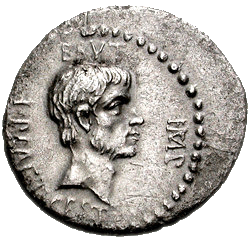
Marcus Junius Brutus
assassin of Julius Caesar

Constantius Chlorus
Roman emperor (250-306)
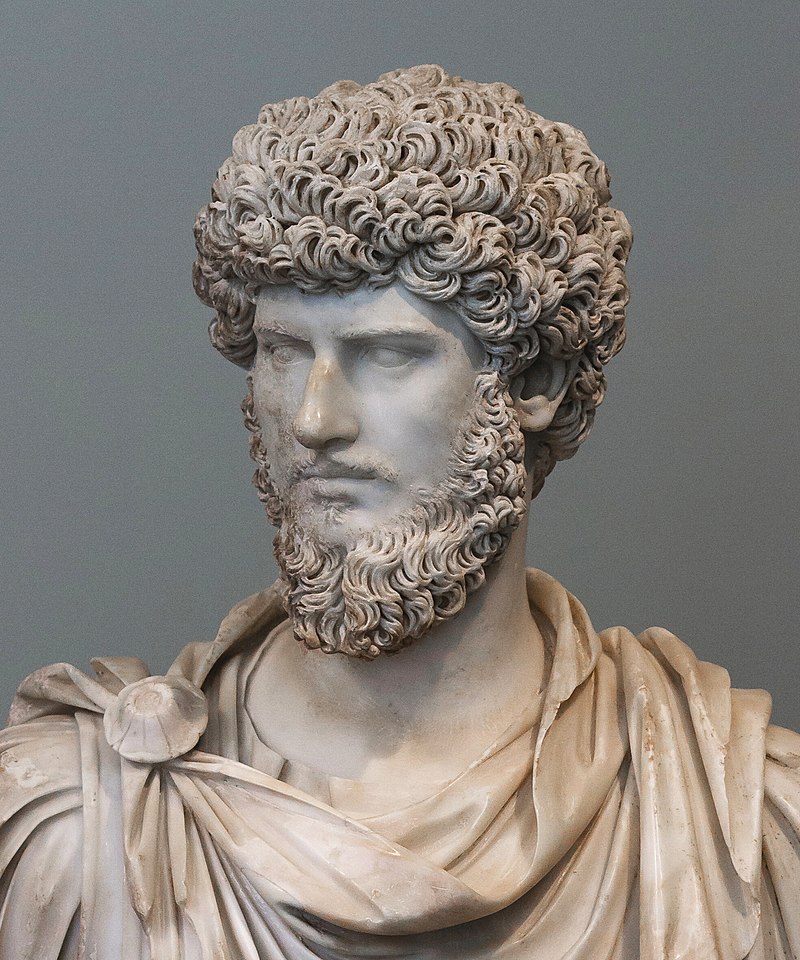
Lucius Verus
joint Roman Emperor with Marcus Aurelius (161–169)

Germanicus
Germanicus Julius Caesar (24 May 15 BC – 10 October AD 19) was a Roman general and politician most famously known for his campaigns against Arminius in Germania. The son of Nero Claudius Drusus and Antonia the Younger, Germanicus was born into an influential branch of the patrician gens Claudia. The agnomen Germanicus was added to his full name in 9 BC when it was posthumously awarded to his father in honor of his victories in Germania. In AD 4 he was adopted by his paternal uncle Tiberius, himself the stepson and heir of Germanicus' great-uncle Augustus; ten years later, Tiberius succeeded Au

Livia
Livia Drusilla (30 January 59 BC
AD 29) was Roman empress from 27 BC to AD 14 as the wife of Augustus, the first Roman emperor. She was known as Julia Augusta after her formal adoption into the Julia gens in AD 14.

Scipio Aemilianus
Roman politician and general (185–129 BC)
Gaius Caesar
eldest son of Marcus Vipsanius Agrippa and Julia the Elder, Emperor Augustus' only daughter, also adopted by Augustus as his own child
%2001.jpg)
Sejanus
Lucius Aelius Sejanus ( – 18 October AD 31), commonly known as Sejanus (), was a Roman soldier and confidant of the Roman Emperor Tiberius. Of the Equites class by birth, Sejanus rose to power as prefect of the Praetorian Guard, the imperial bodyguard, of which he was commander from AD 14 until his execution for treason in AD 31.

Decimus Junius Brutus Albinus
Roman general, politician, and assassin of Julius Caesar (81–43 BC)

Lucius Caesar
grandson of emperor Augustus (17 BC - AD 2)

Titus Pomponius Atticus
Roman banker, writer and philosopher (c.110 BC – 32 BC)

Lucius Aelius Caesar
heir of the Roman Empire as the adopted son of Emperor Hadrian, and father of emperor Lucius Verus

Quintus Caecilius Metellus Pius Scipio Nasica
ancient Roman consul and optimate
Agrippa Postumus
Youngest son of Marcus Agrippa and Julia the Elder (12 BC – AD 14)
Tiberius Gemellus
Julio-Claudian prince, grandson of Emperor Tiberius (19 AD - 37/38 AD) (19-38)
Lucius Junius Gallio Annaeanus
Roman senator, brother of Seneca
Nero Caesar
adopted grandson and heir of the Roman Emperor Tiberius (c. AD 6 - AD 31)
Gnaeus Cornelius Lentulus Vatia
1st century BC Roman owner of the gladiatorial school where Spartacus was trained
Drusus Caesar
adopted grandson and heir of the Roman emperor Tiberius (c. 8 AD-33 AD) (7-33)
Publius Cornelius Dolabella
commander under Julius Caesar
Quintus Petillius Cerialis
son-in-law of emperor Vespasian
Marcus Terentius Varro Lucullus
Roman consul in 73 BC

Serena
niece of Roman emperor Theodosius I
Marcus Livius Drusus Claudianus
father of Roman empress Livia
Gnaeus Cornelius Lentulus Clodianus
Roman consul 72 BC
Lucius Calpurnius Piso Cesoninus
praetor in 154 BC
Marcus Pupius Piso Frugi Calpurnianus
Roman consul 61 BC
Quintus Fabius Maximus Aemilianus
Roman consul in 145 BC
Lucius Julius Ursus Servianus
Iberian Roman politician and consul (45 – 136)
Lucius Calpurnius Piso Frugi Licinianus
adoptive son and heir of Roman emperor Galba
Lucius Arruntius Camillus Scribonianus
1st-century Roman usurper
Mamercus Aemilius Lepidus Livianus
Roman consul 77 BC
Lucius Caesennius Paetus
Roman consul 61 AD
Publius Licinius Crassus Dives Mucianus
Roman consul in 131 BC

Gaius Sallustius Crispus Passienus
Roman consul 44 AD
Marcus Livius Drusus Libo
adoptive brother of Roman empress Livia.
Marcus Peducaeus Plautius Quintillus
Roman noble and consul (died 205)
Marcus Valerius Messalla Appianus
Roman consul 12 BC
Marcus Licinius Crassus Frugi
Roman senator and consul in 14 BC
Lucius Catilius Severus
2nd century Roman senator, consul and general
Quintus Fabius Maximus Servilianus
2nd century BC Roman general, consul 142 BCE
Quintus Pompeius Falco
2nd century Roman senator, governor and general
Lucius Gellius Poplicola
mid-1st century BC Roman politician
Quintus Caecilius Metellus Creticus Silanus
1st century Roman senator, consul and governor of Syria
Gaius Antius Aulus Julius Quadratus
Roman consul in 105 AD
Marcus Pompeius Silvanus Staberius Flavianus
1st century Roman senator, consul, proconsul and provincial governor
Lucius Neratius Marcellus
Roman consul in 95 and 129 AD
Marcus Lollius Paulinus Decimus Valerius Asiaticus Saturninus
Roman consul in 94 and 125 AD
Marcus Aurelius Cotta Maximus Messalinus
Roman Senator and consul who was a friend of the Roman emperors Augustus and Tiberius

Tiberius Plautius Silvanus Aelianus
1st century AD Roman senator and consul