Category
page 1Animal virology

Coronavirus
Coronaviruses are a group of related RNA viruses that cause diseases in mammals and birds. In humans and birds, they cause respiratory tract infections that can range from mild to lethal. Mild illnesses in humans include some cases of the common cold (which is also caused by other viruses, predominantly rhinoviruses), while more lethal varieties can cause SARS, MERS and COVID-19. In cows and pigs, they cause diarrhea; while in mice, they cause hepatitis and encephalomyelitis.
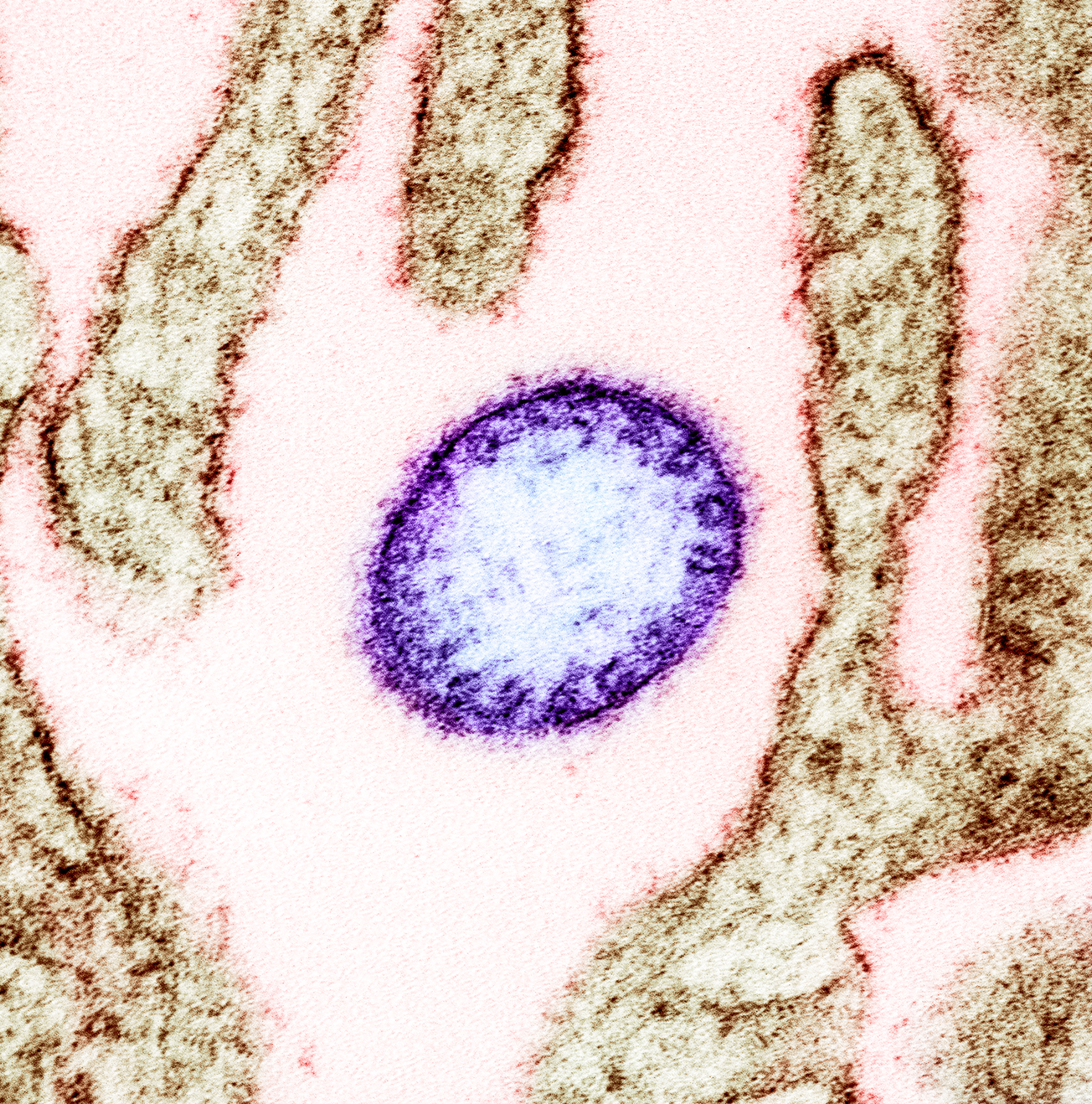
Nipah virus
Nipah virus is a bat-borne, zoonotic virus that causes Nipah virus infection in humans and other animals, a disease with a very high case fatality rate (40–75%). Numerous disease outbreaks caused by the Nipah virus have occurred in India, Malaysia, and Singapore. Nipah virus belongs to the genus Henipavirus along with the Hendra virus, which has also caused disease outbreaks.

Herpesviridae
Orthoherpesviridae, previously named and more widely known as Herpesviridae, is a large family of DNA viruses that cause infections and certain diseases in animals, including humans. The members of this family are commonly known as herpesviruses. The family name is derived from the Greek word ἕρπειν ( 'to creep'), referring to spreading cutaneous lesions, usually involving blisters, seen in flares of herpes simplex 1, herpes simplex 2 and herpes zoster (shingles). In 1971, the International Committee on the Taxonomy of Viruses (ICTV) established Herpesvirus as a genus with 23 viruses among fou

influenza A virus
species of virus

Paramyxoviridae
Paramyxoviridae (from Greek para- “by the side of” and myxa “mucus”) is a family of negative-strand RNA viruses in the order Mononegavirales. Vertebrates serve as natural hosts. Diseases associated with this family include measles, mumps, and respiratory tract infections. The family has nine subfamilies that contain 23 genera.
Nidovirales
Nidovirales is an order of enveloped, positive-strand RNA viruses which infect vertebrates and invertebrates. Host organisms include mammals, birds, reptiles, amphibians, fish, arthropods, molluscs, and helminths. The order includes the families Coronaviridae, Arteriviridae, Roniviridae, Tobaniviridae, and Mesoniviridae.

Henipavirus
Henipavirus is a genus of negative-strand RNA viruses in the family Paramyxoviridae, order Mononegavirales containing five established species, and numerous others still under study. Henipaviruses are naturally harboured by several species of small mammals, notably pteropid fruit bats (flying foxes), microbats of several species, and shrews. Henipaviruses are characterised by long genomes and a wide host range. Their recent emergence as zoonotic pathogens capable of causing illness and death in domestic animals and humans is a cause of concern.
double-stranded RNA virus
type of virus according to Baltimore

Picornavirales
Picornavirales is an order of viruses with vertebrate, invertebrate, protist and plant hosts. The name has a dual etymology. First, picorna- is an acronym for poliovirus, insensitivity to ether, coxsackievirus, orphan virus, rhinovirus, and ribonucleic acid. Secondly, pico-, meaning extremely small, combines with RNA to describe these very small RNA viruses. The order comprises viruses that historically are referred to as picorna-like viruses.

Alphaherpesvirinae
Alphaherpesvirinae is a subfamily of viruses in the family Herpesviridae, primarily distinguished by reproducing more quickly than other subfamilies in the Herpesviridae. Mammals serve as natural hosts. There are currently 45 species in this subfamily, divided among 5 genera, with one species unassigned to a genus. Diseases associated with this subfamily include: HHV-1 and HHV-2: skin vesicles or mucosal ulcers, rarely encephalitis and meningitis, HHV-3: chickenpox (varicella) and shingles, GaHV-2: Marek's disease. In animals, Pseudorabies virus is the causative agent of Aujeszky's disease in
panzootic
A panzootic (from Greek παν all + ζόιον animal) is an epizootic (an outbreak of an infectious disease of non-human animals) that spreads across a large region (for example a continent), or even worldwide. The equivalent in human populations is called a pandemic.

Circoviridae
Circoviridae is a family of DNA viruses. Birds and mammals serve as natural hosts. The family has two genera. Diseases associated with this family include: PCV-2: postweaning multisystemic wasting syndrome; CAV: chicken infectious anemia.

murine leukemia virus
species of virus
Murine coronavirus
species of virus
RaTG13
Bat coronavirus RaTG13 is a SARS-like betacoronavirus identified in the droppings of the horseshoe bat Rhinolophus affinis. It was discovered in 2013 in bat droppings from a mining cave near the town of Tongguan in Mojiang county in Yunnan, China. In February 2020, it was identified as the closest known relative of SARS-CoV-2, the virus that causes COVID-19, sharing 96.1% nucleotide identity. However, in 2022, scientists found three closer matches in bats found 530 km south, in Feuang, Laos, designated as BANAL-52 (96.8% identity), BANAL-103 and BANAL-236.
animal virus
viruses that infect animals