Category
page 1Arab culture

One Thousand and One Nights
collection of Middle Eastern folk stories

Nasreddin
thumb|A 17th-century miniature of Nasruddin, from the collection of the Topkapı Palace Museum|205x205px

harem
thumb|upright=1.2|Ladies of Caubul|Kabul (1848 lithograph, by James Rattray) showing unveiling in [[zenana areas.]]

Arabian horse
horse breed

hookah
thumb|A Rajput man smoking through a hookah, [[Rajasthan, India.]]

Arabic literature
written literature in Arabic language

belly dance
Arabic dance

oud
The oud ( ; , ) is a Middle Eastern short-neck lute-type, pear-shaped, fretless stringed instrument (a chordophone in the Hornbostel–Sachs classification of instruments), usually with 11 strings grouped in six courses, but some models have five or seven courses, with 10 or 13 strings respectively.

niqab
A niqāb, niqab, or niqaab (; ), also known as a ruband () or rubandah (), is a long garment worn by some Muslim women, in order to cover their entire body and face, excluding their eyes. It is an interpretation in Islam of the concept of hijab, and is worn in public and in all other places where a woman may encounter non-mahram men. Most prevalent in the Arabian Peninsula, the niqab is a controversial clothing item in many parts of the world, including in some Muslim-majority countries.
.jpg)
kufiyya
thumb|Yemenis|Yemeni man wearing a keffiyeh in turban-style and a Yemeni shawl on his shoulder
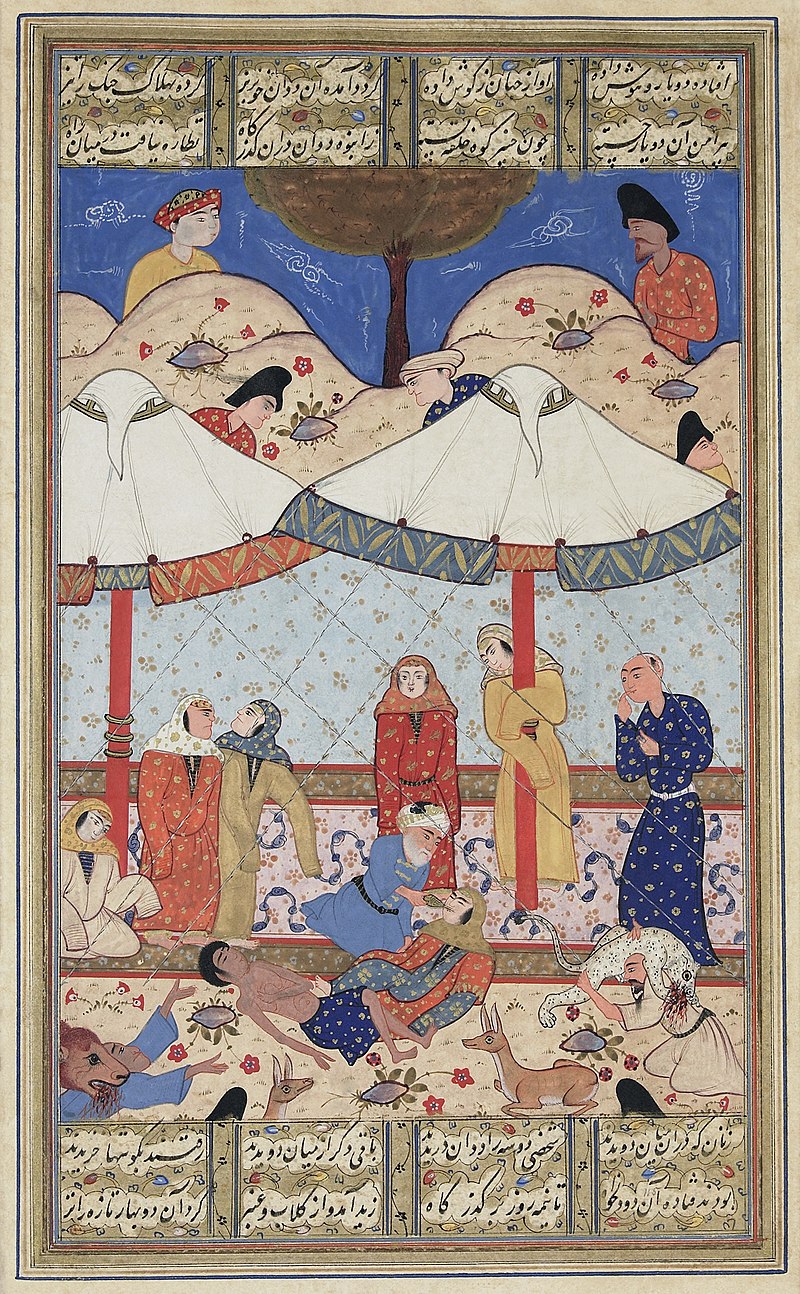
Layla and Majnun
story of Arab origin, about the 7th-century Arabic poet Qays ibn al-Mulawwah and his lover Layla bint Mahdi
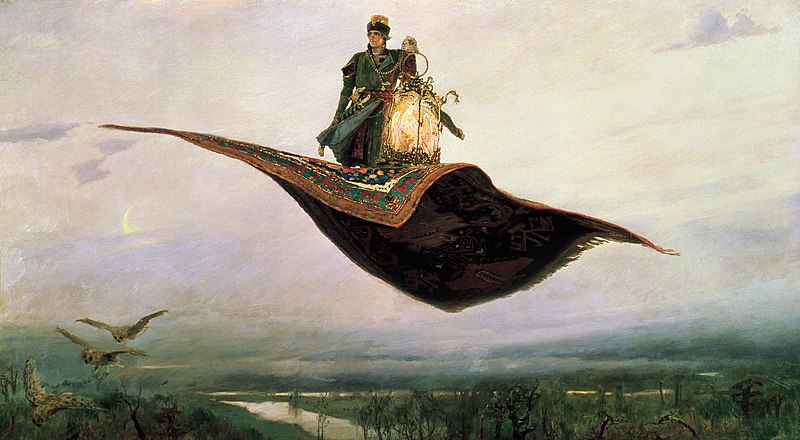
magic carpet
legendary carpet used for transportation

kaftan
thumb|Kurdish people|Kurdish man wearing a kaftan. Illustration by [[Max Karl Tilke published in Oriental Costumes: Their Designs and Colors (1922), Georgian National Museum, Tbilisi.]]

Qasida
The qaṣīda (also spelled qaṣīdah; plural qaṣā’id) is an ancient Arabic word and form of poetry, often translated as ode. The qasida originated in pre-Islamic Arabic poetry and passed into non-Arabic cultures after the Arab Muslim expansion.

Arab cuisine
cuisine of the Arabs

Arabization
thumb|262x262px|Caliph Abd al-Malik ibn Marwan|Abd al-Malik (r. 685–705) established Arabic as the sole official language of the [[Umayyad Caliphate in 686 CE.]]
%20at%20a%20wedding%20in%20India%2001.jpg)
mehndi
thumb|Henna stains on a bride's hand
thumb|Mehndi applied on the palms
thumb|Mehndi applied on the backs of the hand
Arab culture
culture carried and upheld through the family of Arabic languages in the Middle East and North Africa and by immigrants elsewhere

majlis
thumb|upright=1.5|Bowl with a scene by a pond, signed by Abu Zayd al-Kashani in 1187, [[Seljuk Empire, Iran.]]
'''''' is an Arabic term meaning 'sitting room'. It is used to describe various types of special gatherings among common interest groups of administrative, social or religious nature in countries with linguistic or cultural connections to the Muslim world. can refer to a legislature as well and is used in the name of legislative councils or assemblies in some states.

felucca
thumb|right|Felucca on the Nile at Luxor

kasbah
300px|thumb|upright=1.5|Kasbah of Sfax in [[Tunisia]]
Arabic coffee
serving and drinking customs of Arabic coffee

dabke
Dabke ( also spelled dabka, dabki, dubki, dabkeh, plural dabkaat) is a Levantine folk dance, particularly popular among Lebanese, Jordanian, Palestinian, and Syrian communities. Dabke combines circle dance and line dancing and is widely performed at weddings and other joyous occasions. The line forms from right to left and the leader of the dabke heads the line, alternating between facing the audience and the other dancers.

djellaba
thumb|Djellaba
Muhammad
male given name (محمد)
.png)
Nahda
thumb|Renaissance by Moustafa Farroukh (1945), a painting symbolizing the Nahda
The Nahda (, meaning 'the Awakening'), also referred to as the Arab Awakening, Arab Enlightenment or Arab Renaissance, was a cultural movement that flourished in Arab-populated regions of the Ottoman Empire, notably in Syria, Lebanon, Egypt, and Tunisia, during the second half of the 19th century and the early 20th century.
Muwashshah
Muwashshah ( '''' 'girdled'; plural '; also ' 'girdling,' pl. ') is a strophic poetic form that developed in al-Andalus in the late 10th and early 11th centuries. The ', embodying the Iberian rhyme revolution, was the major Andalusi innovation in Arabic poetry, and it was sung and performed musically. The muwaššaḥ features a complex rhyme and metrical scheme usually containing five '''' ( 'branches'; sing. '), with uniform rhyme within each strophe, interspersed with ' ( 'threads for stringing pearls'; sing. '') with common rhyme throughout the song, as well as a terminal kharja'' ( 'exit'), t

Mashrabiya
thumb|300px|A mashrabiya in Tunisia
culture of Syria
pattern of human activity and symbolism associated with Syria and its people
Supreme Council of Antiquities
branch of the Egyptian Ministry of Culture
culture of Iraq
pattern of human activity and symbolism associated with Iraq and its people
culture of Egypt
pattern of human activity and symbolism associated with Egypt and its people
religion in pre-Islamic Arabia
religions practiced by Arabs before Islam
culture of Saudi Arabia
pattern of human activity and symbolism associated with Saudi Arabia and its people
Pearl Roundabout
square in Manama, Bahrain
culture of Lebanon
pattern of human activity and symbolism associated with Lebanon and its people
Arab Capital of Culture
Arab League effort to promote and celebrate Arab culture

Ardah
Ardah ( / ALA-LC: al-‘arḍah) is a type of folkloric group dance in the Arabian Peninsula, in most countries located in the Gulf Cooperation Council. The dance is performed with two rows of men opposite of one another, each of whom may or may not be wielding a sword or cane, and is accompanied by drums and spoken poetry.
Nabulsi soap
type of castile soap in Palestine
culture of Morocco
pattern of human activity and symbolism associated with Morocco and its people
culture of Jordan
pattern of human activity and symbolism associated with Jordan and its people
Fantasia
traditional exhibition of horsemanship in the Maghreb performed during cultural festivals
Haïk
traditional women's garment from the Maghreb

köçek
thumb|200px|right|Köçek in Ottoman miniature.
The '''' (plural ) was typically a young, male, and physically attractive enslaved dancer (rakkas''), who usually cross-dressed in feminine attire, and was employed as an entertainer.
.jpg)
Al-Battoulah
thumb|A Khaleeji woman wearing the battoulah.

Gargee'an
'''Gargee'an (), sometimes spelled as Gerga'oon''' (Arabic: قرقاعون), is a semiannual celebration, observed primarily in Eastern Arabia. It takes place on the 13th, 14th or 15th night of the Islamic month of Ramadan. It is celebrated by children and adults alike dressing in traditional attire and going door-to-door to receive sweets and nuts from neighbours, as they sing traditional songs. This traditional holiday is celebrated by both Sunni and Shia. The tradition has existed for hundreds of years, and is deeply rooted in some parts of the Persian Gulf culture, especially in (Qatif and Al-Ahs
.jpg)
katib
thumb|A Katib, in Bombay' by Edwin Lord Weeks
A katib (, kātib) is a writer, scribe, or secretary in the Arabic-speaking world, Persian World, and other Islamic areas as far as the Indian subcontinent. In North Africa, the local pronunciation of the term also causes it to be written ketib. Duties comprised reading and writing correspondence, issue instructions at the command of the person in charge and archiving documentation.
culture of Yemen
pattern of human activity and symbolism associated with Yemen and its people
culture of Tunisia
pattern of human activity and symbolism associated with Tunisia and its people
Arab cinema
Filmmaking in the Arab world
mukhannathun
Mukhannath (; plural mukhannathun (); "effeminate ones", "ones who resemble women") was a term used in Classical Arabic and Islamic literature to describe effeminate men or people with ambiguous sexual characteristics, who appeared feminine and functioned sexually or socially in roles typically carried out by women. Mukhannathun, especially those in the city of Medina, are mentioned throughout the ḥadīth literature and in the works of many early Arabic and Muslim writers. The historical role and gender identity of mukhannathun have been interpreted by predominantly Western academics of gender
culture of Bahrain
pattern of human activity and symbolism associated with Bahrain and its people
fouta
woven textile used as a wrap or towel in the Mediterranean region
culture of Palestine
overview of the culture of Palestine

Shayla
Shayla () is an Islamic head covering worn by some Muslim women in the presence of any male outside of their immediate family. It is different from a khimar, because it is usually wrapped and pinned. Sometimes it is worn in the form of a half niqab with part of the face still appearing.
thumb|Two mannequins with the left wearing a shayla and the right wearing a niqab
list of Arab flags
Wikimedia list article
İftar Cannon Shot
cannon shot that warns people stop fasting and start eating in the holy month of Ramadan in Turkey
culture of Libya
pattern of human activity and symbolism associated with Libya and its people
Haḍra
collective supererogatory ritual performed by Sufi orders
namus
Nāmūs is an Arabic word describing an ethical category in Middle Eastern patriarchal character. Often literally translated as "virtue", it is now more popularly used in a strong gender-specific context of relations within a family described in terms of honor, attention, respect/respectability, and modesty.