Category
page 1Archiacanthocephala
Archiacanthocephala
Archiacanthocephala is a class within the phylum of Acanthocephala. They are parasitic worms, which attach themselves to the intestinal wall of terrestrial vertebrates, including humans. They are characterised by the body wall and the lemnisci (which are a bundle of sensory nerve fibers), which have nuclei that divide without spindle formation, or the appearance of chromosomes, or it has a few amoebae-like giant nuclei. Typically, there are eight separate cement glands in the male, which is one of the few ways to distinguish the dorsal and ventral sides of these organisms.

Macracanthorhynchus
Macracanthorhynchus, also known as the giant thorny-headed worm of swine, is a member of the Oligacanthorhynchidae which contains four species.
Gigantorhynchus
Gigantorhynchus is a genus of Acanthocephala (thorny-headed worms, also known as spiny-headed worms) that parasitize marsupials, anteaters, and possibly baboons by attaching themselves to the intestines using their hook-covered proboscis. Their life cycle includes an egg stage found in host feces, a cystacanth (larval) stage in an intermediate host such as termites, and an adult stage where cystacanths mature in the intestines of the host. This genus is characterized by a cylindrical proboscis with a crown of robust hooks at the apex followed by numerous small hooks on the rest of the probosci

Oligacanthorhynchidae
Oligacanthorhynchida is an order containing a single parasitic worm family, Oligacanthorhynchidae, that attach themselves to the intestinal wall of terrestrial vertebrates.

Moniliformis moniliformis
species of worm

Pachysentis
Pachysentis is a genus in Acanthocephala (thorny-headed or spiny-headed worms) that parasitize primates and carnivorans. The eleven species are distributed across Africa, the Middle East, and the Americas. Pachysentis species attach themselves to the inner lining of the gastrointestinal tract of their hosts using their hook-covered proboscis. Their life cycle includes an egg stage found in host feces, a cystacanth (larval) stage in an intermediate host which is usually an insect, and an adult stage where cystacanths mature in the intestines of the host. This genus appears identical to the clos
Apororhynchus
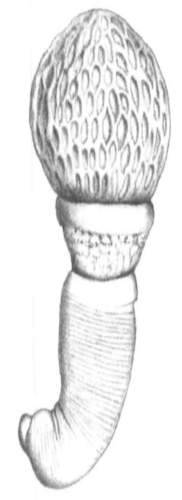
Apororhynchus is a genus of small parasitic spiny-headed (or thorny-headed) worms. It is the only genus in the family Apororhynchidae, which in turn is the only member of the order Apororhynchida. A lack of features commonly found in the phylum Acanthocephala (primarily musculature) suggests an evolutionary branching from the other three orders of class Archiacanthocephala; however no genetic analysis has been completed to determine the evolutionary relationship between species. The distinguishing features of this order among archiacanthocephalans is a highly enlarged proboscis which contain s
Prosthenorchis
Prosthenorchis is a genus of parasitic worms belonging to the family Oligacanthorhynchidae. Prosthenorchis have a trunk up to 50 mm long, a proboscis that is not ornate with three barbed hooks in each of 12 rows. They have complex hook roots with large manubria, and a small discoid posterior hook base. There are up to 23 festoons. Gonopore is subterminal. The primary host are primates in South America and Felidae in Africa with cockroaches and beetles as intermediate hosts.
Pallisentis
Pallisentis is a genus in Acanthocephala (parasitic thorny-headed worms, also known as spiny-headed worms).
Moniliformis
Moniliformis is a genus of parasitic worms in the Acanthocephala phylum.
Oncicola
Oncicola is a genus of parasitic worms belonging to the family Oligacanthorhynchidae. Oncicola belongs to the phylum Acanthocephalans that include many thorny-headed worms. This family contains 12 genera including the genus Oncicola. Oncicola is a part of the phylum Acanthocephalans that include many thorny-headed worms. The name comes from the prefix onc- meaning “barbed” and -cola meaning “to inhabit” in Latin. It was named and discovered in 1916 by Travassos. These worms are defined by their parasitic nature which involves hook structures found at their front end.

Oligacanthorhynchus
Oligacanthorhynchus is a genus of parasitic worms belonging to the family Oligacanthorhynchidae.
==Taxonomy==
Phylogenetic analysis has been conducted on one of the species in the genus, O.tortuosa.

Mediorhynchus
Mediorhynchus is a genus of small parasitic spiny-headed (or thorny-headed) worms. Phylogenetic analysis has been conducted on two known species of Mediorhynchus and confirmed the placement along with the related genus Gigantorhynchus in the family Gigantorhynchida. The distinguishing features of this order among archiacanthocephalans is a divided proboscis (specifically, the presence of a "teloboscis" which is the posterior third of a proboscis). This genus contains fifty-eight species that are distributed globally. These worms exclusively parasitize birds by attaching themselves around the c
Moniliformidae
Moniliformidae is a family of parasitic spiny-headed (or thorny-headed) worms. It is the only family in the Moniliformida order and contains three genera: Australiformis containing a single species, Moniliformis containing eighteen species and Promoniliformis containing a single species. Genetic analysis have determined that the clade is monophyletic despite being distributed globally. These worms primarily parasitize mammals, including humans in the case of Moniliformis moniliformis, and occasionally birds by attaching themselves into the intestinal wall using their hook-covered proboscis. Th
Apororhynchida
REDIRECT Apororhynchus
Gigantorhynchidae
Gigantorhynchida is an order containing a single family, Gigantorhynchidae of Acanthocephala (thorny-headed worms, also known as spiny-headed worms) that parasitize vertebrates by attaching themselves to the intestinal wall of their host. There are over 60 species classified into three genera in Gigantorhynchida: Gigantorhynchus, Intraproboscis, and Mediorhynchus.
Neoncicola
Neoncicola is a genus of parasitic worms containing nine species and belongs to the family Oligacanthorhynchidae.
Promoniliformis ovocristatus
species of worm
Raosentis
Raosentis is a genus of Acanthocephala (thorny-headed worms, also known as spiny-headed worms) that parasitize the intestine of fish.
==Taxonomy==
The National Center for Biotechnology Information does not indicate that any phylogenetic analysis has been published on Raosentis that would confirm its position as a unique order in the family Quadrigyridae.
Heptamegacanthus
Heptamegacanthus is a genus of acanthocephalans (thorny-headed or spiny-headed parasitic worms) containing a single species, Heptamegacanthus niekerki, that is a parasite of the endangered giant golden mole. It is found only in isolated forests in the Transkei and near East London, both in South Africa. The worms are about 4 mm long and 2 mm wide with minimal sexual dimorphism. An individual's body consists of a short, wide trunk and a tubular feeding and sucking organ called the proboscis which is covered with hooks. The hooks are used to pierce and hold the rectal wall of its host.
Palliolisentis
Palliolisentis is a genus in Acanthocephala (parasitic thorny-headed worms, also known as spiny-headed worms).
Mediorhynchus mattei
species of worm
Australiformis
Australiformis is a monotypic genus of acanthocephalans (thorny-headed or spiny-headed parasitic worms) containing a single species, Australiformis semoni, that infests marsupials in Australia and New Guinea. Its body consists of a proboscis armed with hooks which it uses to pierce and hold the gut wall of its host, and a long trunk. This genus resembles species in the genus Moniliformis but is characterized by a lack of spiral muscles in the outer wall of the proboscis receptacle. The proboscis is armed with 12 rows of 13 to 15 hooks which are used to attach themselves to the small or large i
Apororhynchidae
REDIRECT Apororhynchus
Moniliformida
REDIRECT Moniliformidae