Category
page 1Architectural elements

window
A window is an opening in a wall, door, roof, or vehicle that allows the exchange of light and may also allow the passage of sound and sometimes air. Modern windows are usually glazed, or covered in some other transparent or translucent material, a sash set in a frame in the opening. The sash and frame are also referred to as a window. Many glazed windows may be opened, to allow ventilation, or closed to exclude inclement weather. Windows may have a latch or similar mechanism to lock the window shut or to hold it open by various amounts.

dome
A dome () is an architectural element similar to the hollow upper half of a sphere. There is significant overlap with the term cupola, which may also refer to a dome or a structure on top of a dome. The precise definition of a dome has been a matter of controversy and there are a wide variety of forms and specialized terms to describe them.

stairs
Stairs are a structure designed to bridge a large vertical distance between lower and higher levels by dividing it into smaller vertical distances. This is achieved as a diagonal series of horizontal platforms called steps which enable passage to the other level by stepping from one to another step in turn. Steps are very typically rectangular, but may instead be straight, curved, or may consist of two or more straight pieces connected at angles.

column
thumb|right|upright=1|National Capitol Columns at the [[United States National Arboretum in Washington, D.C.]]
thumb|right|upright=1|Columns of the Parliament House, Helsinki|Parliament House in [[Helsinki, Finland]]
thumb|right|upright=1|Column of the Gordon Monument in Waterloo.
A column or pillar in architecture and structural engineering is a structural element that transmits, through compression, the weight of the structure above to other structural elements below. In other words, a column is a compression member. The term column applies especially to a large round support (the shaft of t

sundial
thumb|right|SSW facing, vertical declining sundial on the Moot Hall in Aldeburgh, Suffolk, England. The gnomon is a rod that is very narrow, so it functions as the style. The Latin motto loosely translates as "I only count the sunny hours."
[[File:Melbourne sundial at Flagstaff Gardens.JPG|thumb|right|A horizontal dial commissioned in 1862, the gnomon is the triangular blade. The style is its inclined edge.

minaret
thumb|Minaret at the Umayyad Mosque in [[Damascus]]

mosaic
A mosaic () is a pattern or image made of small regular or irregular pieces of colored stone, glass or ceramic, held in place by plaster/mortar, and covering a surface. Mosaics are often used as floor and wall decoration, and were particularly popular in the Ancient Roman world.

fountain
thumb|right|300px|(Center) Jet d'eau, (Geneva, Switzerland)
Clockwise from top right (1) Fontana di Trevi (Rome) (2) Place de la Concorde (Paris) (3) Fountain in the Garden of Versailles (Versailles) (4) The Hundred Fountains, Villa d'Este (Tivoli, Italy) (5) Fuente de los Leones, (The Alhambra, Granada) (6) Fountain in St. Peter's Square (Rome) (7) Samson and the Lion fountain (Peterhof, St. Petersburg, Russia) (8) Dubai Fountain (Dubai)

balcony
A balcony (from , "scaffold") is a platform that typically projects from the wall of a building, supported by columns or console brackets, and enclosed with a balustrade, usually above the ground floor. They are commonly found on multi-level houses, apartments and buildings.

foundation
lowest and supporting layer of a structure

façade
thumb|Carlo Maderno's monumental façade of [[St. Peter's Basilica in Vatican City]]
thumb|The façade of the Panthéon in Paris illuminated at night on 27 May 2015 for the admittance of [[Germaine Tillion, Geneviève de Gaulle-Anthonioz, Pierre Brossolette and Jean Zay to the mausoleum.]]
A façade or facade (; ) is the front part or exterior of a building. It is a loanword from the French (), which means "frontage" or "face".

capital
upper part of a column (architecture)

atrium
architectural feature

ornament
decoration used to embellish parts of a building or object

architrave
thumb| Architrave of the left-side Portal (architecture)|portal in the [[facade of the Basilica of Sant'Ambrogio in Milan, Italy (with a relieving arch above)]]
thumb|Architrave in the Basilica of San Salvatore, Spoleto, Italy.

pediment
thumb|300px|Types of pediment; "curved" and "broken" examples at the lower right

entablature
thumb|260px|Entablatures at Caesarea Maritima
thumb|260px|Entablature at the Temple of Venus Genetrix, Rome

pilaster
thumb|250px|Two decorative Corinthian architecture|Corinthian pilasters in the Church of Saint-Sulpice (Paris)

lighting
thumb|Acropolis of Athens illuminated at night
thumb|Illuminated cherry blossoms, light from the shop windows, and Japanese lantern at night in Ise, Mie, Japan

portico
225px|thumb|The portico of Croome Court in [[Croome D'Abitot (England)]]
225px|thumb|Temple diagram with location of the pronaos highlighted

arcade
covered walk enclosed by a line of arches on one or both sides

iconostasis
thumb|Five-panel Deesis row (center), iconostasis in the Cathedral of the Annunciation in the [[Moscow Kremlin by Theophanes the Greek, 1405|328x328px]]

colonnade
thumb|300px|right|Colonnade at the Belvedere on the Pfingstberg palace in Germany

herma
type of sculpture with a head and often a torso above a plain lower section, often with male genitals

cornice
thumb|right|Illustrations of cornices in different styles
thumb|Illustrations of various examples of ancient Egyptian cornices, all of them having cavettos

fleur-de-lis
thumb|Fleur-de-lis
thumb|Arms of the Kings of France blazoned Azure, three fleurs-de-lis or
The fleur-de-lis, also spelled fleur-de-lys (plural fleurs-de-lis or fleurs-de-lys), is a common heraldic charge in the (stylized) shape of a lily (in French, and mean and respectively). Most notably, the fleur-de-lis is depicted on multiple flags of Quebec and on the traditional coat of arms of France that was used from the High Middle Ages until the French Revolution in 1792, and then again in brief periods in the 19th century. This design still represents France and the House of Bourbon in the form o
.jpg)
courtyard
A courtyard or court is a circumscribed area, often surrounded by a building or complex, that is open to the sky.

veranda
"Grande" style|thumb|right
thumb|Harlaxton House, Toowoomba, Queensland, 2014
A veranda (also spelled verandah in Australian and New Zealand English) is a roofed, open-air hallway or porch, attached to the outside of a building. A veranda is often partly enclosed by a railing and frequently extends across the front and sides of the structure.
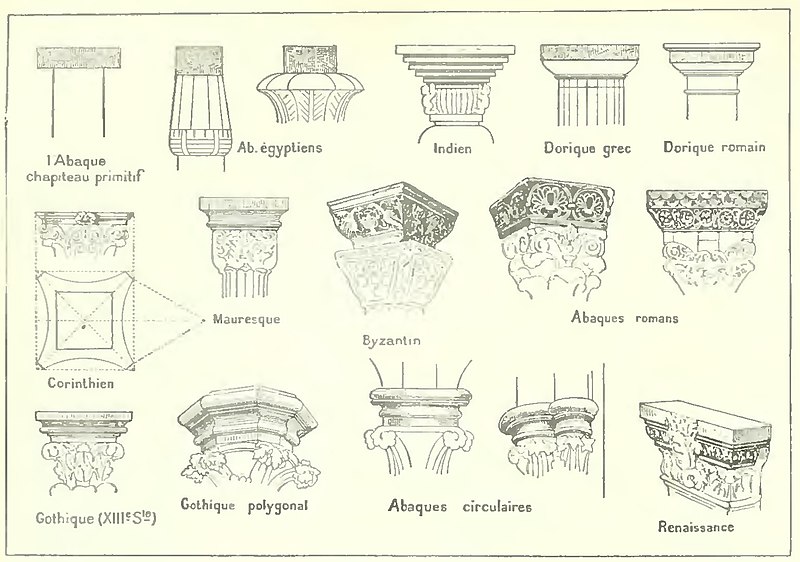
abacus
architectural term; flat slab forming the uppermost member or division of the capital of a column

corbel
In architecture, a corbel is a structural piece of stone, wood or metal keyed into and projecting from a wall to carry a bearing weight, a type of bracket. A corbel is a solid piece of material in the wall, whereas a console is a piece applied to the structure. A piece of timber projecting in the same way was called a "tassel" or a "bragger" in England.
thumb|An interior look at the roof of a corbelled house in South Africa
The technique of corbelling, where rows of corbels deeply keyed inside a wall support a projecting wall or parapet, has been used since Neolithic (New Stone Age) times. It

pergola
thumb|Rose Pergola at Kew Gardens, London|alt=A open-topped passageway of brick pillars and wooden beams with roses growing around in a garden setting under a blue sky with fluffy clouds

mansard roof
four-sided gambrel-style hip roof

transept
thumb|300x300px|Cathedral ground plan. The shaded area is the transept; the darker shading at the centre represents the Crossing (architecture)|crossing.
thumb|South transept at Kilcooly Abbey, [[County Tipperary, Ireland]]

trompe-l'œil
upright=1.3|thumb|Ceiling of the Treasure Room of the National Archaeological Museum of Ferrara |Archaeological Museum of Ferrara, [[Italy, painted in 1503–1506]]

loggia
thumb|200px|The Renaissance three-story arcade loggia of the City Hall in [[Poznań, Poland, served representative and communication purposes.]]
thumb|right|Villa Godi by [[Palladio. The portico is the focal point in the center with loggias used at each side of the structure as a corridor.]]

narthex
thumb|Plan of a Western cathedral, with the narthex in the shaded area at the Liturgical east and west|western end.
The narthex is an architectural element typical of early Christian and Byzantine basilicas and churches consisting of the entrance or vestibule, located at the west end of the nave, opposite the church's main altar. Traditionally the narthex was a part of the church building, but was not considered part of the church proper.

buttress
thumb|Buttresses of Miag-ao Church, [[Philippines]]

dormer
thumb|upright=1.2|Dormer window of the Building of Préfecture de police de Paris (île de la Cité)
thumb|upright=1.2|Gable dormers at Hospices de Beaune in Beaune, France
thumb|upright=1.2|Pair of hip roof dormer windows on the Howard Memorial Hall, [[Letchworth]]
tympanum
architectural element; the vertical, triangular space enclosed by the horizontal and raking cornices of a pediment
.png)
baldachin
thumb|Drawing of a baldachin over a throne, placed on a [[dais]]
thumb|Marie Antoinette's bed, which has a baldachin, in the Petit Trianon (Versailles, France)
thumb|Enthroned Virgin Mary with cloth of honour by [[Hans Memling]]
thumb|State bed of Louis XIV of France, Chambre du Roi, Versailles
A baldachin, or baldaquin (from ), is a canopy of state typically placed over an altar or throne. It had its beginnings as a cloth canopy, but in other cases it is a sturdy, permanent architectural feature, particularly over high altars in cathedrals, where such a structure is more correctly called a ci

niche
architectural recess in a wall
pier
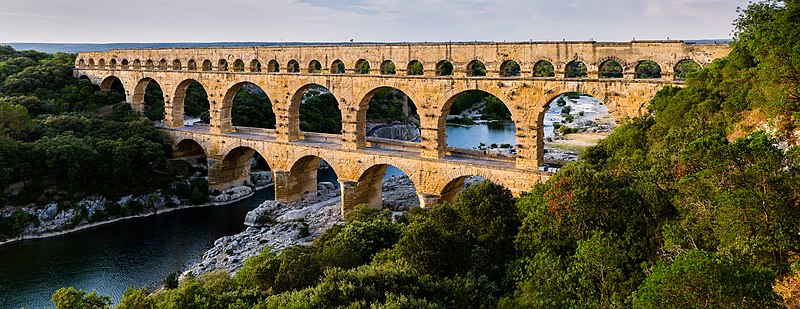
architectural upright support for a structure or superstructure
pylon
monumental gateway of an Egyptian temple

lintel
thumb|225px|Structural lintel
thumb|225px|Lintel above a door in Paris
A lintel or lintol is a type of beam (a horizontal structural element) that spans openings such as portals, doors, windows and fireplaces. It can be a decorative architectural element, or a combined ornamented/structural item. In the case of windows, the bottom span is referred to as a sill, but, unlike a lintel, does not serve to bear a load to ensure the integrity of the wall.
Modern-day lintels may be made using prestressed concrete and are also referred to as beams in beam-and-block slabs or as ribs in rib-and-block sla
terrace
external, raised, open, flat area in architecture

mezzanine
thumb|The mezzanine of the Maastricht Centre Céramique
thumb|right|View of the mezzanine in the lobby of the former Capitol Cinema (Ottawa)|Capitol Cinema, Ottawa, Ontario, [[Canada]]
thumb|right|A structural steel mezzanine used for industrial storage
thumb|right|The mezzanine of Basarrate (Bilbao metro)|Basarrate station in [[Bilbao metro]]
A mezzanine (; or in Italian, mezzanino; mezzo means 'half' in Italian) is an intermediate floor in a building which is partly open to the double-height ceilinged floor below, or which does not extend over the whole floorspace of the building. However, th

keystone
architectural element: wedge-shaped stone of an arch

gable
thumb|A single-story house with three gables, although only two can be seen (highlighted in yellow). This arrangement is a crossed gable roof.
thumb|Gable in Finland
thumb|Decorative gable roof at 176–178 St. John's Place, between Sixth and Seventh Avenue in the Park Slope neighborhood of [[Brooklyn, New York City]]

porch
thumb|Southern façade of the [[Chartres Cathedral, which features both Romanesque and High Gothic architectural styles]]
thumb|Main porch of the Natural History Museum, London|Natural History Museum, 1881, designed by [[Alfred Waterhouse]]

baluster
thumb|upright|Illustration of various examples of balusters, in A Handbook of Ornament, by Franz S. Meyer
thumb|upright|The term derives from the swelling form of the half-open flower of Punica granatum, in Italian balaustra

truss
thumb|Truss bridge for a single-track railway, converted to pedestrian use and pipeline support. In this example the truss is a group of triangular units supporting the bridge.
thumb|Typical detail of a steel truss, which is considered as a revolute joint
thumb|Historical detail of a steel truss with an actual revolute joint
A truss is an assembly of members such as beams, connected by nodes, that creates a rigid structure.

rain gutter
component of a water discharge system for a building

decorative art
arts or crafts concerned with the design and manufacture of functional, beautiful objects

gabion
thumb|An batter (walls)|inclined stacked wall of gabions supporting a multilane roadway
thumb|Gabions as X-ray protection during [[customs inspection]]

parapet
thumb|upright=1.35|The Battlement|crenellated parapet on a bastion of [[Kyrenia Castle, Cyprus]]
A parapet is a barrier that is an upward extension of a wall at the edge of a roof, terrace, balcony, walkway or other structure. The word derives from the Italian parapetto (parare 'to cover/defend' and petto 'chest/breast'). Where extending above a roof, a parapet may simply be the portion of an exterior wall that continues above the edge line of the roof surface, or may be a continuation of a vertical feature beneath the roof such as a fire wall or party wall. Parapets were originally used to de
dry stone walling
mortarless masonry method

wrought iron
iron alloy with a very low carbon content and with fibrous slag inclusions, worked with hammers or dies

pedestal
A pedestal, or plinth is a support at the bottom of a statue, vase, column, or certain altars. Smaller pedestals, especially if round in shape, may be called socles. In civil engineering, it is also called basement. The minimum height of the plinth is usually kept as 45 cm (for buildings). It transmits loads from superstructure to the substructure and acts as the retaining wall for the filling inside the plinth or raised floor.

fluting
architectural practice of cutting grooves through an otherwise plain surface

laurel wreath
wreath made of branches and leaves of the bay laurel