Category
page 1Arguments
.svg)
argument
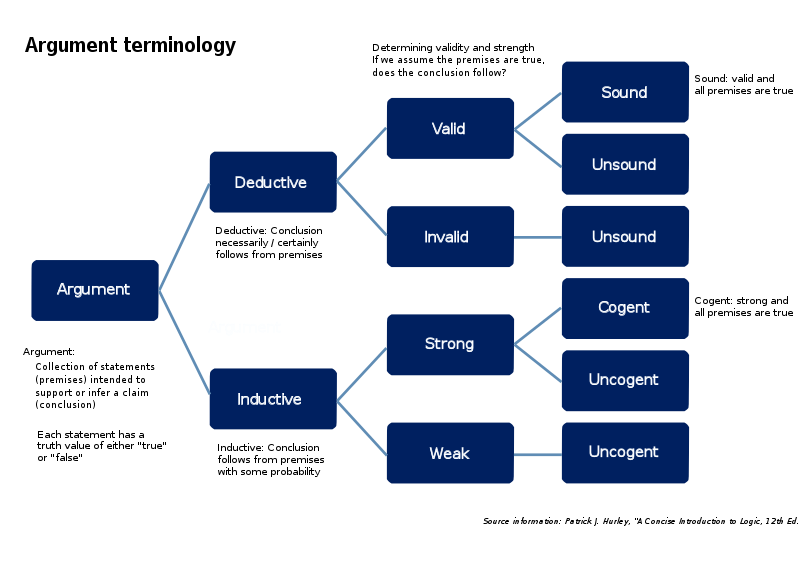
An argument is one or more premises—sentences, statements, or propositions—directed towards arriving at a logical conclusion. The purpose of an argument is to give reasons for one's thinking and understanding via justification, explanation, or persuasion. As a series of logical steps, arguments are intended to determine or show the degree of truth or acceptability of a logical conclusion.

syllogism
A syllogism (, syllogismos, 'conclusion, inference') is a kind of logical argument that applies deductive reasoning to arrive at a conclusion based on two propositions that are asserted or assumed to be true.
inductive reasoning
method of reasoning in which a body of observations is synthesized to hypothesize a general principle

compromise
To compromise is to make a deal between different parties where each party gives up part of their demand. In arguments, compromise means finding agreement through communication, through a mutual acceptance of terms—often involving variations from an original goal or desires. Defining and finding the best possible compromise is an important problem in fields like game theory and the voting system.

premise
A premise or premiss is a proposition—a true or false declarative statement—used in an argument to prove the truth of another proposition called the conclusion. Arguments consist of a set of premises and a conclusion.
.jpg)
dilemma
thumb|Cartoon showing William Ewart Gladstone in a dilemma: If he climbs to escape the guard dog he will face the man's wrath, but if he drops to avoid the man, the dog will attack him.
reductio ad absurdum
form of argument in informal logic
Cantor's diagonal argument
proof technique in set theory
argumentation theory
study of how conclusions are reached through logical reasoning; one of four rhetorical modes
validity
logical correctness of an argument's steps, regardless of the truth of the premises
reason
consideration which justifies or explains
soundness
In logic, soundness can refer to either a property of arguments or a property of formal deductive systems.
Argumentum a fortiori
argument from a yet stronger reason
philosophical razor
principle or rule of thumb that allows one to eliminate unlikely explanations for a phenomenon
informal fallacy
form of incorrect argument in natural language
nothing-to-hide argument
argument that one doesn't need privacy unless someone is doing something wrong
argumentum a contrario

Infant industry argument
Industrial policy
objection
reason arguing against a premise, argument, or conclusion; expression of disagreement
Loki's wager
unreasonable insistence that a concept cannot be defined, and therefore cannot be discussed
logical form
form for logical arguments, obtained by abstracting from the subject matter of its content terms
argument diagram
visual diagram of structured arguments

pragma-dialectics
Pragma-dialectics (also known as the pragma-dialectical theory) is a program in argumentation theory developed since the late 1970s by Dutch scholars Frans H. van Eemeren and Rob Grootendorst at the University of Amsterdam. It conceives argumentation as a form of goal-directed communicative activity aimed at the reasonable resolution of differences of opinion by means of a critical discussion. Combining a pragmatic interest in how argumentative discourse is actually used with a dialectical interest in how it ought to proceed, pragma-dialectics studies argumentation as a complex speech act that
strategy-stealing argument
argument in combinatorial game theory
ugly duckling theorem
an argument showing that classification is not really possible without some sort of bias
rebuttal
In law, rebuttal is a form of evidence that is presented to contradict or nullify other evidence that has been presented by an adverse party. By analogy the same term is used in politics and public affairs to refer to the informal process by which statements, designed to refute or negate specific arguments (see Counterclaim) put forward by opponents, are deployed in the media.
statistical syllogism
non-deductive syllogism