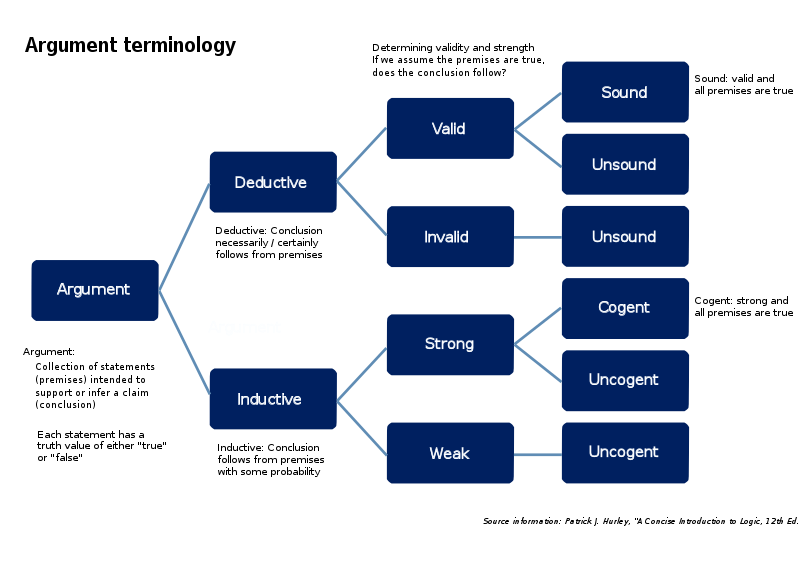
File:Argument_terminology_used_in_logic_(en).svg · Wikimedia Commons · See Wikimedia Commons
argument
Sign in to saveAlso known as logical argument
An argument is one or more premises—sentences, statements, or propositions—directed towards arriving at a logical conclusion. The purpose of an argument is to give reasons for one's thinking and understanding via justification, explanation, or persuasion. As a series of logical steps, arguments are intended to determine or show the degree of truth or acceptability of a logical conclusion.
An argument is a series of statements or premises that are put together to support a conclusion by providing reasons or evidence. Arguments matter because they help us justify our thinking, explain our ideas to others, and determine how true or acceptable our conclusions actually are.
AI-generated from the Wikipedia summary — may contain errors.
Wikidata facts
- Subclass of
- message
Show 6 more facts
- different from
- argument
- topic's main category
- Category:Arguments
- Commons category
- Arguments
- has goal
- persuasion
- has characteristic
- validity
- on focus list of Wikimedia project
- Wikipedia:Vital articles/Level/4
via Wikidata · CC0
~22 min read
Encyclopedic overview
20 sectionsContents
- Etymology
- Formal and informal
- Standard logical account of argument types
- Deductive arguments
- Validity
- Soundness
- Inductive arguments
- Defeasible arguments and argumentation schemes
- By analogy
- Other kinds
- World-disclosing
- Explanations
- Fallacies and non-arguments
- Elliptical or ethymematic arguments
- Argument mining
- See also
- Notes
- References
- Further reading
- External links
An argument is one or more premises—sentences, statements, or propositions—directed towards arriving at a logical conclusion. The purpose of an argument is to give reasons for one's thinking and understanding via justification, explanation, or persuasion. As a series of logical steps, arguments are intended to determine or show the degree of truth or acceptability of a logical conclusion.
The process of crafting or delivering arguments, argumentation, can be studied from three main perspectives: through the logical, the dialectical, and the rhetorical perspective.
Excerpted from Wikipedia’s “argument” article, available under the CC BY-SA 4.0 licence.
Gallery (2)
Available in 63 languages
- Español
- Français
- Deutsch
- 中文
- 日本語
- Русский
- Português
- Italiano
- العربية
- हिन्दी
- Albanian
- Assamese
- Asturian
- Azerbaijani
- Bahasa Indonesia
- Basque
- Belarusian
- Betawi
Show 44 more
- Catalan
- Central Kurdish
- Croatian
- Czech
- Danish
- Esperanto
- Estonian
- Finnish
- Galician
- Georgian
- Greek
- Hebrew
- Hungarian
- Ido
- Kazakh
- Latin
- Latvian
- Lithuanian
- Macedonian
- Malay
- Mingrelian
- mnw
- Nederlands
- Norwegian
- Pashto
- Polski
- Romanian
- Serbian
- Serbian (Latin)
- simple
- Sindhi
- Slovak
- Slovenian
- Sundanese
- Svenska
- Tamil
- Tiếng Việt
- Türkçe
- Ukrainian
- Wu Chinese
- zh_yue
- فارسی
- ไทย
- 한국어
via Wikidata sitelinks · CC0