Category
page 1Arthropod classes

Malacostraca
Malacostraca is the second largest of the six classes of pancrustaceans behind insects, containing about 40,000 living species, divided among 16 orders. Its members, the malacostracans, display a great diversity of body forms and include crabs, lobsters, spiny lobsters, crayfish, shrimp, krill, prawns, isopods, amphipods, mantis shrimp, and many other less familiar animals. They are abundant in all marine environments and have colonised freshwater and terrestrial habitats. They are segmented animals, united by a common body plan comprising 20 body segments (rarely 21), and divided into a head,

Branchiopoda
Branchiopoda (from Ancient Greek βράγχια (bránkhia), meaning "gill", and πούς (poús), meaning "foot") is a class of crustaceans. It comprises fairy shrimp, clam shrimp, Diplostraca (or Cladocera), Notostraca, the Devonian Lepidocaris and possibly the Cambrian Rehbachiella. They are mostly small, freshwater animals that feed on plankton and detritus.

Pycnogonida
class of marine arthropods
%20(10353381334).jpg)
Entognatha
thumb|

Merostomata
Merostomata is a class of chelicerate arthropods that contains the extinct Eurypterida (sea scorpions) and the extant Xiphosura (horseshoe crabs). The term was originally used by James Dwight Dana to refer to Xiphosura only, but was emended by Henry Woodward to cover both groups.

Symphyla
Symphylans, also known as garden centipedes or pseudocentipedes, are soil-dwelling arthropods of the class Symphyla in the subphylum Myriapoda. Symphylans resemble centipedes but are very small, non-venomous, and may or may not form a clade with centipedes. More than 200 species are known worldwide.

Pauropoda
Pauropoda is a class of small, pale, millipede-like arthropods in the subphylum Myriapoda. More than 900 species in twelve families are found worldwide, living in soil and leaf mold. Pauropods look like centipedes or millipedes and may be a sister group of the latter, but a close relationship with Symphyla has also been posited. The name Pauropoda derives from the Greek pauros (meaning "small" or "few") and pous, genitive podos (meaning "foot"), because most species in this class have only nine pairs of legs as adults, a smaller number than those found among adults in any other class of myriap
Remipedia
Remipedia is a class of blind crustacean-like animals, closely related to hexapods. They are found in coastal aquifers which contain saline groundwater, with populations identified in almost every ocean basin so far explored, including in Australia, the Caribbean Sea, and the Atlantic Ocean. The first described remipede was the fossil Tesnusocaris goldichi (Lower Pennsylvanian). Since 1979, at least seventeen living species have been identified in subtropical regions around the world.
Cephalocarida
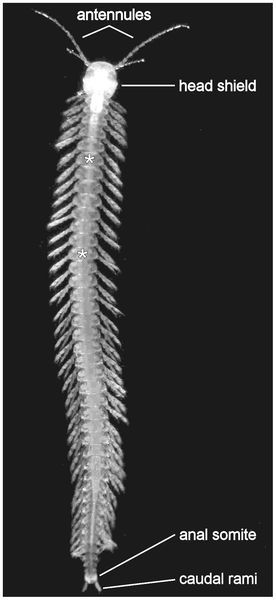
The Cephalocarida (from Ancient Greek κεφαλή (kephalḗ), meaning "head", and καρίς (karís), meaning "shrimp") are a class in the subphylum Crustacea comprising only 12 species. Both the nauplii and the adults are benthic. They were discovered in 1955 by Howard L. Sanders, and are commonly referred to as horseshoe shrimp. They have been grouped together with the Remipedia in the Xenocarida. Although a second family, Lightiellidae, is sometimes used, all cephalocaridans are generally considered to belong in just one family: Hutchinsoniellidae. Fossil records of cephalocaridans have been found in
Thecostraca
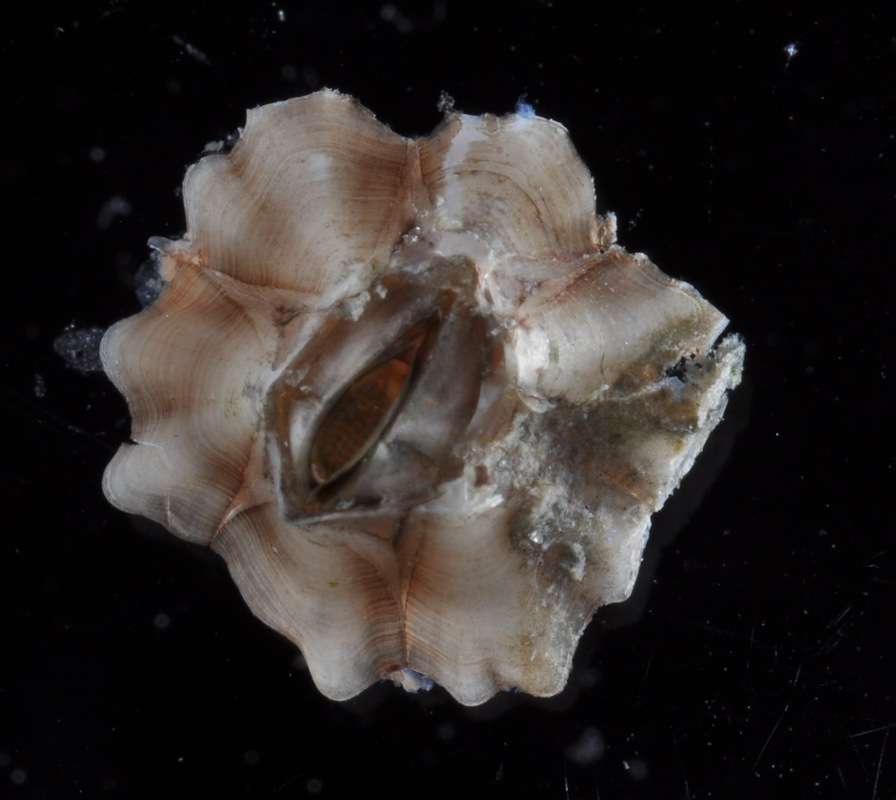
Thecostraca () is a class of marine invertebrates containing over 2,200 described species. Many species have planktonic larvae which become sessile or parasitic as adults.

Dinocaridida
Dinocaridida is a proposed fossil taxon of basal arthropods, which flourished during the Cambrian period and survived up to Early Devonian. Characterized by a pair of frontal appendages and series of body flaps, the name of Dinocaridids (Greek for deinos "terrible" and Latin for caris "crab") refers to the suggested role of some of these members as the largest marine predators of their time. Dinocaridids are occasionally referred to as the 'AOPK group' by some literatures, as the group composed of Radiodonta (Anomalocaris and relatives), Opabiniidae (Opabinia and relatives), and the "gilled lo

Megacheira
Megacheira (from Ancient Greek μέγας (mégas), meaning "great", and χείρ (kheír), meaning "hand", also historically great appendage arthropods) is an extinct class of predatory arthropods defined by their possession of spined "great appendages". Their taxonomic position is controversial, with studies generally either considering them stem-group euarthropods, or stem-group chelicerates. The homology of the great appendages to the cephalic appendages of other arthropods is also controversial. Uncontested members of the group were present in marine environments worldwide from the lower Cambrian to
Hexanauplia
The Hexanauplia is a clade proposed by Oakley et al. (2013) that constitutes a class of crustaceans, comprising the Copepoda and Thecostraca. A number of recent phylogenomic studies have not found support for this clade, with some supporting the alternative clade of Communostraca comprising Thecostraca and Malacostraca.

Marrellomorpha
Marrellomorpha are an extinct group of arthropods known from the Cambrian to the Early Devonian. It is divided into two major groups, Marrellida and Acercostraca. They lacked mineralised hard parts, so are only known from areas of exceptional preservation, limiting their fossil distribution. The best known member is Marrella, with thousands of specimens found in the Cambrian aged Burgess Shale of Canada.
Ichthyostraca
Ichthyostraca is a class of parasitic crustaceans. It is composed of two subclasses; Pentastomida and Branchiura. They mainly parasitize various vertebrates and feed on their blood or mucus.

Thylacocephala
Thylacocephala (from the Greek or ', meaning "pouch", and or ' meaning "head") is an extinct group of mandibulate arthropods, that are generally regarded as a kind of crustacean, though their exact position within this group is uncertain. As a class they have a short research history, having been erected in the early 1980s.