Category
page 1Atomic physics

boson
thumb|upright=1.6|The class of Bosons is one of the two fundamental classes of subatomic particle, the other being [[fermions. All subatomic particles must be one or the other. A composite particle (hadron) may fall into either class depending on its composition.]]

atomic physics
field of physics studying atoms
Bohr model
atomic model introduced by Niels Bohr in 1913
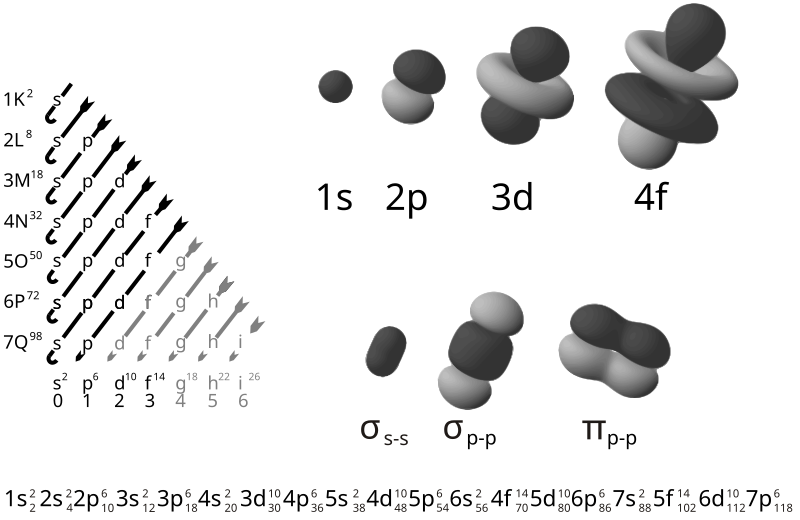
electron configuration
mode of arrangement of electrons in different shells of an atom

ionization
alt=The solar wind moving through the magnetosphere alters the movements of charged particles in the Earth's thermosphere or exosphere, and the resulting ionization of these particles causes them to emit light of varying colour, thus forming auroras near the polar regions.|thumb|201x201px|The solar wind moving through the [[magnetosphere alters the movements of charged particles in the Earth's thermosphere or exosphere, and the resulting ionization of these particles causes them to emit light of varying color, thus forming auroras near the polar regions.]]
Ionization or ionisation is the proce

ionization energy
minimum amount of energy required to remove an electron from an atom or molecule in the gaseous state

atomic orbital
mathematical function describing the location and behavior of an electron within an atom

electron shell
principal energy levels in atomic physics
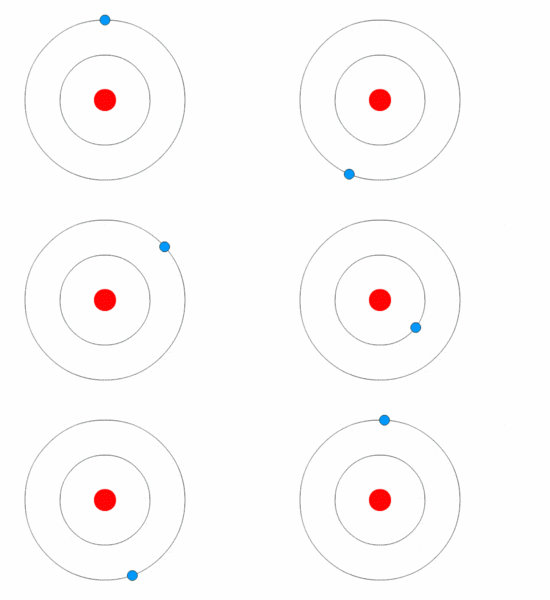
History of atomic theory
history of scientific theory that views matter as made up of atoms of chemical elements

emission spectrum
frequencies of light emitted by atoms or chemical compounds

scattering
thumb|A wine glass in an [[LCD projector's light beam makes the beam scatter.]]
In physics, scattering is a wide range of physical processes where moving particles or radiation of some form, such as light or sound, are forced to deviate from a straight trajectory by localized non-uniformities (including particles and radiation) in the medium through which they pass. In conventional use, this also includes deviation of reflected radiation from the angle predicted by the law of reflection. Reflections of radiation that undergo scattering are often called diffuse reflections and unscattered refle

energy level
different states of quantum systems

electron affinity
amount of energy released when an electron is attached to a neutral atom or molecule in the gaseous state to form a negative ion

Compton scattering
scattering of a photon off of a charged particle
Fraunhofer lines
spectral lines of the Sun

thermionic emission
thermally induced flow of charge carriers from a surface

Bohr radius
physical constant; the most probable distance between an electron and the nucleus in a nonrelativistic model of the hydrogen atom with infinitely heavy nucleus

bremsstrahlung
thumb|upright|Bremsstrahlung produced by a high-energy electron deflected in the electric field of an atomic nucleus
Auger effect
physical phenomenon in which the filling of an inner-shell vacancy of an atom is accompanied by the emission of an electron from the same atom
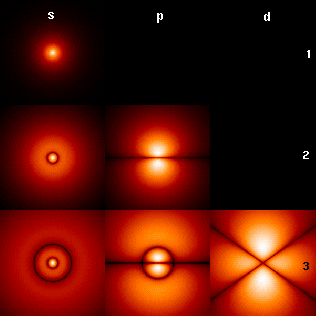
azimuthal quantum number
quantum number for an atomic orbital that determines its orbital angular momentum and describes the shape of the orbital, and is symbolized as ℓ
cross section
measure of probability that a specific process will take place in a collision of two particles
principal quantum number
one of four quantum numbers which are assigned to each electron in an atom to describe that electron's state
Bohr magneton
unit of magnetic moment (approx. 9.2 J/T); the magnetic dipole moment of an electron orbiting an atom with angular momentum ℏ in the Bohr model
Stark effect
energy level splitting via a static electric field
Hund's rules
set of three rules proposed by physicist Friedrich Hund
hyperfine structure
small shifts and splittings in the energy levels of atoms, molecules and ions
gyromagnetic ratio
ratio of magnetic dipole moment to total angular momentum
fine structure
details in the emission spectrum of an atom
spherical harmonic
special function over the surface of a sphere
Rydberg formula
formula for spectral line wavelengths in alkali metals
magnetic quantum number
third in a set of four quantum numbers that distinguishes the orbitals available within a subshell and can be used to calculate the azimuthal component of the orientation of orbital in space
laser cooling
variety of techniques where atomic samples are cooled via interacting with lasers
Moseley's law
empirical law concerning the characteristic x-rays that are emitted by atoms
Larmor precession
Physical phenomenon
Thomson scattering
scattering of electromagnetic radiation by a free charged particle

polarizability
Polarizability usually refers to the tendency of matter, when subjected to an electric field, to acquire an electric dipole moment in proportion to that applied field. It is a property of particles with an electric charge. When subject to an electric field, the negatively charged electrons and positively charged atomic nuclei are subject to opposite forces and undergo charge separation. Polarizability is responsible for a material's dielectric constant and, at high (optical) frequencies, its refractive index.
X-ray fluorescence
emission of characteristic "secondary" X-rays from a material that has been excited by high-energy X-rays or gamma rays
Compton wavelength
in quantum mechanics, the wavelength of a photon whose energy is the same as the rest energy of a particle

H-alpha
thumb|In the Bohr model of the hydrogen atom, the electron transition from energy level n = 3 to n = 2 results in the emission of an H-alpha photon.
spin quantum number
quantum number parameterizing spin and angular momentum

muonium
alt=Simplified drawing of the muonium atom|thumb|300x300px|A muonium atom
Penning trap
device for the storage of charged particles
classical electron radius
physical constant providing length scale to interatomic interactions
electron density
probability density of electrons being somewhere
spin–orbit interaction
relativistic interaction of a particle's spin with its motion inside a potential
Saha ionization equation
relation between ionization state of a gas to the temperature and pressure
atomic units
system of measurement
shielding effect
decrease in attraction between an electron and the nucleus
associated Legendre polynomials
canonical solutions of the general Legendre equation
relativistic quantum mechanics
quantum mechanics taking into account particles near or at the speed of light
Larmor formula
formula used to calculate the total power radiated by a non relativistic point charge as it accelerates
Landé factor
g-factor for electron with spin and orbital angular momentum
g-factor
Relation between observed magnetic moment of a particle and the related unit of magnetic moment
inert pair effect
The reluctance of 'ns' pair of electrons to take part in bond formation
Rabi cycle
quantum mechanical phenomenon
Hollow-cathode lamp
spectral line source used in physics and chemistry
core electron
electrons in an atom's inner shells, which do not participate in chemical bonding
total angular momentum quantum number
quantum number describing the total angular momentum of an atom
Slater's rules
semi-empirical rules for quantum chemistry
term symbol
in quantum physics, an abbreviated description of the total spin and orbital angular momentum quantum numbers of the electrons in a multi-electron atom