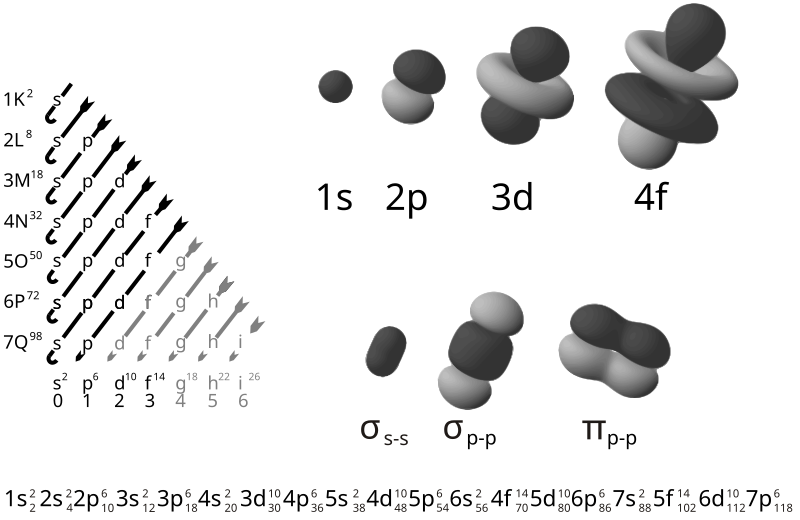
File:Electron_orbitals.svg · Wikimedia Commons · See Wikimedia Commons
electron configuration
Sign in to saveAlso known as atomic electron configuration
mode of arrangement of electrons in different shells of an atom
An electron configuration is the way electrons are arranged in the different shells surrounding an atom's nucleus. Understanding how electrons are positioned in these shells matters because it determines how atoms behave chemically and interact with other atoms.
AI-generated from the Wikipedia summary — may contain errors.
Described at
Electron Configurations
chem.fsu.edu →Electron configurations are the summary of where the electrons are around a nucleus. As we learned earlier, each neutral atom has a number of electrons equal to its number of protons. What we will do now is place those electrons into an arrangement around the nucleus that indicates their energy and the shape of the orbital in which they are located. Here is a summary of the types of orbitals and how many electrons each can contain: The order in which electrons are placed into the orbitals is based on the order of their energy. This is referred to as the Aufbau principle. The lowest energy orbitals fill first. Just like the quantum numbers themselves this order was determined by calculation and is summarized by the following chart: The symbols used for writing the electron configuration start with the shell number (n) followed by the type of orbital and finally the superscript indicates how many electrons are in the orbital. Configurations of ions present a special case of electron configuration and also demonstrate the reason for the formation of those ions in the first place. If you need to write the full electron configuration for an anion , then you are just adding additional electrons and the configuration is simply continued. For example, we know that Oxygen always forms 2- ions when it makes an ion. This would add 2 electrons to its normal configuration making the new configuration: O2- 1s22s22p6 . With 10 electrons you should note that oxygen's electron configuration is now exactly the same as Neon's. We talked about the fact that ions form because they can become more stable with the gain or loss of electrons to become like the noble gases and now you can actually see how they become the same. The electron configurations for Cations are also made based on the number of electrons but there is a slight difference in the way they are configured. First you should write their normal electron configuration and then when you remove electrons you have to take them from the outermost shell. Note that this is not always the same way they were added. One other note on writing electron configurations: A short cut. When writing some of the lower table configurations the total configuration can be fairly long. In these cases, you can use the previous noble gas to abbreviate the configuration as shown below. You just have to finish the configuration from where the noble gas leaves it: As with every other topic we have covered to date there are exceptions to the order of fill as well. But based on the electron configurations that are generated, these exceptions are easy to understand. In the d block, specifically the groups containing Chromium and Copper, there is an exception in how they are filled. The boxes are used to represent the orbitals and to show the electrons placed in them. The order of fill is the same but as you can see from above the electrons are placed singly into the boxes before filling them with both electrons. This is called Hund's Rule: "Half fill before you Full fill" and again this rule was established based on energy calculations that indicated that this was the way atoms actually distributed their electrons into the orbitals. One of the really cool things about electron configurations is their relationship to the periodic table. Basically the periodic table was constructed so that elements with similar electron configurations would be aligned into the same groups (columns). The periodic table shown above demonstrates how the configuration of each element was aligned so that the last orbital filled is the same except for the shell. The reason this was done is that the configuration of an element gives the element its properties and similar configurations yield similar properties. The size of atoms increases going down in the periodic table. This should be intuitive since with each row of the table you are adding a shell (n). What is not as intuitive is why the size decreases from left to right. Bu
Excerpt from a page describing this subject · 10,017 chars · not written by Vinony
Wikidata facts
- Subclass of
- quality
- Depicts
- electron shell
- Image
- Electron orbitals crop.svg
Show 3 more facts
- Commons category
- Electron configurations
- on focus list of Wikimedia project
- Wikipedia:Vital articles/Level/4
via Wikidata · CC0
~30 min read
Encyclopedic overview
Electron atomic and molecular orbitals A Bohr diagram of lithium
In atomic physics and quantum chemistry, the electron configuration is the distribution of electrons of an atom or molecule (or other physical structure) in atomic or molecular orbitals. For example, the electron configuration of the neon atom is 1s 2s 2p, meaning that the 1s, 2s, and 2p subshells are occupied by two, two, and six electrons, respectively.
Excerpted from Wikipedia’s “electron configuration” article, available under the CC BY-SA 4.0 licence.
Gallery (8)
Available in 72 languages
- Español
- Français
- Deutsch
- 中文
- 日本語
- Русский
- Português
- Italiano
- العربية
- हिन्दी
- Afrikaans
- Aragonese
- Asturian
- Bahasa Indonesia
- Bangla
- Basque
- Belarusian
- Bosnian
Show 53 more
- Bulgarian
- Catalan
- Chuvash
- Croatian
- Czech
- Danish
- Esperanto
- Estonian
- Finnish
- Galician
- Georgian
- Greek
- Hebrew
- Hungarian
- Icelandic
- Irish
- Javanese
- Kannada
- Latvian
- Lithuanian
- Low German
- Macedonian
- Malay
- Malayalam
- Manx
- Mongolian
- Nederlands
- Norwegian
- Occitan
- Polski
- Punjabi
- Romanian
- Serbian
- Serbian (Latin)
- simple
- Sinhala
- Slovak
- Svenska
- Tamil
- Tiếng Việt
- Türkçe
- Ukrainian
- Urdu
- Uzbek
- Welsh
- Wu Chinese
- Yakut
- Yiddish
- zh_classical
- zh_yue
- فارسی
- ไทย
- 한국어
via Wikidata sitelinks · CC0