Category
page 1Blood products
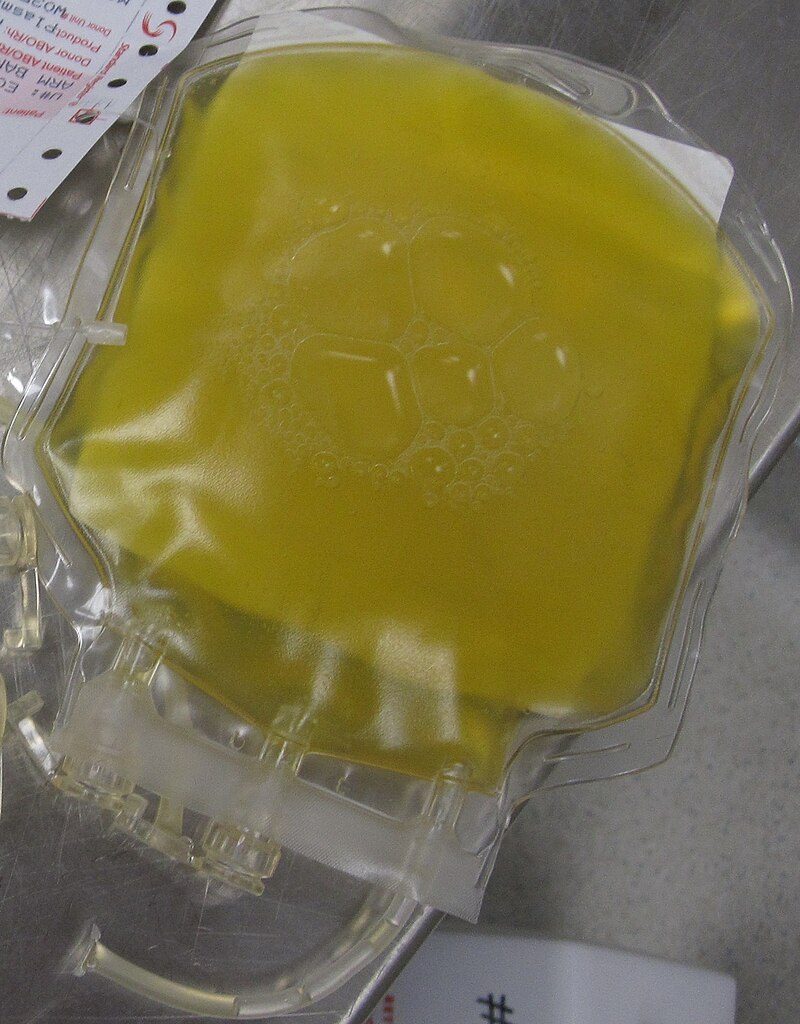
blood plasma
liquid component of blood

platelet
Platelets or thrombocytes () are a part of blood whose function (along with the coagulation factors) is to react to bleeding from blood vessel injury by clumping to form a blood clot. Platelets have no cell nucleus; they are fragments of cytoplasm from megakaryocytes which reside in bone marrow or lung tissue, and then enter the circulation. Platelets are found only in mammals, whereas in other vertebrates (e.g. birds, amphibians), thrombocytes circulate as intact mononuclear cells.

plasmapheresis
Plasmapheresis (from the Greek πλάσμα, plasma, something molded, and ἀφαίρεσις aphairesis, taking away) is the removal, treatment, and return or exchange of blood plasma or components thereof from and to the blood circulation. It is thus an extracorporeal therapy, a medical procedure performed outside the body.
blood product
therapeutic substance prepared from human blood
packed red blood cell
red blood cells separated for blood transfusion
platelet-rich plasma
concentrate of platelet-rich plasma protein derived from whole blood
fresh frozen plasma
frozen plasma, used in medical labs
whole blood
unseparated donated human blood
platelet transfusion
treatment for bleeding irregularities
prothrombin complex concentrate
chemical compound
cryoprecipitate
Cryoprecipitate, also called cryo for short, or Cryoprecipitate Antihemophilic factor (AHF), is a frozen blood product prepared from blood plasma. To create cryoprecipitate, plasma is slowly thawed to 1–6 °C. A cold-insoluble precipitate is formed, which is collected by centrifugation, resuspended in a small amount of residual plasma (generally 10–15 mL) and then re-frozen for storage. Cryoprecipitate contains fibrinogen, Factor VIII, Factor XIII and vWF. In many clinical contexts, use of cryoprecipitate has been replaced with use of clotting factor concentrates (where available), but the
hepatitis B immune globulin
pharmaceutical drug