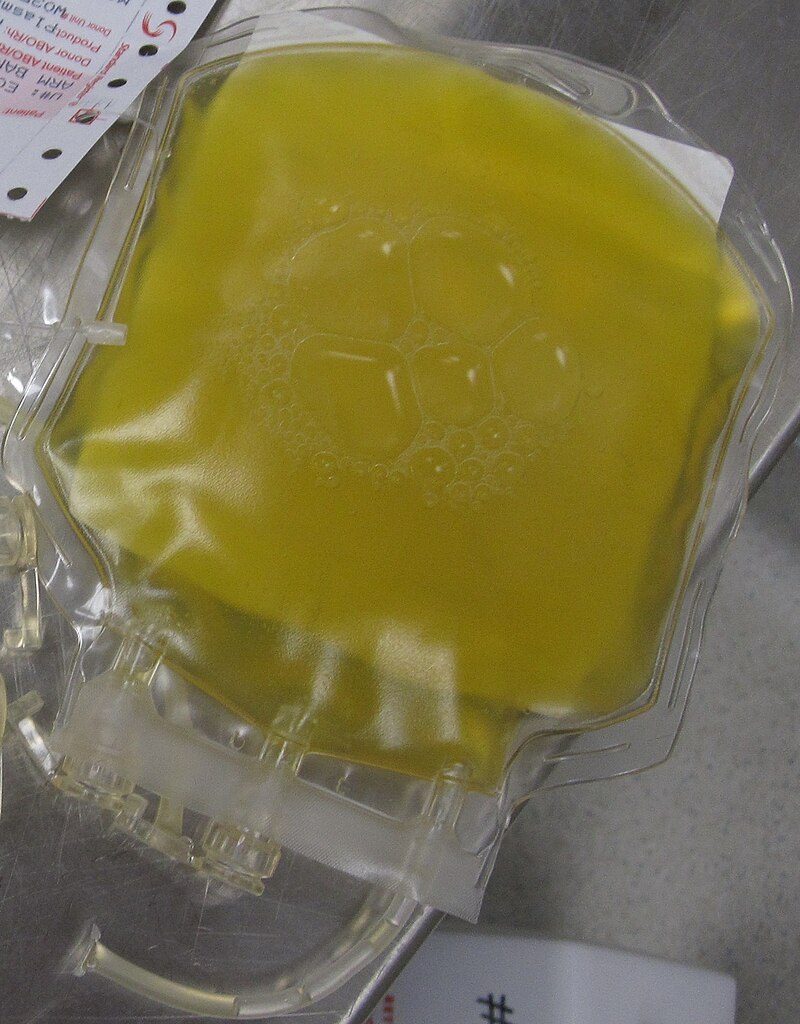
File:FreshFrozenPlasma.JPG · Wikimedia Commons · See Wikimedia Commons
Blood plasma is the yellowish liquid part of your blood that carries water, nutrients, proteins, and other substances throughout your body. It matters because it keeps your blood cells suspended and circulating, and delivers essential materials to your organs and tissues while removing waste products.
AI-generated from the Wikipedia summary — may contain errors.
Research
1,145,079 papers- Albumin Is an Integrative Protein of Blood Plasma and Beyond.International journal of molecular sciences · 2024Belinskaia DA, Jenkins RO, Goncharov NVDOI: 10.3390/ijms252312627
- A self-pressure-driven blood plasma-separation device for point-of-care diagnostics.Talanta · 2022Kim H, Park H, Chung DR et al.DOI: 10.1016/j.talanta.2022.123562
- The past, present and future of blood plasma fractionation.ReviewBiologicals : journal of the International Association of Biological Standardization · 2025Curling J, Farrugia A, von Bonsdorff LDOI: 10.1016/j.biologicals.2025.101849
- Thermodynamic Signatures of Blood Plasma Proteome in Neurodegenerative Pathologies.International journal of molecular sciences · 2023Danailova A, Todinova S, Gartcheva L et al.DOI: 10.3390/ijms24010789
- Smartphone-Enabled Quantification of Potassium in Blood Plasma.Sensors (Basel, Switzerland) · 2021Hidayat AS, Horino H, Rzeznicka IIDOI: 10.3390/s21144751
- Micro-scale blood plasma separation: from acoustophoresis to egg-beaters.Lab on a chip · 2013Kersaudy-Kerhoas M, Sollier EDOI: 10.1039/c3lc50432h
- Enhanced Blood Plasma Extraction Utilising Viscoelastic Effects in a Serpentine Microchannel.Biosensors · 2022Dai Y, Cha H, Simmonds MJ et al.DOI: 10.3390/bios12020120
- Carotenoid extraction and analysis from blood plasma/serum.Methods in enzymology · 2022Sholola MJ, Cooperstone JLDOI: 10.1016/bs.mie.2022.03.021
via PubMed
Wikidata facts
Show 5 more facts
- Commons category
- Blood plasma
- NCI Thesaurus ID
- C13356
- different from
- plasma
- studied by
- physician
- exact match
- purl.obolibrary.org/obo/ENVO_02000027
via Wikidata · CC0
~14 min read
Encyclopedic overview
A unit of donated fresh plasma
Blood plasma is a light amber-colored liquid component of blood in which blood cells are absent, but which contains proteins and other constituents of whole blood in suspension. It makes up about 55% of the body's total blood volume. It is the intravascular part of extracellular fluid (all body fluid outside cells). It is mostly water (up to 95% by volume), and contains important dissolved proteins (6–8%; e.g., serum albumins, globulins, and fibrinogen), glucose, clotting factors, electrolytes (Na , Ca , Mg , HCO3, Cl , etc.), hormones, carbon dioxide (plasma being the main medium for excretory product transportation), and oxygen. It plays a vital role in an intravascular osmotic effect that keeps electrolyte concentration balanced and protects the body from infection and other blood-related disorders.
Excerpted from Wikipedia’s “blood plasma” article, available under the CC BY-SA 4.0 licence.
Gallery (5)
Available in 85 languages
- Español
- Français
- Deutsch
- 中文
- 日本語
- Русский
- Português
- Italiano
- العربية
- हिन्दी
- Afrikaans
- Albanian
- Armenian
- Azerbaijani
- Bahasa Indonesia
- Bangla
- Basque
- Belarusian
Show 66 more
- Bosnian
- Bulgarian
- Catalan
- Central Kurdish
- Chuvash
- Croatian
- Czech
- Danish
- Egyptian Arabic
- Esperanto
- Estonian
- Finnish
- Galician
- Georgian
- Greek
- Haitian Creole
- Hakka Chinese
- Hebrew
- Hungarian
- Icelandic
- Ido
- Iloko
- Interlingua
- Irish
- Javanese
- Kazakh
- Kurdish
- Latin
- Latvian
- Lithuanian
- Low German
- Macedonian
- Malay
- Malayalam
- Marathi
- Moksha
- Mongolian
- Moroccan Arabic
- Nederlands
- Norwegian
- Norwegian Nynorsk
- Occitan
- Oromo
- Polski
- Romanian
- Rusyn
- Serbian
- Serbian (Latin)
- simple
- Slovak
- Slovenian
- Sundanese
- Svenska
- Tamil
- Telugu
- Tiếng Việt
- Türkçe
- Ukrainian
- Urdu
- Uzbek
- Welsh
- Wu Chinese
- zh_yue
- فارسی
- ไทย
- 한국어
via Wikidata sitelinks · CC0