Category
page 1Bodhisattvas

Dalai Lama
Tibetan Buddhist spiritual teacher

Nagarjuna
Nāgārjuna (, ; ) was an Indian philosopher and Mahāyāna Buddhist monk of the Madhyamaka (Centrism, Middle Way) school. Nāgārjuna is widely considered one of the most important Buddhist philosophers. He was the founder of the Madhyamaka school of Buddhist philosophy and a defender of the Mahāyāna movement. His Mūlamadhyamakakārikā (Root Verses on Madhyamaka, MMK) is the most important text on the Madhyamaka philosophy of emptiness. The MMK inspired a large number of commentaries in Sanskrit, Chinese, Tibetan, Korean and Japanese and continues to be studied today.

Bodhisattva
In Buddhism, a bodhisattva is a person who has attained, or is striving towards, bodhi ('awakening', 'enlightenment') or Buddhahood. Often, the term specifically refers to a person who forgoes or delays personal nirvana or bodhi in order to compassionately help other individuals reach Buddhahood.

Avalokiteśvara
In Buddhism, Avalokiteśvara (meaning "the Lord who looks down", ), also known as Lokeśvara ("Lord of the World") and Chenrezig (in Tibetan), is a Bodhisattva associated with Great Compassion (mahākaruṇā). Avalokiteśvara has a vast number of manifestations (e.g., the 108 forms of Avalokiteśvara) and is depicted in various forms and styles across Buddhist traditions of different cultures. In some texts, he is considered to be the source and divine creator of all Hindu deities (such as Vishnu, Shiva, Brahma, Saraswati, Bhudevi, Varuna, etc.). In Mahayana and Vajrayana Buddhism, Avalokiteśvara is

Amaterasu
, often called Amaterasu () for short, also known as and , is the goddess of the sun in Japanese mythology. Often considered the chief deity (kami) of the Shinto pantheon, she is also portrayed in Japan's earliest literary texts, the () and the (720 CE), as the ruler (or one of the rulers) of the heavenly realm Takamagahara and as the mythical ancestress of the Imperial House of Japan via her grandson Ninigi. Along with two of her siblings (the moon deity Tsukuyomi and the impetuous storm-god Susanoo) she ranks as one of the "Three Precious Children" (, ), the three most important offspring of

Maitreya
thumb|Schist Greco-Buddhist art|Greco-Buddhist statue of Maitreya, [[Gandhara, 3rd century]]

Padmasambhava
thumb|Rewalsar Lake#Colossus of Padmasambhava|Colossus of Padmasambhava, 123 ft. (37.5 m) high, in mist overlooking [[Rewalsar Lake, Himachal Pradesh, India]]

Susanoo
__FORCETOC__

Mañjuśrī
Manjushri () is a bodhisattva who represents prajñā (transcendent wisdom) of the Buddhas in Mahāyāna Buddhism. The name "Mañjuśrī" is a combination of Sanskrit word "mañju" and an honorific "śrī"; it can be literally translated as "Beautiful One with Glory" or "Beautiful One with Auspiciousness". Mañjuśrī is also known by the fuller name of Mañjuśrīkumārabhūta (), literally "Mañjuśrī, Still a Youth" or, less literally, "Prince Mañjuśrī". Another name of Mañjuśrī is Mañjughoṣa.

Nüwa
Nüwa, also read Nügua, is a mother goddess, culture hero, and/or member of the Three Sovereigns of Chinese mythology. She is a goddess in Chinese folk religion, Chinese Buddhism, Confucianism and Taoism. She is credited with creating humanity and repairing the Pillar of Heaven.

Milarepa
thumb|238px|A famous statue of Milarepa self made by Milerapa's root student Bhu Rechungpa which later belonged to Nyanang Phelgyeling Monastery, Tibet and now is in Phelgyeling Monastery, Nepal.
Jetsun Milarepa (, 1028/40–1111/23) was a Tibetan , who was famously known as a murderer when he was a young man, before turning to Buddhism and becoming a highly accomplished Buddhist disciple. He is generally considered one of Tibet's most famous yogis and spiritual poets, whose teachings are known among several schools of Tibetan Buddhism. He was a student of Marpa Lotsawa, and a major figure in th
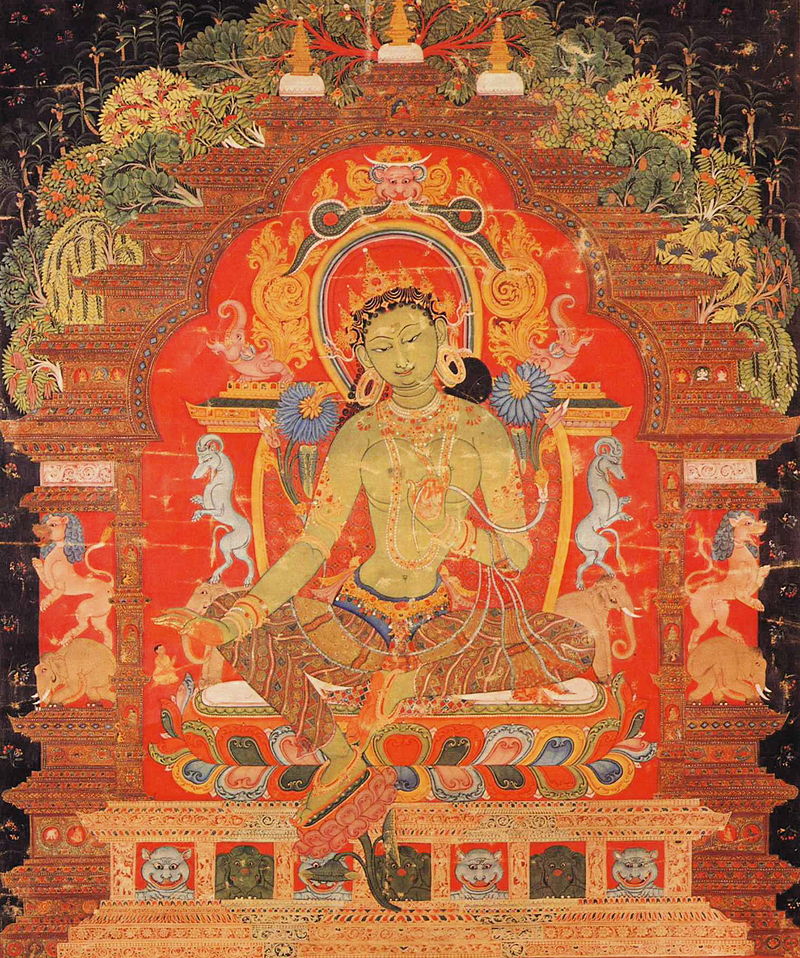
Tārā
female Bodhisattva
Shantideva
Shantideva (Sanskrit: Śāntideva; ; ; ; ) was an 8th-century CE Indian philosopher, Buddhist monk, poet, and scholar at the mahavihara of Nalanda. He was an adherent of the Mādhyamaka philosophy of Nāgārjuna. Abhayadatta Sri also lists Shantideva as one of the eighty-four mahasiddhas and is known as Bhusuku Pa (布苏固巴).

Mazu
Mazu or Matsu is a sea goddess in Chinese folk religion, Chinese Buddhism, Confucianism, and Taoism. She is also known by several other names and titles. Mazu is the deified form of Lin Moniang (), a shamaness from Fujian who is said to have lived in the late 10th century. After her death, she became revered as a tutelary deity of Chinese seafarers, including fishermen and sailors.

Budai
Budai is a nickname given to the historical Chinese monk Qieci () in the Later Liang Dynasty, who is often identified with and venerated as the future Buddha Maitreya in Chan Buddhism and Buddhist scripture. With the spread of Chan Buddhism, he also came to be venerated in Vietnam, Korea, and Japan.
.jpg)
Kṣitigarbha
Kṣitigarbha (, , Wylie: sa yi snying po) is a bodhisattva primarily revered in East Asian Buddhism and usually depicted as a Buddhist monk. His name may be translated as "Earth Treasury", "Earth Store", "Earth Matrix", or "Earth Womb". Kṣitigarbha is known for his vow to take responsibility for the instruction of all beings in the six worlds between the death of Gautama Buddha and the rise of Maitreya, as well as his vow not to achieve Buddhahood until all hells are emptied. He is therefore often regarded as the bodhisattva of hell-beings, as well as the guardian of children and patron deity o
Samantabhadra
in Buddhism, a bodhisattva associated with practice and meditation

Sándor Kőrösi Csoma
Hungarian philologist and orientalist (1784-1842)

Vajrapani
' (Sanskrit; Pali: Vajirapāṇi,' 'holder of the thunderbolt', lit. meaning, "Vajra in [his] hand") is one of the earliest-appearing bodhisattvas in Mahayana Buddhism. He is the protector and guide of Gautama Buddha and rose to symbolize the Buddha's power.

Hachiman
thumb|300px|The Shinto deity Hachiman (Kamakura period 1326) at [[Tokyo National Museum (Lent by Akana Hachimangū), Important Cultural Property]]
, formerly known in Shinto as Yahata, is the syncretic divinity of archery and war, incorporating elements from both Shinto and Japanese Buddhism.

Karmapa
right|thumb|Karmapa's flag
Marpa Chokyi Lodro
Tibetan Buddhist teacher

Aryadeva
right|275px|thumb|Aryadeva

Mahāsthāmaprāpta
Mahāsthāmaprāpta is a Bodhisattva Mahāsattva who represents the power of wisdom. His name literally means "arrival of the great strength".

Vajrasattva
Vajrasattva (, Tibetan: རྡོ་རྗེ་སེམས་དཔའ། Dorje Sempa, short form: རྡོར་སེམས། Dorsem) is a bodhisattva in the Mahayana and Mantrayana/Vajrayana Buddhist traditions.

Tilopa
right|thumb|200px|Tilopa.

Prasenajit
thumb|Procession of Prasenajit of Kosala leaving [[Sravasti to meet the Buddha. Sanchi]]
Pasenadi or Prasenajit (; ;) was a 6th or 5th century BCE Ikshvaku dynasty| ruler of Kosala, where Shravasti was his capital. He succeeded after . As a king, he was a prominent or lay follower of Gautama Buddha, and built many Buddhist monasteries for the Buddha.
Nio
two wrathful and muscular guardians of the Buddha standing at the entrance of Buddhist temples in East Asian Buddhism

Ākāśagarbha
Ākāśagarbha (, Standard Tibetan: ''Namkha'i Nyingpo) is a bodhisattva in Chinese, Japanese and Korean Buddhism who is associated with the great element (mahābhūta) of space (ākāśa'').
Vimalakirti
Vimalakīrti ( ' "stainless, undefiled" + ' "fame, glory, reputation") is a bodhisattva and the central figure in the '''', which presents him as the ideal Mahayana Buddhist upāsaka ("lay practitioner") and a contemporary of Gautama Buddha (6th to 5th century BCE). There is no mention of him in Buddhist texts until after (1st century BCE to 2nd century CE) revived Mahayana Buddhism in India. The Mahayana Vimalakirti Sutra also spoke of the city of Vaisali as where the lay Licchavi bodhisattva Vimalakirti was residing.
Skanda
Mahayana bodhisattva regarded as a devoted guardian of Buddhist monasteries who protects the teachings of Buddhism
tangtong gyalpo
Tibetan lama
Template:Bodhisattvas
Wikimedia template
.jpg)
Kurukullā
Kurukullā (; also (i.e. 'knowledge' or 'magic woman') or ) is a female, peaceful to semi-wrathful Yidam in Tibetan Buddhism particularly associated with rites of magnetization or enchantment. Her Sanskrit name is of unclear origin. She is related to Shri Yantra in Hinduism, occupying the centre of the mystic diagram with varahi, together with whom the fifteen signs of moon phases () were born from. She is identified with Tripura Sundari and Tara in some sources of Hinduism.
Cundī
female bodhisattva and manifestation of Avalokiteśvara
%20-%20Virupa%2016%20century%20Private%20coll..jpg)
Virupa
thumb|Virūpa, 16th century. It depicts a famous episode in his hagiography when he stopped the sun in the sky.
Virupa (; Tib. bi ru pa or bir wa pa, ), also known as Virupaksa and Tutop Wangchuk, was an 8th–9th century Indian mahasiddha and yogi, and the source of important cycles of teachings in Vajrayana Buddhism.

Pha Trelgen Changchup Sempa
living thing group

Mahāmāyūrī
Mahamayuri ( ("great peacock"), Kǒngquè Míngwáng, , , Gongjak Myeongwang), or Mahāmāyūrī Vidyārājñī is a bodhisattva and female Wisdom King in Mahayana and Vajrayana Buddhism. In the latter tradition, Mahamayuri is a popular practice in both the Chinese and Japanese forms of Vajrayana. She is also the name of one of the five protective goddesses in Buddhism.
Suryaprabha
Sūryaprabha (literally "Sunlight", Chinese: 日光菩薩; pinyin: Rìguāng Púsà; Rōmaji: Nikkō Bosatsu) is a bodhisattva whose specialty is sunlight and good health. Sūryaprabha is often seen with Candraprabha, as the two siblings serve Bhaiṣajyaguru. Statues of the two closely resemble each other and are commonly found together, sometimes flanking temple doors. They are also recognized in mainland Asia as devas.

Candraprabha
thumb|right|Gakkō Bosatsu, Nara period, [[Tōdai-ji, Nara]]

Sitātapatrā
Sitātapatrā (Sanskrit: "White Parasol") is a bodhisattva and protector against supernatural danger in Buddhism. She is venerated in both the Mahayana and Vajrayana traditions. She is also known as Usnisasitatapatra or Uṣṇīṣa Sitātapatrā. It is believed that Sitātapatrā is a powerful independent deity emanated by Gautama Buddha from his Uṣṇīṣa. Whoever practices her mantra will be reborn in Amitābha's pure land of Sukhāvatī as well as gaining protection against supernatural danger and witchcraft.

Vasudhārā
Vasudhārā whose name means "stream of gems" in Sanskrit, also known as "Gold Tara", is the Buddhist goddess of wealth, prosperity, and abundance. Her popularity peaks in Nepal where she has a strong following among the Buddhist Newars of the Kathmandu Valley and is thus a central figure in Newar Buddhism. She is one of the most popular goddesses worshipped in many Buddhist countries and is a subject of Buddhist legends and art.
list of bodhisattvas
Wikimedia list article
Bodhisattva vow
vow taken by Mahayana Buddhists to liberate all sentient beings
Pariṇāmanā
Buddhist devotional practice
Zhabkar Tsokdruk Rangdrol
Tibetan Buddhist yogi and poet
Jambhala
Jambhala, also known as Dzambhala, Dzambala, Zambala or Jambala, is the Buddhist deity of fortune and wealth and a member of the Jewel Family . He is sometimes equated with the Hindu deity Kubera. Jambhala is also believed to be an emanation of Avalokitesvara or Chenrezig, the Bodhisattva of Compassion. There are five different wealth Jambhalas; each has his own practice and mantra to help eliminate poverty and create financial stability.
Bhaiṣajyarāja
Bhaiṣajyarāja (Skt.: भैषज्यराज; Traditional Chinese: 藥王; Simplified Chinese: 药王; pinyin: Yào Wáng; Japanese: 薬王 Yakuō; Korean: 약왕보살; Vietnamese: Dược Vương Bồ Tát), commonly known as the Medicine King Bodhisattva, is a prominent bodhisattva in Mahayana Buddhism associated with healing and medicine. He is one of the Twenty-Five Great Bodhisattvas, and in the future is destined to become the buddha Tathāgata Pure-Eye (淨眼如來). His younger brother is Medicine Superior Bodhisattva (藥上菩薩), later known as Tathāgata Pure-Treasury (淨藏如來).
Thirteen Buddhas
Japanese grouping of Buddhist deities
Mahāsattva
A mahāsattva () is a great bodhisattva who has practiced Buddhism for a long time and reached a very high level on the path to awakening (bodhi). Generally refers to bodhisattvas who have reached at least the seventh of the ten bhumis. The transcription of mahāsattva in Chinese is móhé-sāduò (摩訶薩埵), often simplified in móhésà (摩訶薩/大菩薩, Japanese: makasatsu). It is also calqued as dàshì (大士, "great being", Japanese: daishi).
Bodhisattva Precepts
practice of becoming deciple of Buddha
Myōken
Myōken (, ; Chinese: 妙見菩薩 (Traditional) / 妙见菩萨 (Simplified), ; Japanese: 妙見菩薩, Myōken Bosatsu), also known as Sonjō-Ō (尊星王, "Venerable Star King", also Sonsei-Ō or Sonshō-Ō), is a Buddhist deification of the North Star worshiped mainly in the Shingon, Tendai and Nichiren schools of Japanese Buddhism.
Eleven-Faced Avalokiteśvara
In Buddhism, Ekādaśamukha (, , lit. "Eleven-Faced"; Chinese (Traditional): 十一面觀音; Simplified: 十一面观音; pinyin: Shíyīmiàn Guānyīn; Japanese: 十一面観音, Jūichimen Kannon) is a bodhisattva and a manifestation of Avalokiteśvara (known in Chinese as Guanyin), counted as one of six forms of the bodhisattva that represent salvation afforded to beings among the six realms of saṃsāra. Among these incarnations, Ekādaśamukha is believed to save those in the asura realm.
Golden Tara
solid gold statue found in the Philippines
Sumedha
In Buddhist texts, Sumedha is a previous life of Gotama Buddha (Pāli; ) in which he declares his intention to become a Buddha. Buddhist texts describe that this takes place when Gotama Buddha is still a Buddha-to-be (', '). Traditions regard Sumedha's life as the beginning of the spiritual journey leading up to the attainment of Buddhahood by Gotama in his last life, a journey which takes place through many lifetimes. Born in a brahmin family, Sumedha begins to live as an ascetic in the mountains. One day he meets Dīpankara Buddha () and offers his own body for him to walk over. During this sa
Balangoda Ananda Maitreya Thero
Sri Lankan Buddhist monk (1896-1998)

Seto Machindranath Temple
Newa Buddhist temple in Kathmandu
Sadāparibhūta
Sadāparibhūta Bodhisattva, Never Disparaging Bodhisattva, (Ch: 常不輕菩薩 cháng bù qīng púsà; Jp: Jōfukyō Bosatsu) appears in Lotus Sutra Chapter 20 which describes the practices of Bodhisattva Never Disparaging, who lived in the Middle Period of the Law (Ch: 像法 xiàng fă) of the Buddha Awesome Sound King (Ch: 威音王如來 Wēi yīn wáng rúlái). He persevered in the face of persecution for the sake of the correct teaching, and finally attained Buddhahood. Bodhisattva Never Disparaging was Shakyamuni Buddha in one of his past lifetimes.
Niguma
thumb|Niguma
Visistacaritra
Viśiṣṭacāritra (; also known as Superior Practice) is a bodhisattva mentioned in the 15th, 21st, and 22nd chapters of the Lotus Sutra. He is one of the four great perfected bodhisattvas who attends Gautama Buddha and protects the Lotus Sutra and its devotees. The other three are Anantacaritra, Visuddhacaritra, and Supratisthitacaritra; together they make up the four great primarily evolved bodhisattvas. Viśiṣṭacāritra is also believed to represent the "true self" characteristic of buddhahood, which is the selflessness of Nirvana.