Category
page 1Botanical nomenclature

Carl Linnaeus
Swedish botanist, physician, and zoologist (1707–1778)

species
A species () is the basic unit of classification and a taxonomic rank of an organism, as well as a unit of biodiversity. It can be defined as the largest group of organisms in which any two individuals of the appropriate sexes or mating types can produce fertile offspring, typically by sexual reproduction. Other ways of defining species include their karyotype, DNA sequence, morphology, behaviour, or ecological niche. In addition, palaeontologists use the concept of the chronospecies since fossil reproduction cannot be examined. The most recent rigorous estimate for the total number of species

genus
Genus (; : genera ) is a taxonomic rank above species and below family as used in the biological classification of living and fossil organisms as well as viruses. In binomial nomenclature, the genus name forms the first part of the binomial species name for each species within the genus.

class
taxonomic rank in biology
order
taxonomic rank

Wikispecies
Wikispecies is a wiki-based online project supported by the Wikimedia Foundation. Its aim is to create a comprehensive open content catalog of all species; the project is directed at scientists, rather than at the general public. Jimmy Wales stated that editors are not required to fax in their degrees, but that submissions will have to pass muster with a technical audience. Wikispecies is available under the GNU Free Documentation License and CC BY-SA 4.0.

flora
frame|right|Simplified schematic of an island's flora all its plant species, highlighted in boxes
Flora (: floras or florae) is all the plant life present in a particular region or time, generally the naturally occurring (indigenous) native plants. The corresponding term for animals is fauna, and for fungi, it is funga. Sometimes bacteria and fungi are also referred to as flora as in the terms gut flora or skin flora for purposes of specificity.

taxon
thumb|270px|African elephants form the [[genus Loxodonta, a widely accepted taxon.]]

subspecies
In biological classification, subspecies (: subspecies) is a rank below species, used for populations that live in different areas and vary in size, shape, or other physical characteristics (morphology), but that can successfully interbreed. Not all species have subspecies, but for those that do there must be at least two. Subspecies is abbreviated as subsp. or ssp. and the singular and plural forms are the same ("the subspecies is" or "the subspecies are").
tribe
taxonomic rank between family and genus

hybrid
offspring of cross-species reproduction

synonym
one of two or more names that apply to the same taxon
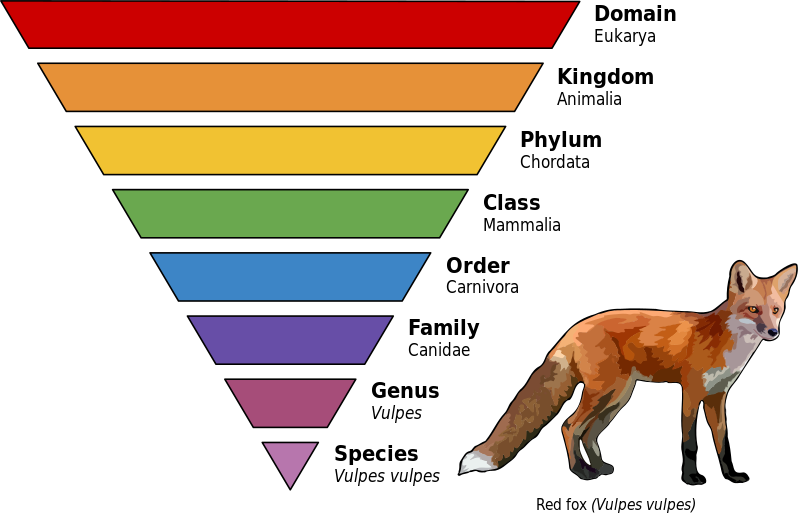
taxonomic rank
in biology, level in a taxonomic hierarchy
variety
taxonomic rank
subfamily
In biological classification, a subfamily (Latin: ', plural ') is an auxiliary (intermediate) taxonomic rank, positioned below family and above genera. It is used to classify groups of related genera within a family, helping organize the diversity of life more precisely.

type species
term used in zoological nomenclature (also non-officially in 'botanical' nomenclature)

International Code of Nomenclature for algae, fungi, and plants
Code of Nomenclature

International Plant Names Index
database of plant names

subgenus
thumb|A hoverfly of the subgenus [[Eristalis (Eoseristalis)]]
In biology, a subgenus ( subgenera) is a taxonomic rank directly below genus.
type
anchoring point (of a name) in taxonomy

Species Plantarum
book by Carl Linnæus
division
taxonomic rank in botanical classification, equivalent to phylum in zoology
list of botanists by author abbreviation
Wikimedia list article
The Plant List
database of scientific plant names

holotype
thumb|Holotype with red type label affixed
thumb|Holotype of Marocaster coronatus, [[MHNT]]
thumb|Live holotype of Eupolybothrus cavernicolus
thumb|thumbtime=2:54|Video of the capture of the holotype for the jellyfish species Santjordia pagesi, as recorded by a [[remotely operated underwater vehicle.]]
World Flora Online
online flora for plants
author citation in botany and mycology
refers to citing the person (or group of people) who validly published a botanical name
nomen nudum
term used in nomenclature (not a name)
type genus
term in zoological nomenclature (also non-officially in 'botanical' nomenclature)
form
one of the secondary taxonomic ranks, below that of variety, in botanical nomenclature
Plants of the World Online
online database of the world's plants
section
taxonomic rank in botany
Raunkiær plant life-form
types of plant form as defined by Christen Raunkiær
botanical name
scientific name for a plant, alga or fungus

cultigen
A cultigen (), or cultivated plant, is a plant that has been deliberately altered or selected by humans, by means of genetic modification, graft-chimaeras, plant breeding, or wild or cultivated plant selection. These plants have commercial value in horticulture, agriculture and forestry. Plants meeting this definition remain cultigens whether they are naturalised, deliberately planted in the wild, or grown in cultivation.
Linnaean taxonomy
rank-based taxonomy, sometimes (wrongly) ascribed to Linnaeus
basionym
In the scientific naming of organisms, a basionym or basyonym is the original name on which a new name is based; the author citation of the new name should include the authors of the basionym in parentheses. The term "basionym" is used in both botany and zoology. In zoology, alternate terms such as original combination or protonym are sometimes used instead. Bacteriology uses a similar term, basonym, spelled without an i.
World Checklist of Selected Plant Families
project in Kew Gardens
International Code of Nomenclature for Cultivated Plants
nomenclature code
Group
grouping used for cultivated plants (capital initial letter mandatory)

paratype
thumb|230px|Paratype of Lepidothrix vilasboasi (Sick, 1959) in [[Museum für Naturkunde, Berlin]]
thumb|230px|Paratype of Cadurcotherium nouleti – MHNT
botanical nomenclature
scientific naming of algae, fungi and plants
International Association for Plant Taxonomy
organization
nomen conservandum
conserved name (a protected scientific name)
sensu
Sensu is a Latin word meaning "in the sense of". It is used in a number of fields including biology, geology, linguistics, semiotics, and law. Commonly it refers to how strictly or loosely an expression is used in describing any particular concept, but it also appears in expressions that indicate the convention or context of the usage.
infraspecific name
name of a taxon, at a rank lower than species

Genera Plantarum
book by Carl Linnaeus
section
taxonomic rank
recombination
later scientific name that uses the same epithet
series
taxonomic rank in botany
Index Kewensis
register of botanical names of seed plants

Graft-chimaera
thumb|250px|right| The small tree +Laburnocytisus 'Adamii'|+Laburnocytisus 'Adamii' is a spectacular example of a graft-chimaera
In horticulture, a graft-chimaera may arise in grafting at the point of contact between rootstock and scion and will have properties intermediate between those of its "parents". Unlike graft hybrids, a graft-chimaera is not a true hybrid but a mixture of cells, each with the genotype of one of its "parents": it is a chimaera. Hence, the once widely used term "graft-hybrid" is no longer regarded as suitable for a graft-chimaera.
subtribe
In a social context, a subtribe is a secondary division of a broader ethnic grouping or tribe, functioning as a distinct unit defined by specific kinship ties, geographic territory, or linguistic dialects. For example, the Kipsigis are a major sub-tribe that falls under the broader Kalenjin ethnic group of East Africa.
homonym
scientific name that is identical in spelling to a name with a different type

Philosophia Botanica
book by Carolus Linnaeus
nomen illegitimum
term used in nomenclature (ICNafp)
species nova
phrase used when publishing the name of a new species
nothospecies
nomenclature of hybrid species
syntype
thumb|Close-up profile view of a Nylanderia pygmaea syntype male preserved in [[Baltic amber at the Natural History Museum, Vienna]]
In biological nomenclature, a syntype is any one of two or more biological types that is listed in a description of a taxon where no holotype was designated. Precise definitions of this and related terms for types have been established as part of the International Code of Zoological Nomenclature and the International Code of Nomenclature for algae, fungi, and plants.
correct name
the one scientific name to be used (from a particular scientific point of view)