Category
page 1Brachycera families

Syrphidae
Hoverflies, also called flower flies or syrphids, make up the insect family Syrphidae. As their common name suggests, they are often seen hovering or nectaring at flowers; the adults of many species feed mainly on nectar and pollen, while the larvae (maggots) eat a wide range of foods. In some species, the larvae are saprotrophs, specifically detritivores, eating decaying plant and animal matter in the soil or in ponds and streams. In other species, the larvae are insectivores, preying on aphids, thrips, and other plant-sucking insects.

Muscidae
Muscidae are a family of flies found in the superfamily Muscoidea.

Asilidae
The Asilidae are the robber fly family, also called assassin flies. They are powerfully built, bristly flies with a short, stout proboscis enclosing the sharp, sucking hypopharynx. The name "robber flies" reflects their expert predatory habits; they feed mainly or exclusively on other insects and, as a rule, they wait in ambush and catch their prey in flight.

Calliphoridae
The Calliphoridae (commonly known as blowflies, blow flies, blow-flies, carrion flies, bluebottles, or greenbottles) are a family of insects in the order Diptera, with almost 1,900 known species. The maggot larvae, often used as fishing bait, are known as gentles. The family is known to be polyphyletic, but much remains disputed regarding proper treatment of the constituent taxa, some of which are occasionally accorded family status (e.g., Bengaliidae and Helicoboscidae).

Drosophilidae
The Drosophilidae are a diverse, cosmopolitan family of flies, which includes species called fruit flies, although they are more accurately referred to as vinegar or pomace flies. Another distantly related family of flies, Tephritidae, are true fruit flies because they are frugivorous, and include apple maggot flies and many pests. The best known species of the Drosophilidae is Drosophila melanogaster, within the genus Drosophila, also called the "fruit fly." Drosophila melanogaster is used extensively for studies concerning genetics, development, physiology, ecology and behaviour. Many fundam

Tachinidae
The Tachinidae are a large and variable family of true flies within the insect order Diptera, with more than 8,200 known species and many more to be discovered. Over 1,300 species have been described in North America alone. Insects in this family commonly are called tachinid flies or simply tachinids. As far as is known, they all are protelean parasitoids, or occasionally parasites, of arthropods, usually other insects. The family is known from many habitats in all zoogeographical regions and is especially diverse in South America.

Bombyliidae
The Bombyliidae are a family of flies, commonly known as bee flies. Some are colloquially known as bomber flies. Adults generally feed on nectar and pollen, some being important pollinators. Larvae are mostly parasitoids of other insects.

Tephritidae
The Tephritidae are one of two fly families referred to as fruit flies, the other family being the Drosophilidae. The family Tephritidae does not include the biological model organisms of the genus Drosophila (in the family Drosophilidae), which is often called the "common fruit fly". Nearly 5,000 described species of tephritid fruit fly are categorized in almost 500 genera of the Tephritidae. Description, recategorization, and genetic analyses are constantly changing the taxonomy of this family. To distinguish them from the Drosophilidae, the Tephritidae are sometimes called peacock flies, in
Stratiomyidae
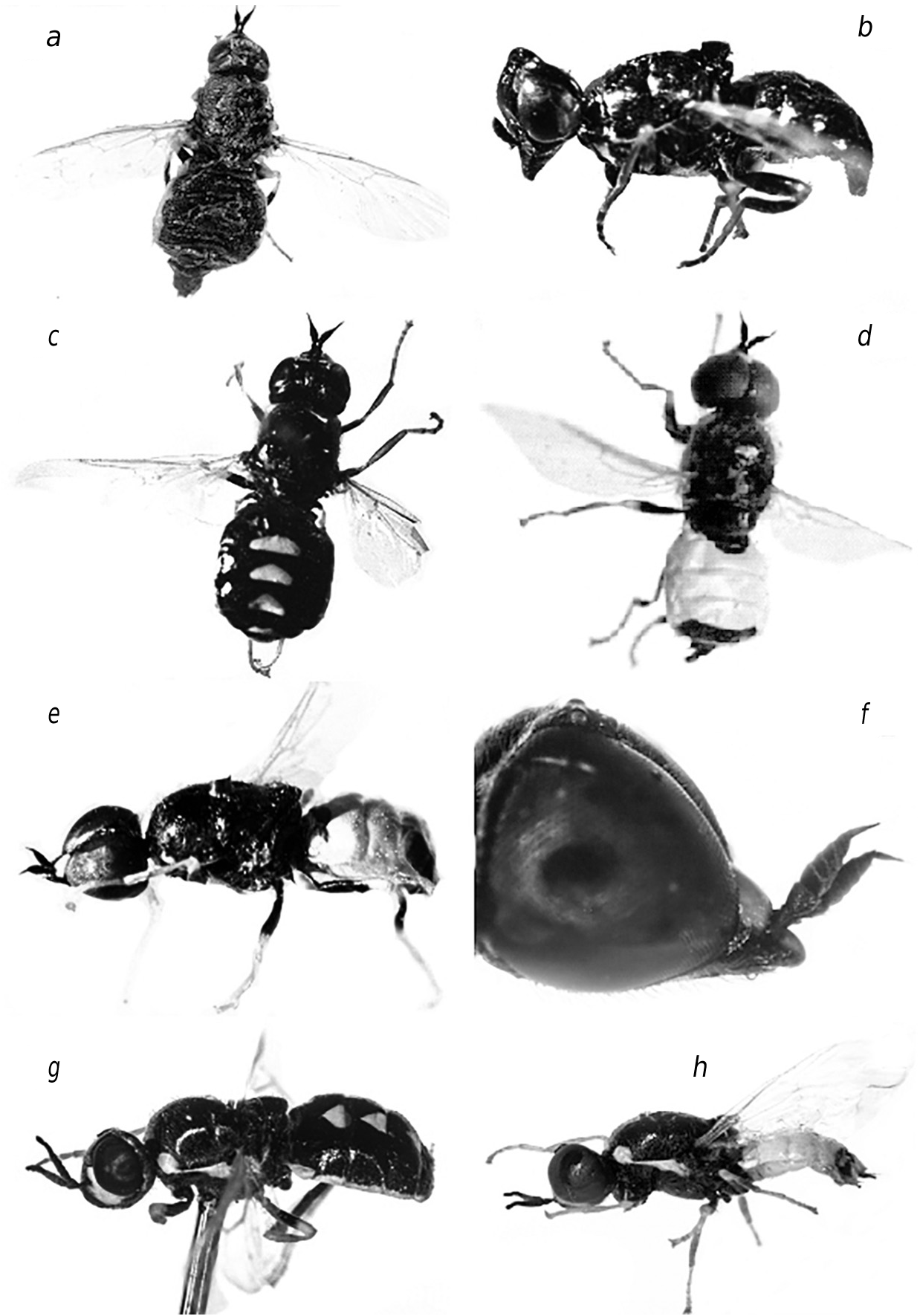
The soldier flies (Stratiomyidae, sometimes misspelled as Stratiomyiidae, from Greek - soldier; - fly) are a family of flies (historically placed in the now-obsolete group Orthorrhapha). The family contains over 2,700 species in over 380 extant genera worldwide. Larvae are found in a wide array of locations, mostly in wetlands, damp places in soil, sod, under bark, in animal excrement, and in decaying organic matter. Adults are found near larval habitats. They are diverse in size and shape, though they commonly are partly or wholly metallic green, or somewhat wasplike mimics, marked with black

Hippoboscidae
__NOTOC__

Agromyzidae
The Agromyzidae are a family of flies, commonly referred to as the leaf-miner flies for the feeding habits of their larvae, most of which are leaf miners on various plants. It includes roughly 2,500 species, they are small, some with wing length of 1 mm. The maximum size is 6.5 mm. Most species are in the range of 2 to 3 mm.

Rhagionidae
Rhagionidae or snipe flies are a small family of flies.
They get their name from the similarity of their often prominent proboscis that looks like the beak of a snipe.

Chloropidae
The Chloropidae are a family of flies commonly known as frit flies or grass flies. About 2000 described species are in over 160 genera distributed worldwide. These are usually very small flies, yellow or black and appearing shiny due to the virtual absence of any hairs. The majority of the larvae are phytophagous, mainly on grasses, and can be major pests of cereals. However, parasitic and predatory species are known. A few species are kleptoparasites. Some species in the genera Hippelates and Siphunculina (S. funicola being quite well known in Asia) are called eye gnats or eye flies for their

Anthomyiidae
thumb|Adia cinerella
thumb|Anthomyia pluvialis

Empididae
__NOTOC__
.jpg)
Dolichopodidae
Dolichopodidae, the long-legged flies, are a large, cosmopolitan family of true flies with more than 8,000 described species in about 250 genera. The genus Dolichopus is the most speciose, with some 600 species.

Scathophagidae
The Scathophagidae are a small family of Muscoidea which are often known as dung flies, although this name is not appropriate except for a few species of the genus Scathophaga which do indeed pass their larval stages in animal dung. The name probably derives from the yellow dung fly (Scathophaga stercoraria), which is one of the most abundant and ubiquitous flies in many parts of the Northern Hemisphere.

Conopidae
thumb|Physocephala tibialis male
thumb|Thecophora

Phoridae
The Phoridae are a family of small, hump-backed flies resembling fruit flies. Phorid flies can often be identified by their escape habit of running rapidly across a surface rather than taking flight. This behaviour is a source of one of their alternate names, scuttle fly. Another vernacular name, coffin fly, refers to Conicera tibialis. About 4,000 species are known in 230 genera. The most well-known species is cosmopolitan Megaselia scalaris. At 0.4 mm in length, the world's smallest fly is the phorid Euryplatea nanaknihali.

Ephydridae
Ephydridae (shore flies, sometimes brine flies) is a family of insects in the order Diptera. Shore flies are tiny flies that can be found near seashores or at smaller inland waters, such as ponds. About 2,000 species have been described worldwide, including Ochthera.
Pipunculidae
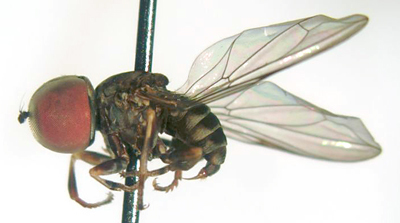
Pipunculidae is a family of flies (Diptera) commonly termed big-headed flies, a reference to the large (holoptic) eyes, which cover nearly the entire head. The family is found worldwide and more than 1300 species have been described.
Sepsidae
The Sepsidae are a family of flies, commonly called the black scavenger flies or ensign flies. Over 300 species are described worldwide. They are usually found around dung or decaying plant and animal material. Many species resemble ants, having a "waist" and glossy black body. Many Sepsidae have a curious wing-waving habit made more apparent by dark patches at the wing end.

Acroceridae
The Acroceridae are a small family of odd-looking flies. They have a hump-backed appearance with a strikingly small head, generally with a long proboscis for accessing nectar. They are rare and not widely known. The most frequently applied common names are small-headed flies or hunch-back flies. Many are bee or wasp mimics. Because they are parasitoids of spiders, they also are sometimes known as spider flies.
Fanniidae
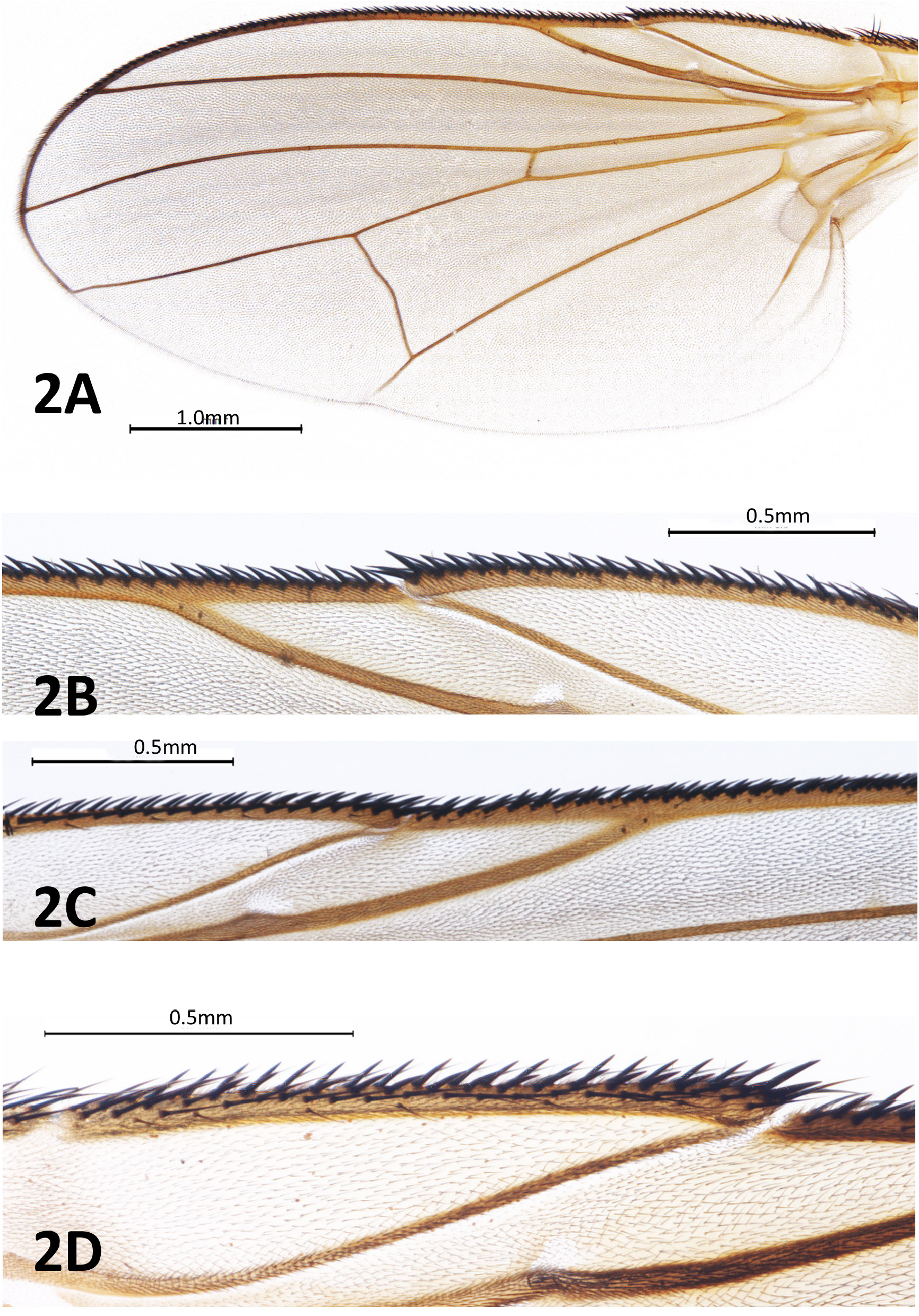
The Fanniidae are a small (285 species in five genera) group of true flies largely confined to the Holarctic and temperate Neotropical realms; there are 11 Afrotropical species, 29 Oriental, and 14 Australasian.

Athericidae
Athericidae is a small family of flies known as water snipe flies or ibis flies. They used to be placed in the family Rhagionidae, but were removed by Stuckenberg in 1973. They are now known to be more closely related to Tabanidae. Species of Athericidae are found worldwide.

Nemestrinidae
thumb|Moegistorhynchus longirostris
thumb|Neorhynchocephalus tauscheri (10) and Hirmoneura obscura (11) in Europäischen Zweiflügeligen
Nemestrinidae, or tangle-veined flies is a family of flies in the superfamily Nemestrinoidea, closely related to Acroceridae.

Vermileonidae
The Brachyceran family Vermileonidae (the sole family in the infraorder Vermileonomorpha) is a small family of uncertain affinities and unusual biology. It includes fewer than 80 described species, most of them rare and with restricted distribution, in 11 genera. Historically the vermileonids had been regarded as belonging to the family Rhagionidae, possibly in a subfamily Vermileoninae. Their biology and morphology are so markedly distinct from the main Rhagionidae sensu stricto however, that the placement as a separate family has been widely accepted. They are called wormlions, in analogy to

Therevidae
The Therevidae are a family of flies of the superfamily Asiloidea commonly known as stiletto flies. The family contains about 1,600 described species worldwide, most diverse in arid and semiarid regions with sandy soils. The larvae are predators of insect larvae in soil.
thumb|230px|left|Plate from Johann Wilhelm Meigen EuropäischenZweiflügeligen.Showing the gross features mentioned in the text (figures 5-9)
Sciomyzidae
thumb|Pherbellia annulipes hunting on decaying wood (video, 1m 6s)
thumb|Limnia sp. on a blade of grass (video, 34s)

Lonchaeidae
The Lonchaeidae are a family of acalyptrate flies commonly known as lance flies. 610 described species are placed into 10 genera. These are generally small but robustly built flies with blue-black or metallic bodies. They are found, most commonly in wooded areas, throughout the world with the exception of polar regions and New Zealand. Details of the distribution of genera and species by biogeographic realm are included in the World Catalogue of the family Lonchaeidae
Psilidae
The Psilidae are family of flies. Commonly called the rust flies, at least 38 species are in four genera. The carrot fly (Chamaepsila rosae) is a member of this group. They are found mainly in the Holarctic.
Nycteribiidae
Nycteribiidae is a family of the true fly superfamily Hippoboscoidea. Together with their close relatives the Streblidae, they are known as "bat flies". As the latter do not seem to be a monophyletic group, it is conceivable that bat flies cannot be united into a single family.
Mydidae
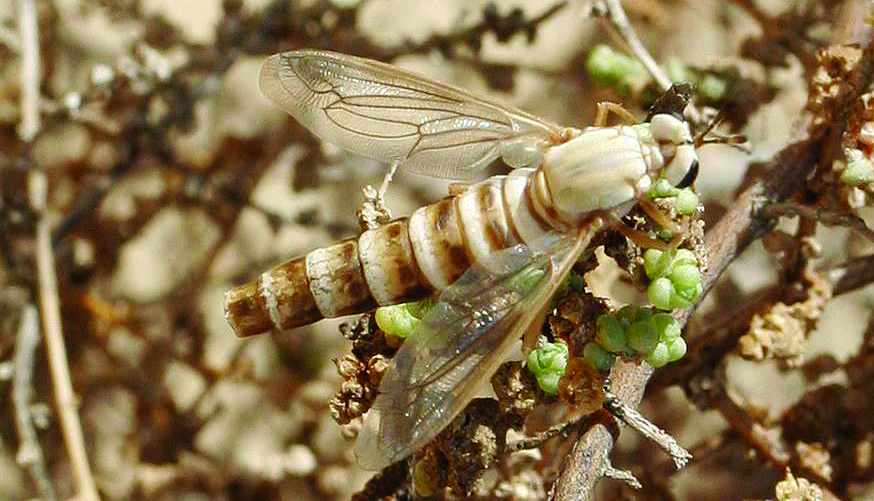
family of flies
Pantophthalmidae
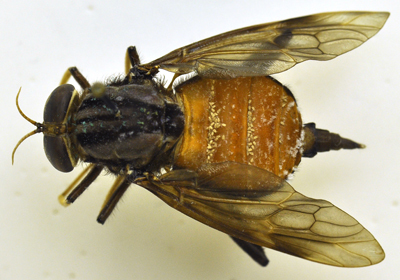
Pantophthalmidae (sometimes spelled as Panthophthalmidae) is a small family of very large, robust flies, sometimes referred to as timber flies. There are 21 known species in two genera in the family, all of Neotropical distribution. Superficially they resemble horse flies, but are only distantly related; they are most closely related to the soldier flies (Stratiomyidae). The larvae feed by boring into living wood, an unusual habit for Diptera, and can sometimes be pests. The adult stage is brief and does not feed at all, and most active at dusk.

Piophilidae
The Piophilidae are a family of "true flies", in the order Diptera. The so-called cheese flies are the best-known members, but most species of the Piophilidae are scavengers in animal products, carrion, and fungi. They may accordingly be important in forensic entomology and medical entomology. For a fly maggot, the larvae of many species have an unusually well-developed ability to leap when alarmed or when abandoning their larval food to pupate; they accordingly may be known as cheese skippers or other kinds of skippers according to their food source.
Platypezidae
thumb|Agathomyia wankowiczii ovipositing on an Artist's Bracket fungus
thumb|Larval plant gall|galls (black objects) of [[Agathomyia wankowiczii on an Artist's Bracket fungus (Ganoderma applanatum)]]
Platypezidae is a family of true flies of the superfamily Platypezoidea. The more than 250 species are found worldwide primarily in woodland habitats. A common name is flat-footed flies, but this is also used for the closely related Opetiidae which were formerly included in the Platypezidae.

Xylomyidae
Xylomyidae is a family of flies known commonly as the wood soldier flies. They are xylophagous and are associated with dead or dying wood.
Braulidae
Braulidae, or bee lice, is a family of true flies (Diptera) with seven species in two genera, Braula and Megabraula. They are found in honey bee colonies due to their phoretic, inquiline, and kleptoparasitic relationships with the bees. Similar in appearance but not closely related to keds, these flies are also small, wingless, and occasionally mistaken for mites or lice, hence their common name.

Opomyzidae
Opomyzidae is a family of acalyptrate Diptera. They are generally small, slender, yellow, brown or black coloured flies. The larval food plants are grasses, including cereal crops, the adults are mainly found in open habitats. Some species being agricultural pests.

Lauxaniidae
thumb|
The Lauxaniidae are a family of acalyptrate flies. They generally are small flies (length 7 mm or less) with large compound eyes that often are brightly coloured in life, sometimes with characteristic horizontal stripes, such as in Cestrotus species. Many species have variegated patterns on their wings, but in contrast they generally do not have variegated bodies, except for genera such as Cestrotus, whose camouflage mimics lichens or the texture of granitic rocks.

Sphaeroceridae
Sphaeroceridae are a family of true flies in the order Diptera, often called small dung flies, lesser dung flies or lesser corpse flies due to their saprophagous habits. They belong to the typical fly suborder Brachycera as can be seen by their short antennae, and more precisely they are members of the section Schizophora. There are over 1,300 species and about 125 genera accepted as valid today, but new taxa are still being described.

Pyrgotidae
The Pyrgotidae are an unusual family of flies (Diptera), one of only two families of Cyclorrhapha that lack ocelli. Most species are "picture-winged" (i.e., have patterns of bands or spots on the wings), as is typical among the Tephritoidea, but unlike other tephritoids, they are endoparasitoids; the females pursue scarab beetles in flight, laying an egg on the beetle's back under the elytra where the beetle cannot reach it. The egg hatches and the fly larva enters the body cavity of the beetle, feeding and eventually killing the host before pupating. In the United States, some species of Pyrg

Anthomyzidae
Anthomyzidae is a family of small, slender, yellow to black flies with narrow and elongated wings, which may have distinct markings. Some species have greatly reduced wings. Fewer than 100 species are known, mostly from Europe. Although they occur in all major regions, they seem to be most varied in the Holarctic region.

Xylophagidae
thumb|Coenomyia ferruginea
thumb|Dialysis elongata
%20wing.png)
Hybotidae
Hybotidae, the typical dance flies, are a family of true flies. They belong to the superfamily Empidoidea and were formerly included in the Empididae as a subfamily.

Scenopinidae
The Scenopinidae or window flies are a small (about 400 described species) family of flies (Diptera), distributed worldwide. In buildings, they are often taken at windows, hence the common name window flies.
Carnidae
Carnidae, also known as bird flies or filth flies, is a family of flies (Diptera). There are 6 genera, containing about 93 species worldwide.

Ulidiidae
The Ulidiidae (formerly Otitidae) or picture-winged flies are a large and diverse cosmopolitan family of flies (Diptera), and as in related families, most species are herbivorous or detritivorous. They are often known as picture-winged flies, along with members of other families in the superfamily Tephritoidea that have patterns of bands or spots on the wings. Some species share with the Tephritidae an unusual elongated posteroapical projection of the anal cell in the wing, but can be differentiated by the smoothly curving subcostal vein. Two species, Tetanops myopaeformis and Euxesta stigmati

Milichiidae
Milichiidae are a family of flies. Most species are very small and dark. Details of their biology have not yet been properly studied, but they are best known as kleptoparasites of predatory invertebrates, and accordingly are commonly known as freeloader flies or jackal flies. However, because of the conditions under which many species breed out, they also are known as filth flies.

Canacidae
Canacidae, incorrectly Canaceidae, or beach flies, surf or surge flies, is a family of Diptera. As of 2010, 307 species in 27 genera.
The family now includes Tethininae as a subfamily.
thumb|230px|left|face on view of the head of Canace ranula, Loew
thumb|230px|left|Wing venation
Heleomyzidae
thumb|thumbtime=1:57|Mating behaviour of Suillia cf. bicolor on fungus
thumb|Tephrochlamys
thumb|Eccoptomera longiseta

Pallopteridae
thumb|Toxonevra jucunda
thumb|Palloptera ustulata
Pallopteridae is a family of flies. The various species are collectively called flutter-wing flies, trembling-wing, or waving-wing flies, because of the striking vibration of the wings in many species. Over 70 species in about 15 genera are found in the temperate regions of the Northern and Southern Hemispheres.
_(cropped).jpg)
Curtonotidae
The Curtotonidae or quasimodo flies are a small family of small grey to dark brown humpbacked flies (Diptera) with a worldwide distribution, but with very few species in the Nearctic, Australasian/Oceanian, and Palaearctic regions. Most members of the family are found in tropical to subtropical latitudes in Africa and the Neotropics. Many remain undescribed in collections, since little work on the family has been done since the 1930s.

Lonchopteridae
thumb|right|wing venation (male)
Strongylophthalmyiidae
The Strongylophthalmyiidae are a small family of about 80 species of slender, long-legged flies, the majority of which occur in the Oriental and Australasian regions. They are divided into two genera, the monotypic Southeast Asian genus Nartshukia Shatalkin, 1993 and Strongylophthalmyia Heller, 1902. The relationships of the group are obscure; formerly the genus Strongylophthalmyia was classified with the Psilidae, and some recent classifications place it within the Tanypezidae. Little is known of their biology, but many species seem to be associated with rotting bark.

Richardiidae
thumb|Richardiidae from Brazil, likely Setellia sp.
The Richardiidae are a family of Diptera in the superfamily Tephritoidea.
Aulacigastridae
Aulacigastridae is a very small family of flies known as sap flies. The family Stenomicridae used to be included within this family, but was moved by Papp in 1984. They are found in all the Ecoregions.
Clusiidae
thumb|Clusia tigrina engaged in lek (mating arena)|lekking behaviour

Micropezidae
thumb|Mating pair
The Micropezidae are a moderate-sized family of acalyptrate muscoid flies in the insect order Diptera, comprising about 500 species in about 50 genera and five subfamilies worldwide, (except New Zealand and Macquarie Island). They are most diverse in tropical and subtropical habitats, especially in the Neotropical Region.

Celyphidae
The Celyphidae, commonly known as beetle flies or beetle-backed flies, are a family of flies (order Diptera). About 115 species in about 9 genera are known chiefly from the Oriental and Afrotropic biogeographic regions with one lineage in the New World.