Category
page 1Cellular processes

cell
basic structural and functional unit of all organisms

meiosis
thumb|300x300px|In meiosis, the chromosomes duplicate (during [[interphase) and homologous chromosomes exchange genetic information (chromosomal crossover) during the first division, called meiosis I. The daughter cells divide again in meiosis II, splitting up sister chromatids to form haploid gametes. Two gametes fuse during fertilization, forming a diploid cell (zygote) with a complete set of paired chromosomes.]]

DNA replication
cellular metabolic process in which a cell duplicates one or more molecules of DNA

cell division
process resulting in division and partitioning of components of a cell to form more cells

action potential
process by which neurons communicate with each other by changes in their membrane potentials.

transcription
biosynthesis of RNA carried out on a template of DNA

necrosis
thumb|upright=1.6|Structural changes of cells undergoing necrosis and apoptosis

phagocytosis
alt=|thumb|323x323px|Overview of phagocytosis
thumb|300px|Phagocytosis versus exocytosis
Phagocytosis () is the process by which a cell uses its plasma membrane to engulf a large particle (≥ 0.5 μm), giving rise to an internal compartment called the phagosome. It is one type of endocytosis. A cell that performs phagocytosis is called a phagocyte.
thumb|The engulfing of a pathogen by a phagocyte
In a multicellular organism's immune system, phagocytosis is a major mechanism used to remove pathogens and cell debris. The ingested material is then digested in the phagosome. Bacteria, dead tissue ce

translation
in biology, the creation of proteins using information from nucleic acids

DNA repair
process of restoring DNA after damage

cell differentiation
process in which relatively unspecialized cells acquire specialized features

autophagy
thumb|right|A Diagram of the process of autophagy, which produces the structures autophagosomes (AP), and [[autolysosomes (AL)B Electron micrograph of autophagic structures AP and AL in the fat body of a fruit fly larvaC Fluorescently labeled autophagosomes AP in liver cells of starved mice]]

endocytosis
thumb|right|400px|The different types of endocytosis
Endocytosis is a cellular process in which substances are brought into the cell. The material to be internalized is surrounded by an area of cell membrane, which then buds off inside the cell to form a vesicle containing the ingested materials. Endocytosis includes pinocytosis (cell drinking) and phagocytosis (cell eating). It is a form of active transport.

central dogma of molecular biology
explanation of the flow of genetic information within a biological system
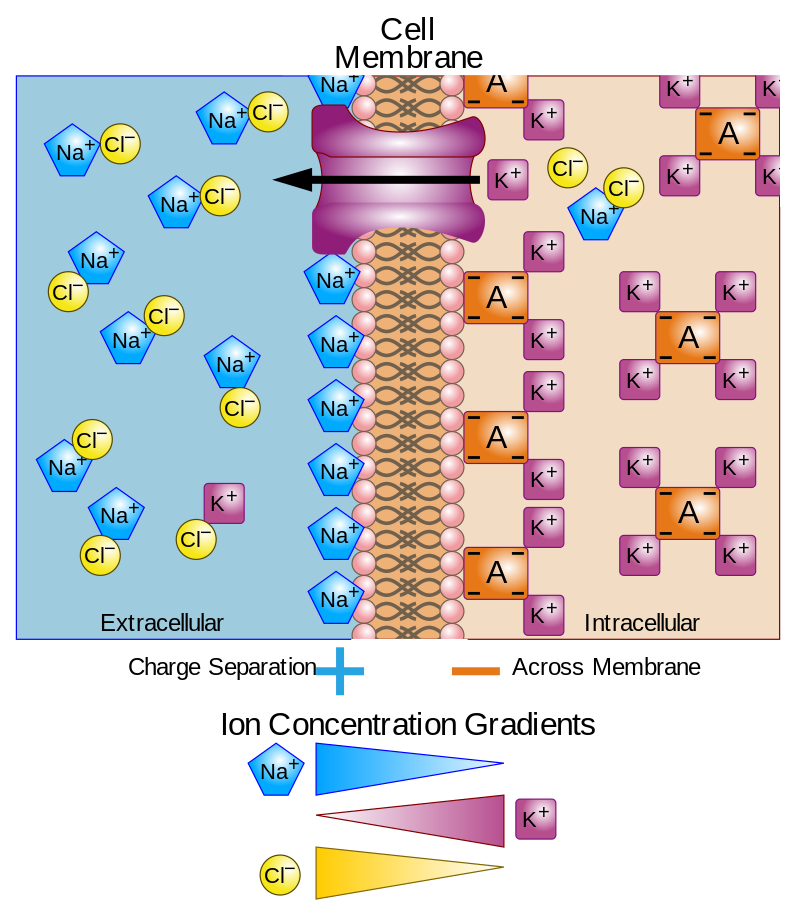
membrane potential
type of physical quantity
crossing over
cellular process
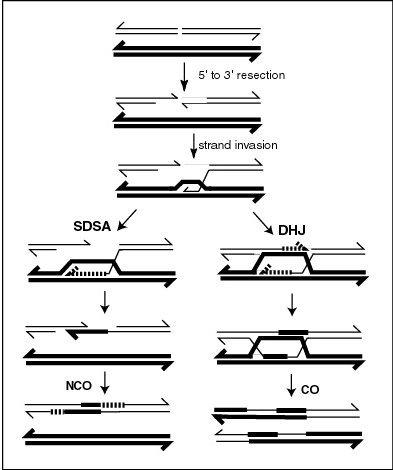
genetic recombination
production of offspring with combinations of traits that differ from those found in either parent

exocytosis
thumb|upright=1.35|Exocytosis of neurotransmitters into a synapse from neuron A to neuron B.
Exocytosis () is a form of active transport in which a cell transports molecules (e.g., neurotransmitters and proteins) out of the cell. As an active transport mechanism, exocytosis requires the use of energy to transport material. Exocytosis and its counterpart, endocytosis, are used by all cells because most chemical substances important to them are large polar molecules that cannot pass through the hydrophobic portion of the cell membrane by passive means. Exocytosis is the process by which a large

pinocytosis
thumb|right|250px|Pinocytosis

prophase
thumb|upright=1.35|Prophase is the first step of cell division in mitosis. As it occurs after G2 of interphase, DNA has been already replicated when prophase begins.
thumb|right|200px|Fluorescence microscope image of two mouse cell nuclei in prophase (scale bar is 5 μm).

senescence
Senescence () or biological aging is the gradual deterioration of functional characteristics in living organisms. Whole organism senescence involves an increase in death rates or a decrease in fecundity with increasing age, at least in the later part of an organism's life cycle. However, the effects of senescence can be delayed. The 1934 discovery that calorie restriction can extend lifespans by 50% in rats, the existence of species having negligible senescence, and the existence of potentially immortal organisms such as members of the genus Hydra have motivated research into delaying senescen
autolysis
cellular process
passive transport
membrane transport that occurs down an electrochemical gradient and does not require energy
cell population proliferation
rapid growth or proliferation of organic tissue
cytoplasmic streaming
directed flow of cytosol (the liquid component of the cytoplasm) and the organelles it contains
cell death
biological processes that result in permanent cessation of all vital functions of a cell
cell migration
controlled self-propelled movement of a cell from one site to a destination guided by molecular cues
epithelial to mesenchymal transition
transition where an epithelial cell becomes a migratory mesenchymal cell
cell growth
process in which a cell irreversibly increases in size over time by accretion and biosynthetic production of matter similar to that already present
receptor-mediated endocytosis
endocytosis process in which cell surface receptors ensure specificity of transport. A specific receptor on the cell surface binds tightly to the extracellular macromolecule (the ligand) that it recognizes; the plasma-membrane region containing th

Karyorrhexis
thumb|300px|Apoptosis
Karyorrhexis (from Greek κάρυον karyon, "kernel, seed, nucleus," and ῥῆξις rhexis, "bursting") is the destructive fragmentation of the cell nucleus that occurs in a dying cell. It is characterized by the breakdown of the nuclear envelope and the dispersal of condensed chromatin into the cytoplasm. The process is usually preceded by pyknosis (irreversible chromatin condensation) and followed by karyolysis (enzymatic dissolution of chromatin). It may occur during programmed cell death (apoptosis), cellular senescence, or necrosis.

transcytosis
thumb|right
Transcytosis (also known as cytopempsis) is a type of transcellular transport in which various macromolecules are transported across the interior of a cell. Macromolecules are captured in vesicles on one side of the cell, drawn across the cell, and ejected on the other side. Examples of macromolecules transported include IgA, transferrin, and insulin. While transcytosis is most commonly observed in epithelial cells, the process is also present elsewhere. Blood capillaries are a well-known site for transcytosis, though it occurs in other cells, including neurons, osteoclasts and M c

necroptosis
thumbnail|right|The Necroptosis Signaling Pathway
Necroptosis is a programmed form of necrosis and one of the many modalities of programmed cell death that has been described insofar. Conventionally, necrosis is associated damage caused by traumatic external forces, such as mechanical damage, heat, osmotic pressure and disruption by certain parasites. In contrast to orderly, programmed cell death via apoptosis, necrosis in this sense doesn't involve biological processes happening within the cell. The content of the cell only matters after its death: released into the extracellular environment,

Karyolysis
thumb|right|350px|Morphological characteristics of karyolysis and other forms of nuclear destruction.
Karyolysis (from Greek κάρυον karyon—"kernel, seed, or nucleus", and λύσις lysis from λύειν lyein, "to separate") is the complete dissolution of chromatin in a dying cell caused by enzymatic degradation through endonucleases. Following karyolysis, the entire cell typically stains uniformly with eosin. Karyolysis represents the final step in the process of necrosis, a form of cellular injury in which living tissue undergoes irreversible damage through premature cell death. Unlike apoptosis, whi
cellular senescence
phenomenon characterized by the cessation of cell division
Pyknosis
thumb|275px|Apoptosis

dynamin
Dynamin is a GTPase protein responsible for endocytosis in the eukaryotic cell. Dynamin is part of the "dynamin superfamily", which includes classical dynamins, dynamin-like proteins, Mx proteins, OPA1, mitofusins, and GBPs. Members of the dynamin family are principally involved in the scission of newly formed vesicles from the membrane of one cellular compartment and their targeting to, and fusion with, another compartment, both at the cell surface (particularly caveolae internalization) as well as at the Golgi apparatus. Dynamin family members also play a role in many processes including div
malignant transformation
process by which cells acquire the properties of cancer

ferroptosis
Ferroptosis (also known as oxytosis) is a type of programmed cell death dependent on iron and characterized by the accumulation of lipid peroxides. Ferroptosis is biochemically, genetically, and morphologically distinct from other forms of regulated cell death such as apoptosis and necroptosis. Oxytosis/ferroptosis can be initiated by the failure of the glutathione-dependent antioxidant defenses, resulting in unchecked lipid peroxidation and eventual cell death. Lipophilic antioxidants and iron chelators can prevent ferroptotic cell death.

endoplasmic reticulum unfolded protein response
molecular signals generated from unfolded proteins in the endoplasmic reticulum or other ER-related stress
fibrinoid necrosis
irreversible, uncontrolled cell death
necrobiosis
Necrobiosis is the physiological death of a cell, and can be caused by conditions such as basophilia, erythema, or a tumor. It is identified both with and without necrosis.
invagination
thumb|358x358px|A sheet of cells undergoing invagination
Invagination is the process of a surface folding in on itself to form a cavity, pouch or tube. In developmental biology, invagination of epithelial sheets occurs in many contexts during embryonic development. Invagination is critical for making the primitive gut during gastrulation in many organisms, forming the neural tube in vertebrates, and in the morphogenesis of countless organs and sensory structures. Models of invagination that have been most thoroughly studied include the ventral furrow in Drosophila melanogaster, neural tube for
efferocytosis
thumb|Labelled diagram of a cell undergoing apoptosis
In cell biology, efferocytosis (from efferre, Latin for 'to carry out' (to the grave), extended meaning 'to bury') is the process by which apoptotic cells are removed by phagocytic cells. It can be regarded as the 'burying of dead cells'.
pachytene
The pachytene stage (/ˈpækɪtiːn/ PAK-i-teen; from Greek words meaning "thick threads".), also known as pachynema, is the third stage of prophase I during meiosis, the specialized cell division that reduces chromosome number by half to produce haploid gametes. It follows the zygotene stage and is followed by the stage diplotene.
interkinesis
Interkinesis or interphase II is a period of rest that cells of some species enter during meiosis between meiosis I and meiosis II. No DNA replication occurs during interkinesis; however, replication does occur during the interphase I stage of meiosis (See meiosis I). During interkinesis, the spindles of the first meiotic division disassemble and the microtubules reassemble into two new spindles for the second meiotic division. Interkinesis follows telophase I; however, many plants skip telophase I and interkinesis, going immediately into prophase II. Each chromosome still consists of two chro
zygotene
Zygotene (from Greek for "paired threads") is the second stage of prophase I during meiosis, the specialized cell division that reduces the chromosome number by half to produce haploid gametes. It follows the Leptotene stage and is followed by Pachytene stage.
heat shock response
effect of subjecting a cell to a higher-than-optimal temperature; causes protein misfolding, cytoskeletal rearrangement, organelle localization changes, ATP production decrease, unsafe pH drop, decreased protein translation and RNA splicing changes
Parasexual cycle
Nonsexual mechanism for transferring genetic material without meiosis
effector cell
any cell which responds to stimuli and effects some change
DNA damage
abnormal chemical structure in DNA
emperipolesis
thumb|right|Micrograph showing emperipolesis in a case of [[Rosai-Dorfman disease. H&E stain.]]
Emperipolesis is the presence of an intact cell within the cytoplasm of another cell. It is derived from Greek (en is inside, peripoleomai is go round). Emperipolesis is an uncommon biological process, and can be physiological or pathological.
bacterial secretion system
in gram negative bacteria, multiprotein complexes that move pathogen proteins across the cell envelope
coagulative necrosis
type of cell death
leptotene
cell cycle phase which is the first stage of prophase I in meiosis, and during which the chromosomes first become visible
formins
thumb|left|Domain structure of formin proteins across phyla.
ERAD pathway
protein catabolic pathway which targets endoplasmic reticulum-resident proteins for degradation by the cytoplasmic proteasome
Filamentation
thumb|250px|upright|right|A Bacillus cereus cell that has undergone filamentation following antibacterial treatment (upper electron micrograph; top right) and regularly sized cells of untreated B. cereus (lower electron micrograph)
Filamentation is the anomalous growth of certain bacteria, such as Escherichia coli, in which cells continue to elongate but do not divide (no septa formation). The cells that result from elongation without division have multiple chromosomal copies.
density dependence
density-dependent processes occur when population growth rates are regulated by the density of a population
ribosome biogenesis
a cellular process that results in the biosynthesis of constituent macromolecules, assembly, and arrangement of constituent parts of ribosome subunits; includes transport to the sites of protein synthesis