Category
page 1Central Asian cuisine

yogurt
Yogurt (; , from , ; also spelled yoghurt, yogourt or yoghourt) is a food produced by bacterial fermentation of milk. Fermentation of sugars in the milk by these bacteria produces lactic acid, which acts on milk protein to give yogurt its texture and characteristic tart flavor. Cow's milk is most commonly used to make yogurt. Milk from water buffalo, goats, ewes, mares, camels, and yaks is also used to produce yogurt. The milk used may be homogenized or not. It may be pasteurized or raw. Each type of milk produces substantially different results.
.%20Leiden%20University%20Library%2C%20Collection%20A.%20P.%20H.%20Hotz.jpg)
kabab
Kebab ( , ), kebap, kabob (alternative North American spelling), kebob, or kabab (Hindi and Kashmiri spelling) is a variety of roasted meat dishes that originated in the Middle East.

samosa
A samosa () () is a fried Indian pastry with a savoury filling that mostly consists of vegetables like spiced potatoes, onions, and peas, but can include cheese such as paneer, meat or even fish. Its name originates from the Middle Persian word sambosag () (meaning 'triangular pastry'). It is made in different shapes, including triangular, cone, or crescent, depending on the region. Samosas are often accompanied by chutney, and have origins in medieval times or earlier. Sweet versions containing traditional Indian flavours or even chocolate are also made. Samosas are popular snacks in South As

pilaf
Pilaf (), pilav, pilau or plov () is a rice dish, or in some regions, a wheat dish, whose recipe usually involves cooking in stock or broth, adding spices, and other ingredients such as vegetables and meat, and employing some technique for achieving cooked grains that do not adhere.

ayran
Ayran ( ) is a cold savory yogurt-based beverage that is consumed across Central Asia, the Balkans, and the Middle East. The principal ingredients are yogurt, water and salt. Herbs such as mint may be optionally added. Some varieties are carbonated. It is a national drink of Turkey.

shashlik
Shashlik, or shashlyck ( shashlyk ), is a dish of skewered and grilled cubes of meat, similar to or synonymous with shish kebab. It is known traditionally by various other names in the Caucasus, Eastern Europe and Central Asia, and from the 19th century became popular as shashlik across much of the Russian Empire and nowadays in former Soviet Union republics.

börek
Börek (also burek or byrek) is a family of pastries or pies made in the Middle East and Southeast Europe. The pastry is made of a thin flaky dough such as filo with a variety of fillings, such as meat, cheese, spinach, or potatoes. A börek may be prepared in a large pan and cut into portions after baking, or as individual pastries. They are usually baked but some varieties can be fried. Börek is sometimes sprinkled with sesame or nigella seeds, and it can be served hot or cold.

boza
thumb|upright|Boza from Turkey
Boza, also bosa, is a fermented beverage originating from Central Asia and made in Turkey, Central Asia, the Caucasus, and North Africa. It is a malt drink made by fermenting various grains: millet, wheat (or bulgur) and maize (corn) in Turkey. It is one of the oldest Turkic beverages. It has a thick consistency, a low alcohol content (around 1%), and a slightly acidic sweet flavor.

kofta
thumb|Koofteh Tabrizi from Iran
Kofta is a family of meatball or meatloaf dishes found in South Asian, Central Asian, Balkan, Middle Eastern, North African, and South Caucasian cuisines. In the simplest form, koftas consist of balls of minced meat—usually beef, chicken, lamb or mutton, camel, seldom pork, or a mixture—mixed with spices and sometimes other ingredients. The earliest known recipes are found in early Turkish cookbooks and call for ground lamb.

tea house
thumb|Tea served in a tea room at the Shantytown Heritage Park in New Zealand
thumb|Tea house in Moscow, 2017

baba ghanoush
Levantine appetizer consisting of finely chopped roasted eggplant, olive oil, lemon juice, various seasonings, and tahini

kaymak
Kaymak, sarshir, or qashta/ashta ( ; or ; ) is a creamy dairy food similar to clotted cream, made from the milk of water buffalo, cows, sheep, or goats in Central Asia, Turkic regions, some Balkan countries, some Caucasus countries, and the Levant.

sujuk
Sujuk, sugou or sucuk (/suːˈd͡ʒʊk/) is a dry, spicy and fermented sausage which is consumed in several Anatolian, Balkan, Middle Eastern and Central Asian cuisines. Sujuk mainly consists of ground meat and animal fat usually obtained from beef or lamb, but beef is mainly used in Turkey, Egypt, Sudan, Armenia, Azerbaijan, Bosnia and Herzegovina, Albania, Georgia, Bulgaria, Kazakhstan, and Kyrgyzstan.
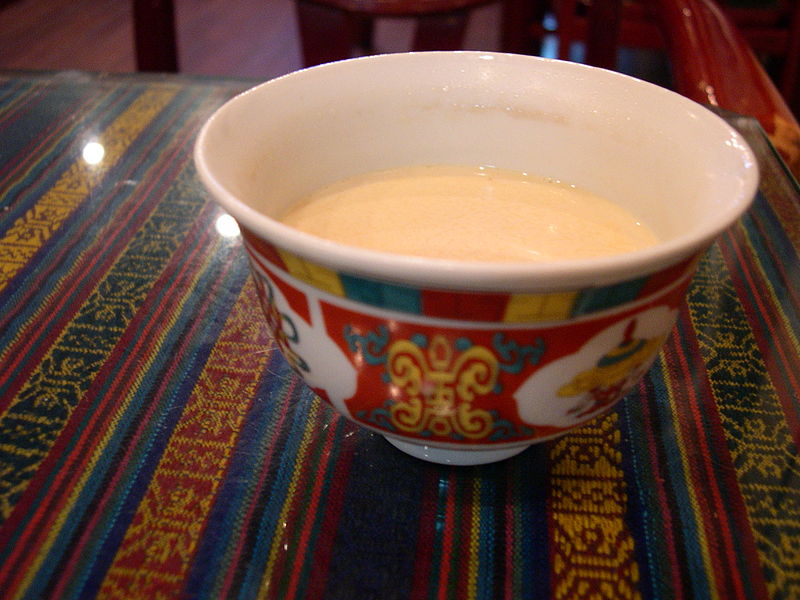
butter tea
South Asian drink mainly consisting of butter churned with tea

strained yogurt
dairy product
.jpg)
pirozhki
Pirozhki (, ; ; see also other names) is the Russian name for baked or fried yeast-leavened boat-shaped buns with a variety of fillings in Russian and Eastern European cuisine in general. Pirozhki are a popular street food and comfort food. They are especially popular in countries with large ethnic Russian communities, and may also be found in other parts of the world.
samsa
pastry from Central Asia
laghman
Central Asian noodle dish
Cuisine of Uzbekistan
culinary traditions of Uzbekistan
Kazakh cuisine
culinary traditions of Kazakhstan

tsampa
Tsampa or tsamba (; ) is a Tibetan and Himalayan staple foodstuff; it is also prominent in parts of northern Nepal. It is a glutinous meal made from roasted flour, usually barley flour and sometimes also wheat flour and flour prepared from tree peony seeds. It is usually mixed with Tibetan butter tea. It is also eaten in Turkestan and Mongolia, where it is known as zamba.
Kyrgyz cuisine
culinary traditions of Kyrgyzstan

joshpara
Joshpara is a kind of dumpling popular in Central Asia, South Caucasus and the Middle East. They are made of unleavened wheat dough squares filled with ground meat and condiments.

tava
thumb|A concave tawa designed for use in a home kitchen
A tava(h) / tawa(h) (mainly on the Indian subcontinent), saj (in Arabic), sac (in Azerbaijani and Turkish), and other variations, is a metal cooking utensil. The tawa is round and is usually curved: the concave side is used as a wok or frying pan, the convex side for cooking flatbreads and pancakes. There are also flat tawas.
Tajik cuisine
culinary traditions of Tajikistan
tandoor bread
bread made in a tandoor

Kahwah
Kahwah (also transliterated as qehwa, kehwa or kahwa, ) is a traditional Kashmiri green tea (Camellia sinensis) preparation, widely believed to have originated in the Kashmir Valley. It is widely consumed in India, Pakistan, Afghanistan, and some regions of Central Asia.
Turkmen cuisine
food and drink in Turkmenistan
maida flour
fine wheat flour
Lula kebab
type of kebab, made from minced meat
yak butter
butter made from the milk of the domesticated yak
yahni
Yakhni (, , , , ), yahni (Turkish), or yahniya (, Serbian, ), jahni (Albanian), iahnie (Romanian) is a class of dishes traditionally prepared in a vast area encompassing South Asia, the Middle East and the Balkans. Generally, it is a stew of meat and vegetables.

Morkovcha
thumb|Morkovcha served plain
Morkovcha also known as Korean-style carrots or Korean carrot salad, is a spicy marinated carrot salad. It is a dish in Koryo-saram cuisine, and is a variant of kimchi.
Soviet cuisine
culinary traditions of the Soviet Union
Doogh
Doogh () is a cold and savoury Persian drink. It is made with fermented milk. Unlike its sister beverage of Turkish origin, ayran, Doogh is not diluted yogurt. According to the Iranian Ministry of Food Standards, Doogh "is a drink resulting from lactic fermentation of milk whose dry matter is standardized by diluting yogurt (after fermentation) or buttermilk (before fermentation)."
Mastava
Māstāba, or mastava (Cyrillic: Мастава, Tajik: Мастоба), is a traditional Uzbek and Tajik soup. Sometimes it is called "liquid pilaf".

piyāla
thumb|Chinese ceramics|Chinese porcelain piyāla from the period of the [[Qing dynasty]]
thumb|Simple ceramic piyāla
Central Asian cuisine
regional cuisine
Shakarap
Shakarap (also spelt shakarob, ; achchiq-chuchuk, achuchuk) is a simple salad originating from Central Asia, which consists of thinly sliced tomatoes and onions, with salt and black pepper. The salad is particularly popular in Tajikistan, Uzbekistan, and Kyrgyzstan.
thumb|202x202px|Plate of shakarap
Juweri gurtik
Meat dumpling dish from Karakalpakstan
Black Kashk
Qaraqurut ( or , from Turkic: Qara "black" and Qurut "Kashk") is a highly acidic brittle dairy product, made by dehyrating sour whey. It appears eponymously black and is produced in Iran, Afghanistan, Tajikistan and other Central Asian countries. Lighter variants and variants made from other kinds of whey do exist. It is sometimes merely called qārā (Persian: قارا) compare Azeri: قارا, black.