Category
page 1Christian folklore

Santa Claus
Santa Claus is a legendary figure originating in Western Christian culture who is said to bring gifts during the late evening and overnight hours on Christmas Eve. Christmas elves are said to make the gifts in Santa's workshop, while flying reindeer pull his sleigh through the air.

Saint Nicholas
Saint Nicholas of Myra, also known as Nicholas of Bari, was an early Christian bishop of Greek descent from the maritime city of Patara in Anatolia during the time of the Roman Empire. Because of the many miracles attributed to his intercession, he is also known as Nicholas the Wonderworker. Saint Nicholas is the patron saint of sailors, merchants, archers, repentant thieves, children, brewers, pawnbrokers, toymakers, unmarried people, and students in various cities and countries around Europe. His reputation evolved among the pious, as was common for early Christian saints, and his legendary habit of secret gift-giving gave rise to the folklore of Santa Claus through Sinterklaas.
_04.jpg)
Euphorbia pulcherrima
The poinsettia (; Euphorbia pulcherrima) is a commercially important flowering plant species of the diverse spurge family Euphorbiaceae. Indigenous to Mexico and Central America, the poinsettia was first described by Europeans in 1834. It is particularly well known for its red and green foliage and is widely used in Christmas floral displays. It derives its common English name from Joel Roberts Poinsett, the first United States minister to Mexico, who is credited with introducing the plant to the US in the 1820s; however, there have been recent efforts to rename the flower to its Nahuatl name,

Silybum marianum
species of plant of genus Silybum in family Asteraceae

Pope Joan
legendary female pope

Easter Bunny
folkloric figure and symbol of Easter

Margaret the Virgin
saint (275–304) usually shown with a dragon (292–307)

Joseph of Arimathea
disciple of Jesus, donated his heart for the burial of Jesus

True Cross
concept of the cross upon which Jesus was crucified

Salome
Salome (; , related to , "peace"; ), also known as Salome III, was a Jewish princess, the daughter of Herod II and princess Herodias. She was granddaughter of Herod the Great and stepdaughter of Herod Antipas. She is known from the New Testament, where she is not named, and from an account by Josephus. In the New Testament, the stepdaughter of Herod Antipas demands and receives the head of John the Baptist. According to Josephus, she was first married to her uncle Philip the Tetrarch, after the death of which in AD 34, she married her cousin Aristobulus of Chalcis, thus becoming queen of
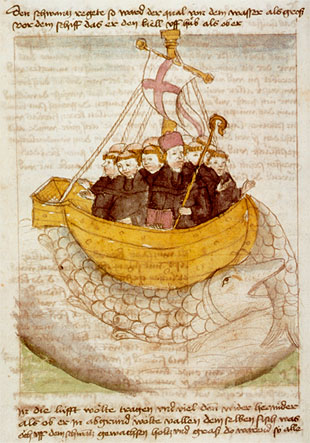
Brendan the Navigator
Irish monastic saint

Golden Legend
collection of hagiographies compiled by Jacobus de Voragine c.1264

Saint Maurice
Egyptian saint and leader of the legendary Roman Theban Legion
Wandering Jew
European Christian legendary figure of a Jew who taunted Jesus and was cursed to immortally walk the Earth until the Second Coming

Penitent Thief
Christian saint; thief pardoned by Jesus on the cross in Luke 23:39-43
Zwarte Piet
companion of Saint Nicholas in the folklore of the Netherlands and Belgium
Holy Lance
according to the Gospel of John, lance that pierced the side of Jesus as he hung on the cross
Rudolph the Red-Nosed Reindeer
fictional male reindeer

Sinterklaas
Sinterklaas () or Sint-Nicolaas () is a legendary figure based on Saint Nicholas, patron saint of children. Other Dutch names for the figure include De Sint ("The Saint"), De Goede Sint ("The Good Saint") and De Goedheiligman (derived from goed hylickman meaning "good marriage man", alluding to his historical reputation as a Saint who can help you find a good life partner). Many descendants and cognates of "Sinterklaas" or "Saint Nicholas" in other languages are also used in the Low Countries, nearby regions, and former Dutch colonies.

Pontius Pilate's wife
ancient Roman woman and saint
Santa Muerte
Mexican cult image, female deity, and folk saint

Tarasque
The Tarasque () is a creature from French mythology. According to the Golden Legend, the beast had a lion-like head, a body protected by turtle-like carapace(s), six feet with bear-like claws, a serpent's tail, and could expel a poisonous breath.

Christkind
thumb|Christkind
The Christkind (; ), also called Christkindl, is the traditional Christmas gift-bringer in Austria, Switzerland, Slovenia, Southern Germany and Western Germany, the Czech Republic, Croatia, Liechtenstein, Luxembourg, the eastern part of Belgium, Portugal, Slovakia, Hungary, parts of northeastern France, Upper Silesia in Poland, parts of Latin America, in certain areas of southern Brazil, and in the Acadiana region of Louisiana.
Caesarius of Africa
deacon and martyr
Father Christmas
Folkloric personification of Christmas in several English‐speaking parts of the world
Knecht Ruprecht
companion of Saint Nicholas in the folklore of Germany
Mrs. Claus
wife of Santa Claus
holy well
spring or other small body of water revered either in a Pagan or Christian context, often both

Joulupukki
thumb|right|Joulupukki and his wife.
'''' () is a Finnish Christmas figure. The name literally means or in Finnish; the word comes from the Old Swedish word bukker'', a cognate of English "buck", meaning . An old Nordic folk tradition, the figure is now often conflated with Santa Claus.
Saint Brendan's Island
phantom island in North Atlantic Ocean
Red Jews
in German legends, a Jewish nation that would invade Europe during the tribulations leading to the end of the world
Vasilopita
Vasilopita (, Vasilópita, lit. '(St.) Basil-pie' or 'Vassilis pie', see below) is a New Year's Day bread, cake or pie in Greece and throughout Southeastern Europe which contains a hidden coin or trinket which gives good luck to the receiver, like the Western European king cake. It is associated with Saint Basil's day, 1 January, in most of Greece, but in some regions, the traditions surrounding a cake or pita with a hidden coin are attached to Epiphany or to Christmas. It is made of a variety of dough, depending on regional and family tradition, including tsoureki. In some families, instead of

Little Flowers of St. Francis
literary work
Black Nazarene
Roman Catholic devotional image of a black Jesus the Nazarene
Santa Compaña
deep-rooted mythical belief
Saint George and the Dragon
medieval legend

Gauchito Gil
Argentine folk saint

altar cruet
small, stoppered vessel for wine and water used in the celebration of the Christian Eucharist
Père Fouettard
Companion of St. Nicholas in folklore
Chiaffredo
Chiaffredo (also Chiaffredus, Theofredus, Ciafrè, Chaffre, Teofredo, Jafredo, Jafredus, Eufredus, Jofredus, Sinfredus, Zaffredus) is venerated as the patron saint of Saluzzo, Italy.
church grim
mythical churchyard-guardian spirit-animal
Saint Amaro
Abbot and sailor
Percht
Primitive rituals based on folklore, pre-christian Alpine traditions
Elucidarium
thumb|A German chapbook version printed in 1559. The title page shows a [[compass rose with the names of twelve winds.]]
Elucidarium (also Elucidarius, so called because it "elucidates the obscurity of various things") is an encyclopedic work or summa about medieval Christian theology and folk belief, originally written in the late 11th century by Honorius Augustodunensis, influenced by Anselm of Canterbury and John Scotus Eriugena. It was probably complete by 1098, as the latest work by Anselm that finds mention is Cur deus homo. This suggests that it is the earliest work by Honorius, written
list of names for the biblical nameless
Wikimedia list article
soul cake
religious cake to commemorate the dead
Himmelsbrief
A Himmelsbrief, also known as a "heaven's letter" or "heavenly letter", is a religious document said to have been written by God or a divine agent. Their purpose is to protect the bearer or place from all evil and danger; however, there is a price for their protection.
Companions of Saint Nicholas
folkloric figures who accompany the gift-bringer
folk saint
spirit unofficially recognized by a group of people
Christmas gift-bringer
Christmas folklore being
Chavittu Nadakam
Indian folk dance drama