Category
page 1Classical mechanics

force
In physics, a force is an action that can cause an object to change its velocity or its shape, or to resist other forces, or to cause changes of pressure in a fluid. In mechanics, force makes ideas like 'pushing' or 'pulling' mathematically precise. Because the magnitude and direction of a force are both important, force is a vector quantity (force vector). The SI unit of force is the newton (N), and force is often represented by the symbol .

Newton's laws of motion
classical formulation of Mechanics by Isaac Newton

classical mechanics
sub-field of mechanics, which is concerned with the set of physical laws describing the motion of bodies under the action of a system of forces

inertia

kinematics
Kinematics is a subfield of physics and
a branch of geometry. In physics, kinematics studies the geometrical aspects of motion of physical objects independent of forces that set them in motion. Constrained motion such as linked machine parts are also described as kinematics. In geometry, kinematics studies the time dependence of geometrical quantities such as position, distance and angular measure with respect to a frame of reference. Most frequently, the quantities that kinematics deals with are the time derivatives of these quantities and the relations between them. Objects whose motion is

friction
thumb|360px|The blue plate has more friction on the sloped surface than the green one, so slides down slower.
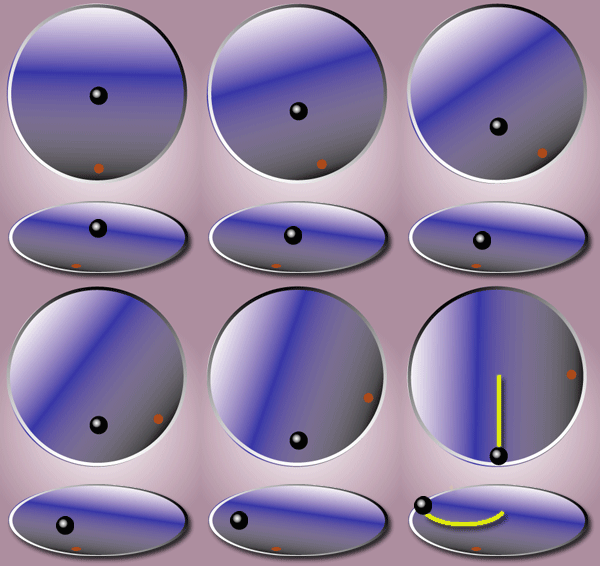
Coriolis force
apparent or fictitious force on objects moving within a reference frame that rotates with respect to an inertial frame

rotation
right|thumb|A sphere rotating (spinning) about an axis
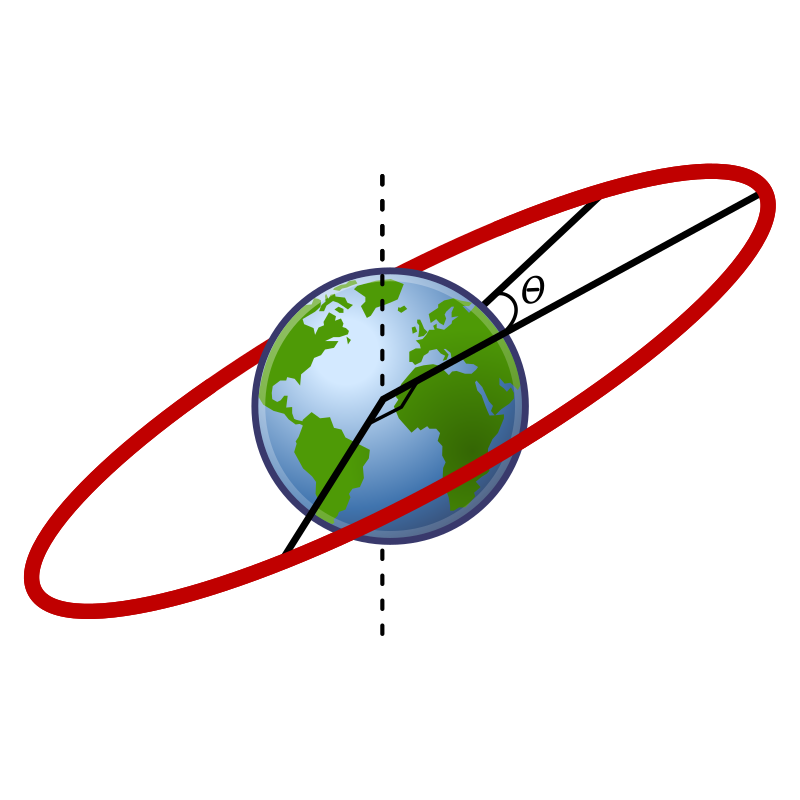
celestial mechanics
branch of astronomy

center of mass
unique point where the weighted relative position of a distributed mass sums to zero

lift
force; aerodynamics term

impulse
integral of a force over the time interval for which it acts; term in classical mechanics

continuum mechanics
branch of physics which studies the behavior of materials modeled as continuous media
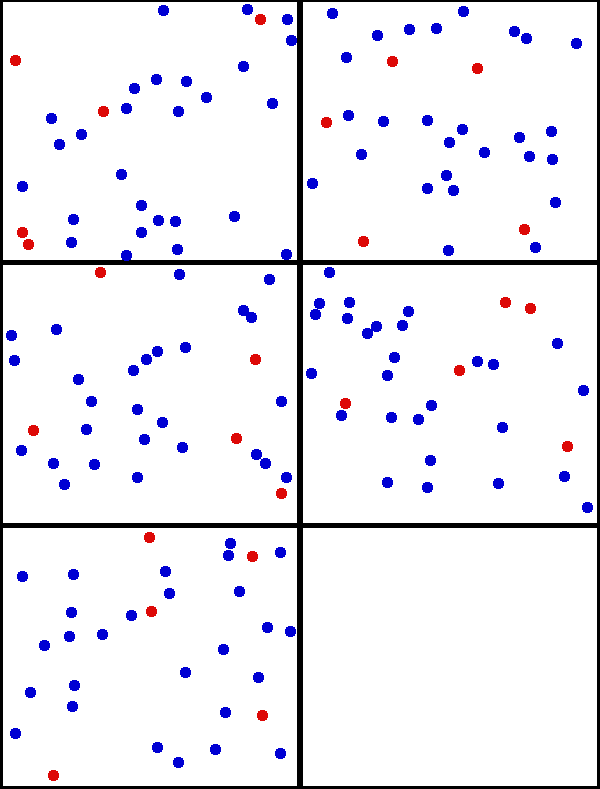
kinetic theory
mathematical model explaining macroscopic properties of gases in microscopic terms

inertial frame of reference
frame of reference not undergoing acceleration

circular motion
object movement along a circular path
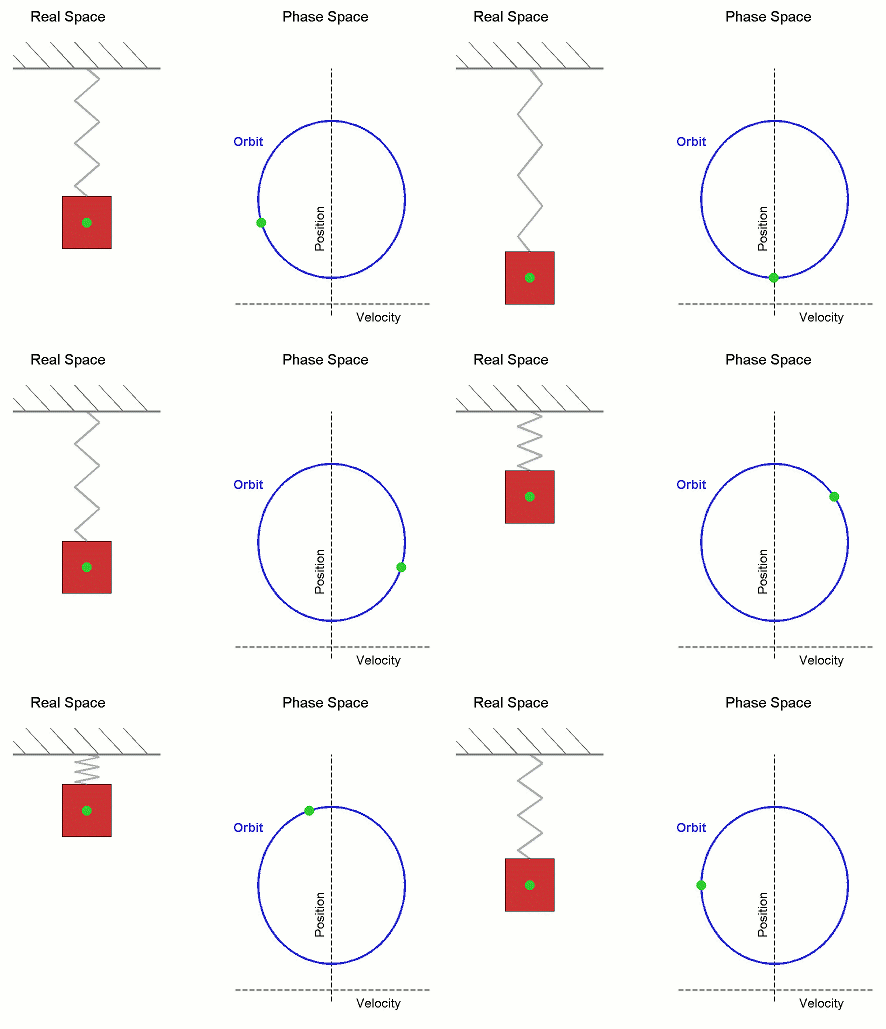
simple harmonic motion
to and fro periodic motion in science and engineering
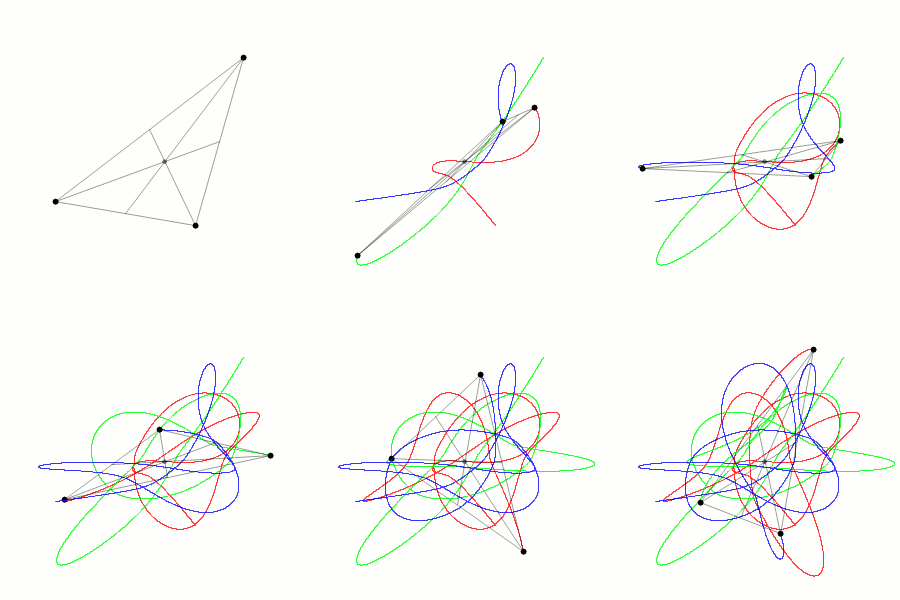
three-body problem
classical mechanics problem of three massive point particles interacting via Newtonian gravity; special case of the 𝑛‐body problem for 𝑛=3
Hamiltonian mechanics
formulation of classical mechanics in terms of phase space and Hamiltonian function

equations of motion
differential equation that describes the motion of a physical system
fictitious force
apparent force that acts on all masses whose motion is described using a non-inertial frame of reference, such as a rotating reference frame

jerk
rate of change of acceleration

point particle
particle with no physical extent, either an idealization or a feature of elementary particles

damping
thumb|upright|Underdamped spring–mass system with
principle of least action
a variational principle that, when applied to the action of a mechanical system, can be used to obtain the equations of motion for that system
D'Alembert's principle
principle
linear motion
motion along a dimension of length (straight line in space)
central force
force directed towards or away from a point
absolute time and space
theoretical foundation of Newtonian mechanics
specific impulse
how efficiently a reaction mass engine creates thrust, which is often proportional to effective exhaust gas velocity
elastic collision
collision in which kinetic energy is conserved and not dissipated
Mohr's circle
geometric engineering calculation technique
Modified Newtonian dynamics
alternative explanation of the non-Newtonian rotation of galaxies
potential well
concept in quantum mechanics
Galilean invariance
principle in classical mechanics stating that the laws of motion are the same in all inertial frames
normal mode
pattern of motion in which all parts of the system move sinusoidally with the same frequency and with a fixed phase relation
rolling resistance
force resisting the motion when a body (such as a ball, tire, or wheel) rolls on a surface
Laplace–Runge–Lenz vector
vector used chiefly to describe the shape and orientation of the orbit of one astronomical body around another, such as a planet revolving around a star
non-inertial reference frame
frame of reference

hodograph
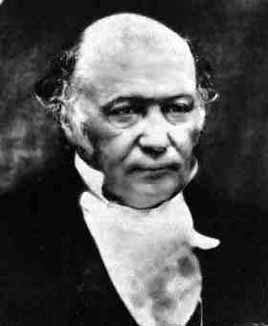
A hodograph is a diagram that gives a vectorial visual representation of the movement of a body or a fluid. It is the locus of one end of a variable vector, with the other end fixed. The position of any plotted data on such a diagram is proportional to the velocity of the moving particle. It is also called a velocity diagram. It appears to have been used by James Bradley, but its practical development is mainly from Sir William Rowan Hamilton, who published an account of it in the Proceedings of the Royal Irish Academy in 1846.
inelastic collision
collision where energy is lost to heat, so that kinetic energy is not conserved
reaction
part of Newton's laws
N-body problem
problem of predicting the individual motions of a group of celestial objects interacting with each other gravitationally
free particle
particle that, in some sense, is not bound by an external force, or equivalently not in a region where its potential energy varies
relative velocity
velocity of an object or observer B in the rest frame of another object or observer A
elastic energy
forms of energy
theory of impetus
concept similar to inertia and momentum
Bertrand's theorem
theorem that, among central-force potentials with bound orbits, there are only 2 types of central-force scalar potentials such that all bound orbits are closed: inverse square and radial harmonic
configuration space
in classical mechanics, configuration of a system consisting of the set of positions taken by all components subject to kinematical constraints
history of classical mechanics
aspect of history
coefficient of restitution
measure used to characterise inelastic collisions
geometric phase
phase of a cycle
tennis racket theorem
theorem that, in a 3d rigid body with 3 principal axes, rotation around 1st and 3rd principal axes is stable, but rotation around 2nd principal axis is not
holonomic constraints
type of constraints for optimization problems
Kepler problem
special case of the two-body problem
Virtual displacement
Displacement in analytical mechanics
surface density
the density of a two-dimensional object, or of the surface of a three-dimensional object, calculated as the mass per area
tppe top
spinning physics toy
rotating reference frame
special case of a non-inertial reference frame that is rotating relative to an inertial reference frame
impact parameter