File:Translational_motion.gif · Wikimedia Commons · See Wikimedia Commons
kinetic theory
Sign in to saveAlso known as kinetic theory of gases
mathematical model explaining macroscopic properties of gases in microscopic terms
Kinetic theory is a mathematical model that explains the large-scale properties we observe in gases—like pressure and temperature—by describing what's happening at the microscopic level with individual gas molecules. It matters because it lets us understand and predict how gases behave based on the motion and collisions of their tiny particles.
AI-generated from the Wikipedia summary — may contain errors.
Wikidata facts
- Instance of
- scientific theory
- Image
- Translational motion frame.png
Show 2 more facts
- Stack Exchange tag
- physics.stackexchange.com/tags/kinetic-theory
- maintained by WikiProject
- WikiProject Mathematics
via Wikidata · CC0
~40 min read
Encyclopedic overview
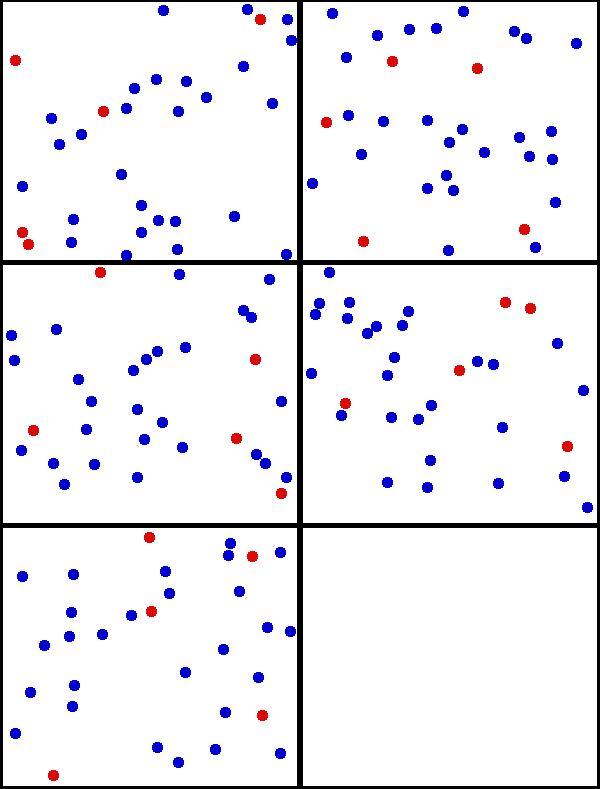
The temperature of the ideal gas is proportional to the average kinetic energy of its particles. The size of helium atoms relative to their spacing is shown to scale under 1,950 atmospheres of pressure. The atoms have an average speed relative to their size slowed down here two trillion fold from that at room temperature.
The kinetic theory of gases is a simple classical model of the thermodynamic behavior of gases. Its introduction allowed many principal concepts of thermodynamics to be established. It treats a gas as composed of numerous particles, too small to be seen with a microscope, in constant, random motion. These particles are now known to be the atoms or molecules of the gas. The kinetic theory of gases uses their collisions with each other and with the walls of their container to explain the relationship between the macroscopic properties of gases, such as volume, pressure, and temperature, as well as transport properties such as viscosity, thermal conductivity and mass diffusivity.
Excerpted from Wikipedia’s “kinetic theory” article, available under the CC BY-SA 4.0 licence.