Category
page 1Classical music styles

opera
280px|thumb|Macbeth (Verdi)|Macbeth at the [[Savonlinna Opera Festival in St. Olaf's Castle, Savonlinna, Finland, in 2007]]
thumb|280px|La Scala of Milan
thumb|280px|Palais Garnier of the [[Paris Opéra]]
Opera is a form of Western theatre in which music is a fundamental component and dramatic roles are taken by singers. Such a "work" (the literal translation of the Italian word "opera") is typically a collaboration between a composer and a librettist and incorporates a number of the performing arts, such as acting, scenery, costume, and sometimes dance or ballet. The performance is typically g

symphony
thumb|300px|A performance of Gustav Mahler's Eighth Symphony in the [[Kölner Philharmonie by the conducted by ]]

chamber music
form of classical music composed for a small group of instruments

sonata
thumb|upright=1.3|Ludwig van Beethoven's manuscript sketch for Piano Sonata No. 28, Movement IV Geschwind, doch nicht zu sehr und mit Entschlossenheit (Allegro), in his own handwriting. The piece was completed in 1816.

cantata
thumb|300px|Soloquartet and strings

oratorio
An oratorio () is a musical composition with dramatic or narrative text for choir, soloists and orchestra or other ensemble.

fugue
thumb|The six-part fugue in the "Ricercar a 6" from [[The Musical Offering, in the hand of Johann Sebastian Bach]]
In classical music, a fugue (, from Latin , meaning 'flight' or 'escape') is a contrapuntal, polyphonic compositional technique in two or more voices, built on a subject (a musical theme) that is introduced at the beginning in imitation (repetition at different pitches), which recurs frequently throughout the course of the composition. It is not to be confused with a fuguing tune, which is a style of song popularized by and mostly limited to early American (i.e. shape note or "Sac

serenade
right|thumb|Serenade by Leyster|Serenade by [[Judith Leyster]]
thumb|Serenade in the Ottoman empire, 1688
In music, a serenade (; also sometimes called a serenata, from the Italian) is a musical composition or performance delivered in honour of someone or something. Serenades are typically calm, light pieces of music. The term comes from the Italian word , which itself derives from the Latin . Sense influenced by Italian sera "evening", from Latin sera, fem. of serus "late".

motet
thumb|250px|The first page from the manuscript of [[J. S. Bach's Baroque era motet, entitled Der Geist hilft unser Schwachheit auf (BWV226)]]

nocturne
thumb|Frédéric Chopin's Nocturne in G Minor, Op. 15, No. 3. The marking "languido e rubato", slow tempo, and subdued dynamics creates an evocative mood characteristic of nocturnes.
A nocturne is a musical composition that is inspired by, or evocative of, the night.
.jpg)
concerto
thumb|Violinist Irvine Arditti performing Ligeti's Violin Concerto with the [[Mexico City Philharmonic Orchestra under conductor José Areán, 14 June 2014]]
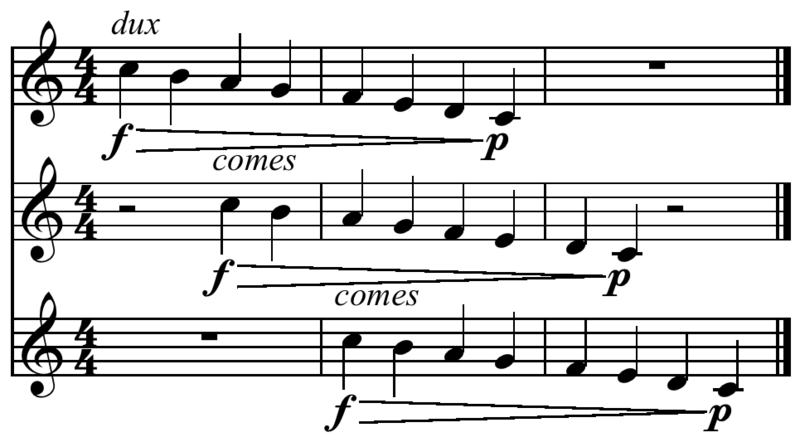
canon
contrapuntal form of music involving a self-harmonizing theme with imitations offset in time

étude
upright=1.3|thumb|Frédéric Chopin's Étude Op. 10, No. 2 (Chopin)|Étude Op. 10, No. 2: a rapid [[chromatic scale in the right hand is used to develop the weaker fingers of the right hand. Most études are written to perfect a particular technical skill.]]
upright=1.3|thumb|Frédéric Chopin's Étude Op. 25, No. 11 (Chopin)|Étude Op. 25, No. 11
prelude
musical compositions that introduce another or larger instrumental work
scherzo
A scherzo (, , ; plural scherzos or scherzi), in western classical music, is a short composition – sometimes a movement from a larger work such as a symphony or a sonata. The precise definition has varied over the years, but scherzo often refers to a movement that replaces the minuet as the third movement in a four-movement work, such as a symphony, sonata, or string quartet. The term can also refer to a fast-moving humorous composition that may or may not be part of a larger work.
rhapsody
musical form

toccata
thumb|upright=1.35|The first page of Johann Sebastian Bach|J. S. Bach's [[Toccata and Fugue in D minor, BWV 565]]
Toccata (from Italian toccare, literally, "to touch", with "toccata" being the action of touching) is a virtuoso piece of music typically for a keyboard or plucked string instrument featuring fast-moving, lightly fingered or otherwise virtuosic passages or sections, with or without imitative or fugal interludes, generally emphasizing the dexterity of the performer's fingers. Less frequently, the name is applied to works for multiple instruments (the opening of Claudio Monteverdi's
divertimento
(; from the Italian divertire "to amuse") is a musical genre, with most of its examples from the 18th century. The mood of the divertimento is most often lighthearted (as a result of being played at social functions) and it is generally composed for a small ensemble. The term is used to describe a wide variety of secular (non-religious) instrumental works for soloist or chamber ensemble. It is usually a kind of music entertainment, although it could also be applied to a more serious genre. After 1780, the term generally designated works that were informal or light.
romance
musical form of brief, simple melody
intermezzo
In music, an intermezzo (, , plural form: intermezzi), in the most general sense, is a composition which fits between other musical or dramatic entities, such as acts of a play or movements of a larger musical work. In music history, the term has had several different usages, which fit into two general categories: the opera intermezzo and the instrumental intermezzo.
fantasia
free form musical interpretation; musical composition with a free form and often an improvisatory style
capriccio
piece of music, usually fairly free in form and of a lively character
impromptu
An impromptu (, , loosely meaning "offhand") is a free-form musical composition with the character of an ex tempore improvisation as if prompted by the spirit of the moment, usually for a solo instrument, such as piano. According to Allgemeine musikalische Zeitung, Johann Baptist Cramer began publishing piano pieces under the (sub-)title of "impromptu." (AMZ, Mar. No II, 1815, col. 6), which seems to be the first recorded use of the term impromptu in this sense.

ricercar
A ricercar ( , ) or ricercare ( , ) is a type of late Renaissance and mostly early Baroque instrumental composition. The term ricercar derives from the Italian verb , which means "to search out; to seek"; many ricercars serve a preludial function to "search out" the key or mode of a following piece. A ricercar may explore the permutations of a given motif, and in that regard may follow the piece used as illustration. The term is also used to designate an etude or study that explores a technical device in playing an instrument, or singing.
bagatelle
short piece of music
cantabile
Cantabile is a term in music meaning to perform in a singing style. The word is taken from the Italian language and literally means "singable" or "songlike". In instrumental music, it is a particular style of playing designed to imitate the human voice. The German-language equivalent to cantabile is gesangvoll.
quodlibet
A quodlibet (; Latin for "whatever you wish" from quod, "what" and libet, "pleases") is a musical composition that combines several different melodies—usually popular tunes—in counterpoint, and often in a light-hearted, humorous manner.
villanella
In music, a villanella (; plural villanelle) is a form of light Neapolitan secular vocal music which originated in the Kingdom of Naples just before the middle of the 16th century. It first appeared in Naples, and influenced the later canzonetta, and from there also influenced the madrigal.
humoresque
Humoresque () is a genre of Romantic music characterized by pieces with fanciful humor in the sense of mood rather than wit.
canzonetta
In music, a canzonetta (; pl. canzonette, canzonetti or canzonettas) is a popular Italian secular vocal composition that originated around 1560. Earlier versions were somewhat like a madrigal but lighter in style—but by the 18th century, especially as it moved outside of Italy, the term came to mean a song for voice and accompaniment, usually in a light secular style.
cantilena
A (Italian for "lullaby" and Latin for "old, familiar song") is a vocal melody or instrumental passage in a smooth, lyrical style.
salon music
popular music genre in Europe during the 19th century
chorale prelude
musical composition for organ based on a chorale melody
waltz
music genre and type of musical composition, performed in triple meter, often written in ¾ time
cassation
minor musical genre related to the serenade and divertimento; comprises loosely assembled sets of short movements intended for outdoor performance by orchestral or chamber ensembles
light music
music genre; musical style of "light" orchestral music
ballade
musical setting of a literary ballad; poetic and musical genre in the 18th and 19th centuries, popular with the Romantics and their later epigones

intermedio
thumb|Setting designed by Bernardo Buontalenti for the third intermedio from the 1589 Medici wedding: Apollo defeats the monster terrorizing [[Delos.]]
thumb|Another of the 1589 intermedi: number 4: the demons lament that with the coming of the Golden Age there will be no more souls to torment.
sinfonietta
symphony that is smaller in scale (either in terms of length or the instrumental forces required), or lighter in approach than a standard symphony
list of classical music genres
Wikimedia music-related list
art song
vocal music composition, usually written for one voice with piano accompaniment, and usually in the classical art music tradition
ballet
musical form
stile antico
manner of musical composition
Ruggiero
musical scheme
arabesque
type of music which uses melodies to create the atmosphere of Arabic architecture
Unmeasured prelude
Harmonie
A '''''' is an ensemble of wind instruments (usually about five to eight players) employed by an aristocratic patron, particularly during the Classical era of the 18th century. The Harmonie would be employed for outdoor or recreational music, or as a wind section of an orchestra. Music composed for Harmonie is often called .
masonic music
Music used in connection with the ritual and social functions of freemasonry
melodeclamation
Melodeclamation (from Greek “melos” = song, and Latin “declamatio” = declamation) was a chiefly 19th century practice of reciting poetry while accompanied by concert music. It is also described as "a type of rhythmic vocal writing that bears a resemblance to Sprechstimme."