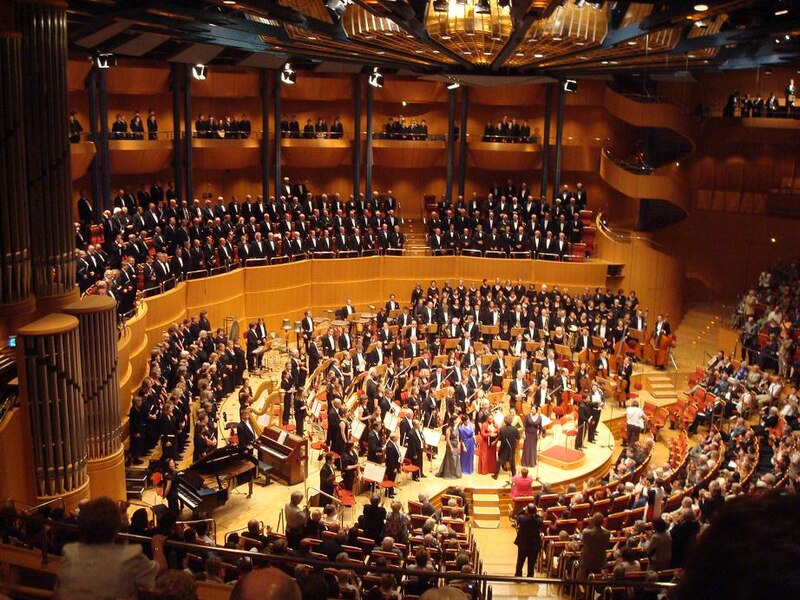
File:8th_symphony_of_Mahler,_Kölner_Philharmonie,_27-6-2009.JPG · Wikimedia Commons · See Wikimedia Commons
symphony
Sign in to saveAlso known as symphonies
thumb|300px|A performance of Gustav Mahler's Eighth Symphony in the [[Kölner Philharmonie by the conducted by ]]
I cannot write an accurate overview based on this context alone, as it only contains a photo caption of a specific symphony performance and lacks information about what symphonies are, their characteristics, or their significance. To provide accurate and factual information as requested, I would need more substantive source material.
AI-generated from the Wikipedia summary — may contain errors.
Wikidata facts
- Instance of
- music genre
- Subclass of
- composed musical work
- Image
- Ninth Symphony original.png
Show 9 more facts
- different from
- sinfonia concertante
- Commons category
- Symphonies
- topic's main category
- Category:Symphonies
- on focus list of Wikimedia project
- Wikipedia:Vital articles/Level/4
- described by source
- Granat Encyclopedic Dictionary
- maintained by WikiProject
- WikiProject Classical music
- has list
- list of symphonies by number
- inception
- 1600-00-00
- influenced by
- sinfonia
via Wikidata · CC0
~24 min read
Encyclopedic overview
12 sectionsContents
- Etymology and origins
- Baroque era
- Galant and classical eras
- Romantic era
- Late-Romantic, Modernist and Postmodernist eras
- Symphonies for concert band
- Other modern usages of "symphony"
- See also
- References
- Sources
- Further reading
- External links
thumb|300px|A performance of Gustav Mahler's Eighth Symphony in the [[Kölner Philharmonie by the conducted by ]]
A symphony is an extended musical composition in Western classical music, most often for orchestra. Although the term has had many meanings from its origins in the ancient Greek era, by the late 18th century the word had taken on the meaning common today: a work usually consisting of multiple distinct sections or movements, often four, with the first movement in sonata form. Symphonies are almost always scored for an orchestra consisting of a string section (violin, viola, cello, and double bass), brass, woodwind, and percussion instruments which altogether number about 30 to 100 musicians. Symphonies are notated in a musical score, which contains all the instrument parts. Orchestral musicians play from parts which contain just the notated music for their own instrument. Some symphonies also contain vocal parts (e.g., Beethoven's Ninth Symphony, or Mahler's Second Symphony).
Excerpted from Wikipedia’s “symphony” article, available under the CC BY-SA 4.0 licence.
Gallery (4)
Available in 106 languages
- Español
- Français
- Deutsch
- 中文
- 日本語
- Русский
- Português
- Italiano
- العربية
- हिन्दी
- Afrikaans
- Albanian
- Albanian
- Aragonese
- Armenian
- Assamese
- Asturian
- azb
Show 87 more
- Azerbaijani
- Bahasa Indonesia
- Bangla
- Bashkir
- Basque
- bat_smg
- be_x_old
- Belarusian
- Bosnian
- Breton
- Bulgarian
- Burmese
- Catalan
- Central Kurdish
- Crimean Tatar
- Croatian
- Czech
- Danish
- Egyptian Arabic
- Esperanto
- Estonian
- Fiji Hindi
- Finnish
- Galician
- Georgian
- Greek
- Guarani
- Hebrew
- Hungarian
- hyw
- Icelandic
- Ido
- Interlingua
- Irish
- Kazakh
- Kyrgyz
- Latin
- Latvian
- Limburgish
- Lithuanian
- Low German
- Macedonian
- Malay
- Malayalam
- Marathi
- Mongolian
- nds_nl
- Nederlands
- Newari
- Norwegian
- Norwegian Nynorsk
- Occitan
- Piedmontese
- Polski
- Punjabi
- Romanian
- Rusyn
- Saterland Frisian
- Serbian
- Serbian (Latin)
- simple
- Sindhi
- Slovak
- Slovenian
- Svenska
- Swahili
- Tajik
- Tamil
- Tatar
- Tiếng Việt
- Türkçe
- Ukrainian
- Urdu
- Uzbek
- Veps
- Walloon
- Waray
- Welsh
- Western Frisian
- Western Panjabi
- Wu Chinese
- Yiddish
- zh_min_nan
- zh_yue
- فارسی
- ไทย
- 한국어
via Wikidata sitelinks · CC0