Category
page 1Complex analysis

Pi
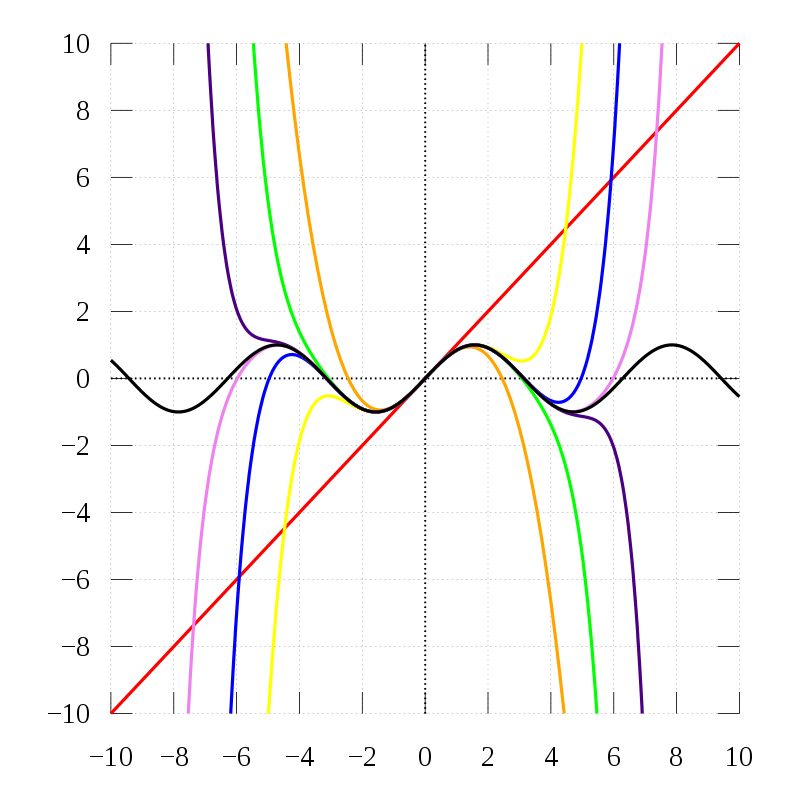
Taylor series
expression of a function as an infinite sum

complex analysis
branch of mathematics studying functions of a complex variable

power series
infinite sum of monomials
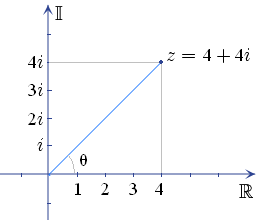
complex plane
geometric representation of the complex numbers
line integral
definite integral of a scalar or vector field along a path
Laurent series
power series generalized to allow negative powers
Cauchy–Riemann equations
system of linear partial differential equations characterizing holomorphic (complex differentiable) functions
pole
isolated singularity of a holomorphic function 𝑓 such that 1/𝑓 has a zero and is holomorphic at the singularity
residue
coefficient of the term of order −1 in the Laurent expansion of a function holomorphic outside a point, whose value can be extracted by a contour integral
bounded function
function or sequence whose possible values form a bounded set
argument
angle of complex number about real axis
Mellin transform
mathematical operation
binomial series
Taylor series
winding number
number of times a curve wraps around a point in the plane
logarithmic derivative
ratio of a function's derivative to the function; d(ln|f(x)|)/dx
Cauchy product
concept in mathematics
essential singularity
isolated singularity that is neither removable nor a pole
Kramers–Kronig relations
relations connecting the real and imaginary parts of any complex function that is analytic in the upper half-plane
asymptotic expansion
series which gives an approximation to a function as the argument tends to some point
isolated singularity
isolated singularity is one that has no other singularities close to it
domain coloring
technique for visualizing complex functions

monodromy
thumb|The imaginary part of the complex logarithm. Trying to define the complex logarithm on \C-\{0\} gives different answers along different paths. This leads to an infinite cyclic monodromy group and a covering of \C-\{0\} by a [[helicoid (an example of a Riemann surface).]]
branch point
point of interest for complex multi-valued functions
Hardy space
space of holomorphic functions on the unit disk or upper half plane
contour integration
method of evaluating certain integrals along paths in the complex plane
inverse Laplace transform
the inverse operation to the Laplace transform
almost periodic function
function that "converges" to periodicity
upper half-plane
complex numbers with positive imaginary part
subharmonic function
function f such that, if f≤h on the boundary of a ball for any harmonic function h, then f≤h also inside the ball
complex dynamics
branch of mathematics about iteration of complex-valued functions
positive-definite function
bimodal function
Hilbert's inequality
inequality applying to sequences of complex numbers
Antiholomorphic function
Function family in complex analysis
hyperfunction
In mathematics, hyperfunctions are generalizations of functions, as a 'jump' from one holomorphic function to another at a boundary, and can be thought of informally as distributions of infinite order. Hyperfunctions were introduced by Mikio Sato in 1958 in Japanese, (1959, 1960 in English), building upon earlier work by Laurent Schwartz, Grothendieck and others.
quasiperiodic function
mathematical function
Schramm–Loewner evolution
conformally invariant stochastic process
algebraic analysis
technique of studying linear partial differential equations
normal family
collection of continuous functions
principal value
values along one branch of a multivalued function so that it is single-valued
Stefan Bergman Prize
annual mathematics award
ramification
branching out of a mathematical structure
dessin d'enfant
type of graph drawing used to study Riemann surfaces
Wirtinger derivative
linear partial differential operators (first order constant coefficients) on f(ℂⁿ or ℝ²ⁿ)
holomorphic function of exponential type
holomorphic function with growth bounded by an exponential function
Nörlund–Rice integral
mathematical integral
Schwarzian derivative
nonlinear differential operator used to study conformal mappings
Blaschke product
concept in complex analysis
Partial fractions in complex analysis
way of writing a meromorphic function
Cousin problems
creating a meromorphic function in multiple variables
Line integral convolution
method for visualizing vector fields
regular singular point
concept in differential equation mathematics
Rothe–Hagen identity
mathematical theorem
principal branch
function which selects one section of a multi-valued function
Bergman space
Quasiconformal mapping
homeomorphism between plane domains