Category
page 1Concepts in astrophysics

black body
idealized physical body that absorbs all incident electromagnetic radiation

event horizon
boundary of a region of spacetime from which one cannot escape once entered

luminosity
thumb|The Sun has an intrinsic luminosity of . In astronomy, this amount is equal to one [[solar luminosity, represented by the symbol L⊙. A star with four times the radiative power of the Sun has a luminosity of .]]
Luminosity is an absolute measure of radiated electromagnetic energy per unit time, and is synonymous with the radiant power emitted by a light-emitting object. In astronomy, luminosity is the total amount of electromagnetic energy emitted per unit of time by a star, galaxy, or other astronomical objects.
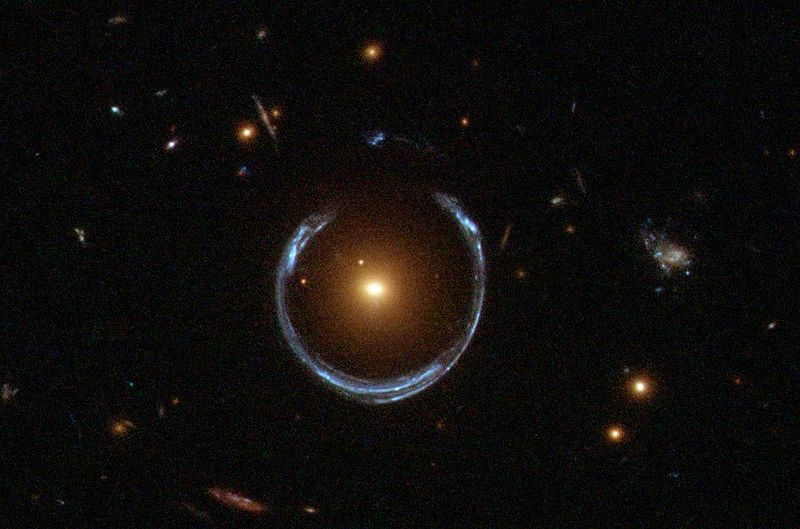
gravitational lens
distribution of matter between a distant light source and a observer

Roche limit
astronomical concept

metallicity
thumb|250px|right|The globular cluster M80. Stars in globular clusters are mainly older metal-poor members of [[population II.]]
In astronomy, metallicity is the abundance of elements present in an object that are heavier than hydrogen and helium. Most of the normal currently detectable (i.e. non-dark) matter in the universe is either hydrogen or helium, and astronomers use the word metals as convenient shorthand for all elements except hydrogen and helium. This word-use is distinct from the conventional chemical or physical definition of a metal as an electrically conducting element. Sta

accretion
astrophysical process in which matter gravitationally collects into a massive object

degenerate matter
collection of free, non-interacting particles with a pressure and other physical characteristics determined by quantum mechanical effects
hydrostatic equilibrium
in fluid mechanics, state in which compression due to gravity is balanced by a pressure gradient which creates a pressure gradient force in the opposite direction

effective temperature
estimated temperature of an astronomical body

black-body radiation
thermal electromagnetic radiation
photodissociation
Photodissociation, photolysis, photodecomposition, or photofragmentation is a chemical reaction in which molecules of a chemical compound are broken down by absorption of light (photons). It is defined as the interaction of one or more photons with one target molecule that dissociates into two fragments.
axion
An axion () is a hypothetical elementary particle originally theorized in 1978 independently by Frank Wilczek and Steven Weinberg as the Goldstone boson of Peccei–Quinn theory, which had been proposed in 1977 to solve the strong CP problem in quantum chromodynamics (QCD). If axions exist and have low mass within a specific range, they are of interest as a possible component of cold dark matter.
Eddington luminosity
maximum luminosity of a body in hydrostatic equilibrium
Yarkovsky effect
force acting on a rotating body in space caused by the anisotropic emission of thermal photons, which carry momentum
neutronium
Neutronium (or element zero) is a hypothetical substance made purely of neutrons. The word was coined by scientist Andreas von Antropoff in 1926 (before the 1932 discovery of the neutron) for the hypothetical "element of atomic number zero" (with no protons in its nucleus) that he placed at the head of the periodic table (denoted by -).
space weather
branch of space physics concerned with conditions in the Solar System
light cone
path taken by a flash of light through spacetime
differential rotation
astronomical phenomenon
helium flash
brief thermal runaway nuclear fusion in the core of low mass stars
frost line
astrophysics concept
Kelvin–Helmholtz mechanism
process of energy release of a contracting star or planet
galaxy rotation curve
plot of the orbital speeds of visible stars or gas in that galaxy versus their radial distance from that galaxy’s center
Jeans instability
mechanism which causes the collapse of interstellar gas clouds and subsequent star formation

r-process
In nuclear astrophysics, the rapid neutron-capture process, also known as the '''r-process', is a set of nuclear reactions that is responsible for the creation of approximately half of the atomic nuclei heavier than iron, the "heavy elements", with the other half produced largely by the s-process. The r-process synthesizes the more neutron-rich of the stable isotopes of even elements, and those separated from the beta-stable isotopes by those that are not often have very low s-process yields and are considered r-only nuclei; the heaviest isotopes of most even elements from zinc to mercury fall
N-body problem
problem of predicting the individual motions of a group of celestial objects interacting with each other gravitationally
baryon asymmetry
abundance of matter (baryons) and lack of antimatter (antibaryons) in our Observable Universe
Bond albedo
albedo subtype
bidirectional reflectance distribution function
function of four real variables that defines how light is reflected at an opaque surface
atmospheric escape
loss of planetary atmospheric gases to outer space
standard candle
one of several types of star with common characteristics that may be used to calculate the distance to celestial bodies
tidal heating
thermal effect of tidal deformation
circular polarization
polarization state
Urca process
phenomenon in astroparticle physics
ekpyrotic universe
cosmological model which identifies the Big Bang with a collision between branes and which solves the flatness and homogeneity problems via the flatness of the branes without invoking inflation
strangelet
A strangelet (pronounced ) is a hypothetical particle consisting of a bound state of roughly equal numbers of up, down, and strange quarks. An equivalent description is that a strangelet is a small fragment of strange matter, small enough to be considered a particle. The size of an object composed of strange matter could, theoretically, range from a few femtometers across (with the mass of a light nucleus) to arbitrarily large. Once the size becomes macroscopic (on the order of meters across), such an object is usually called a strange star. The term "strangelet" originates with Edward Farhi a
Strömgren sphere
sphere of ionized hydrogen around a young star of the spectral classes O or B
Hayashi limit
Value in astrophysics
cosmogenic nuclide
isotopes that are produced by interaction of cosmic rays with the nucleus of the atom
mass-to-light ratio
ratio of total mass of a galaxy or cluster to its luminosity

Plasmoid
thumbnail|right|300px|Natural plasmoid produced in the near-Earth magnetotail by magnetic reconnection
A plasmoid is a coherent structure of plasma and magnetic fields. Plasmoids have been proposed to explain natural phenomena such as ball lightning, magnetic bubbles in the magnetosphere, and objects in cometary tails, in the solar wind, solar atmosphere, and in the heliospheric current sheet. Plasmoids produced in the laboratory include the compact toroids (similar to a vortex ring in low temperature fluid dynamics or hydrodynamics) field-reversed configurations, spheromaks, and filamentary v
velocity dispersion
in astronomy, the statistical dispersion of velocities about the mean velocity for a cluster of stars or galaxies
Flux tube
regió de l'espai tubular que conté un camp magnètic
Gunn–Peterson trough
feature of the spectra of quasars
Lindblad resonance
phenomenon in astrophysics
Gyrochronology
Gyrochronology is a method for estimating the age of a low-mass (cool) main sequence star (spectral class F8 V or later) from its rotation period. The term is derived from the Greek words gyros, chronos and logos, roughly translated as rotation, age, and study respectively. It was coined in 2003 by Sydney Barnes to describe the associated procedure for deriving stellar ages, and developed extensively in empirical form in 2007.
absolute horizon
boundary in spacetime, defined with respect to the external universe, events inside which cannot affect an external observer
Reverberation mapping
astrophysical technique
central massive object
central object of a galaxy
electron beam ion trap
electromagnetic bottle producing and confining highly charged ions
Klemperer rosette
type of gravitational system
Polarization in astronomy