File:A_Swarm_of_Ancient_Stars_-_GPN-2000-000930.jpg · Wikimedia Commons · See Wikimedia Commons
metallicity
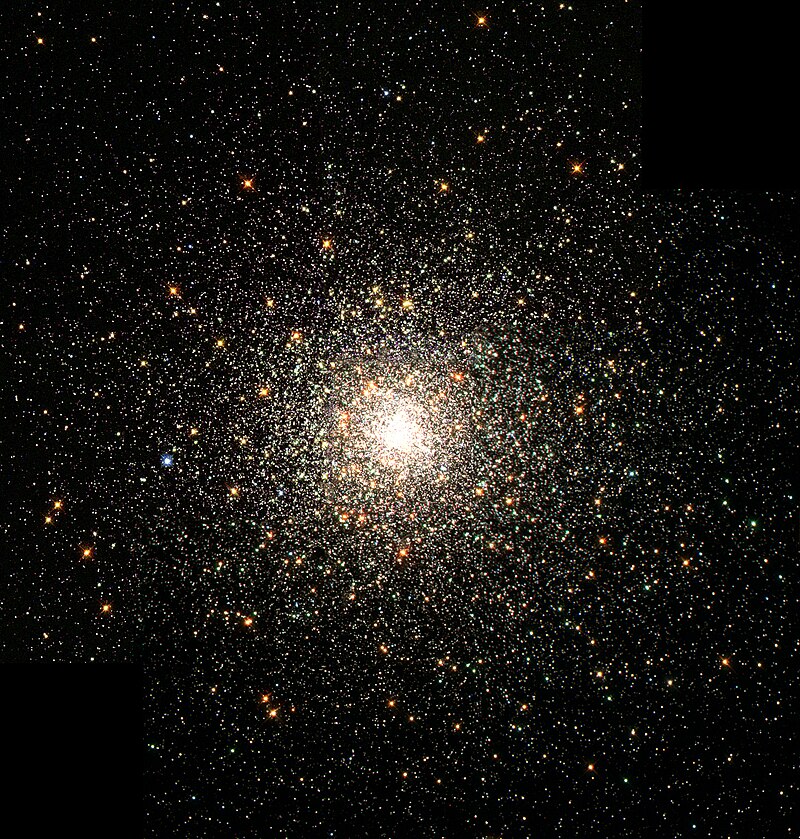
Sign in to savethumb|250px|right|The globular cluster M80. Stars in globular clusters are mainly older metal-poor members of [[population II.]] In astronomy, metallicity is the abundance of elements present in an object that are heavier than hydrogen and helium. Most of the normal currently detectable (i.e. non-dark) matter in the universe is either hydrogen or helium, and astronomers use the word metals as convenient shorthand for all elements except hydrogen and helium. This word-use is distinct from the conventional chemical or physical definition of a metal as an electrically conducting element. Sta
Wikidata facts
- Instance of
- physical property
- Subclass of
- dimensionless quantity
Show 4 more facts
- Stack Exchange tag
- physics.stackexchange.com/tags/metallicity
- different from
- metal
- topic's main category
- Category:Population II stars
- on focus list of Wikimedia project
- Wikipedia:Vital articles/Level/4
Sources (3)
via Wikidata · CC0
~17 min read
Encyclopedic overview
15 sectionsContents
- Metals in early spectroscopy
- Origin of metallic elements
- Stellar populations
- Common methods of calculation
- Mass fraction
- Chemical abundance ratios
- Photometric colors
- Metallicities in various astrophysical objects
- Stars
- Relationship between stellar metallicity and planets
- <span class="anchor" id="H-II-region-anchor">H II regions</span>
- Metallicity calibrations at high redshift
- See also
- References
- Further reading
thumb|250px|right|The globular cluster M80. Stars in globular clusters are mainly older metal-poor members of [[population II.]] In astronomy, metallicity is the abundance of elements present in an object that are heavier than hydrogen and helium. Most of the normal currently detectable (i.e. non-dark) matter in the universe is either hydrogen or helium, and astronomers use the word metals as convenient shorthand for all elements except hydrogen and helium. This word-use is distinct from the conventional chemical or physical definition of a metal as an electrically conducting element. Stars and nebulae with relatively high abundances of heavier elements are called metal-rich in discussions of metallicity, even though many of those elements are called nonmetals in chemistry.
The presence of heavier elements is the result of stellar nucleosynthesis. The majority of elements that are heavier than hydrogen and helium in the Universe are formed in the cores of stars as they evolve. Over time, stellar winds and supernovae deposit those heavier metals into the surrounding environment, which enriches the interstellar medium and provides material for the birth of new stars. Older generations of stars formed in a metal-poor early stage of the Universe, so it follows that they have lower metallicities than younger generations of stars which formed in a more metal-rich Universe.
Excerpted from Wikipedia’s “metallicity” article, available under the CC BY-SA 4.0 licence.