Category
page 1Conoidasida

toxoplasmosis

Toxoplasma gondii
obligate intracellular parasitic protozoan that causes toxoplasmosis

Cryptosporidium
Cryptosporidium, sometimes called crypto, is an apicomplexan genus of alveolates which are parasites that can cause a respiratory and gastrointestinal illness (cryptosporidiosis) that primarily involves watery diarrhea (intestinal cryptosporidiosis), sometimes with a persistent cough (respiratory cryptosporidiosis).
Coccidia
Coccidia (Coccidiasina) are a subclass of microscopic, spore-forming, single-celled obligate intracellular parasites belonging to the apicomplexan class Conoidasida.
As obligate intracellular parasites, they must live and reproduce within an animal cell. Coccidian parasites infect the intestinal tracts of animals, and are the largest group of apicomplexan protozoa.
cryptosporidiosis
Cryptosporidiosis, sometimes informally called crypto, is a parasitic disease caused by Cryptosporidium, a genus of protozoan parasites in the phylum Apicomplexa. It affects the distal small intestine and can affect the respiratory tract in both immunocompetent (i.e., individuals with a normal functioning immune system) and immunocompromised (e.g., persons with HIV/AIDS or autoimmune disorders) individuals, resulting in watery diarrhea with or without an unexplained cough. In immunosuppressed individuals, the symptoms are particularly severe and can be fatal. It is primarily spread through the

Eimeria
Eimeria is a genus of apicomplexan parasites that includes various species capable of causing the disease coccidiosis in animals such as cattle, poultry and smaller ruminants including sheep and goats. Eimeria species are considered to be monoxenous because the life cycle is completed within a single host, and stenoxenous because they tend to be host specific, although a number of exceptions have been identified. Species of this genus infect a wide variety of hosts. Thirty-one species are known to occur in bats (Chiroptera), two in turtles, and 130 named species infect fish. Two species (E. ph

Gregarinasina
The gregarines are a group of Apicomplexan alveolates, classified as the Gregarinasina or Gregarinia. The large (roughly half a millimeter) parasites inhabit the intestines of many invertebrates. They are not found in any vertebrates. Gregarines are closely related to both Toxoplasma and Plasmodium, which cause toxoplasmosis and malaria, respectively. Both protists use protein complexes similar to those that are formed by the gregarines for gliding motility and for invading target cells. This makes the gregarines excellent models for studying gliding motility, with the goal of developing treat
Cryptosporidium parvum
species of apicomplexan parasitic alveolate
Conoidasida
Conoidasida is a class of parasitic alveolates in the phylum Apicomplexa. The class was defined in 1988 by Levine and contains two subclasses – the coccidia and the gregarines. All members of this class have a complete, hollow, truncated conoid. Gregarines tend to parasitize invertebrates with the mature gamonts being extracellular; the coccidia mostly infect vertebrates and have intracellular gamonts.
cystoisosporiasis
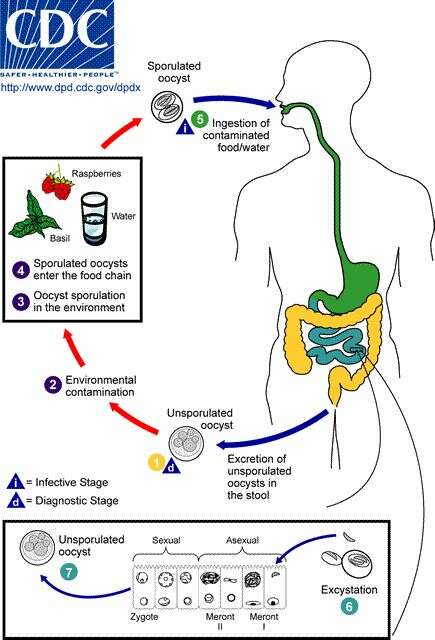
Isosporiasis, also known as cystoisosporiasis, is a human intestinal disease caused by the parasite Cystoisospora belli (previously known as Isospora belli). It is found worldwide, especially in tropical and subtropical areas. Infection often occurs in immuno-compromised individuals, notably AIDS patients, and outbreaks have been reported in institutionalized groups in the United States. The first documented case was in 1915. It is usually spread indirectly, normally through contaminated food or water (CDC.gov).
Eucoccidiorida
The Eucoccidiorida are an order of microscopic, spore-forming, single-celled parasites belonging to the apicomplexan class Conoidasida. Protozoans of this order include parasites of humans, and both domesticated and wild animals including birds. Among these parasites are the Toxoplasma gondii that cause toxoplasmosis and Isospora belli, which results in isosporiasis.

Sarcocystis
Sarcocystis is a genus of protozoan parasites, with many species infecting mammals, reptiles and birds. Its name is derived from Greek sarx = flesh and kystis = bladder.
Eimeriidae
Eimeriidae is a family of Apicomplexa. It contains the following genera:
Acroeimeria Paperna & Landsberg, 1989
Alveocystis Bel'tenev, 1980
Caryospora Léger, 1904
Cyclospora Schneider, 1881
Diaspora Léger, 1898
Dorisa Levine, 1979
Eimeria Schneider, 1875
Epieimeria Dyková & Lom, 1981
Gousseffia Levine & Ivens, 1979
Hoarella Arcay de Peraza, 1963
Isospora Schneider, 1881
Mantonella Vincent, 1936
Octosporella Ray & Ragavachari, 1942
Pfeifferinella von Wasielewski, 1904
Polysporella McQuistion, 1990
Pythonella Ray & Das Gupta, 1937
Sivatoshella Ray & Sarkar, 1968
Cystoisospora belli
parasite that causes cystoisosporiasis

Toxoplasma
REDIRECT Toxoplasma gondii
_Figures_1%E2%80%932.jpg)
Isospora
thumb|right | alt=Figures 1–2; Sporulated oocysts of Isospora machadoae sp. nov. recovered from Turdus albicolis from Brazil: (1) line drawing; (2) photomicrographs. Note the micropyle and micropyle cap (m/mc), nucleus (n), polar granule (pg), refractile body (rb), rough oocyst wall (row), Stieda (sb) and sub-Stieda bodies (ssb) and the sporocyst residuum (sr). Scale bar = 10 μm. | Figures 1–2; Sporulated oocysts of Isospora machadoae sp. nov. recovered from Turdus albicolis from Brazil: (1) line drawing; (2) photomicrographs. Note the micropyle and micropyle cap (m/mc), nucleus (n), polar gra
Sarcocystidae
The Sarcocystidae are a family of Apicomplexa associated with a variety of diseases in humans and other animals.
Cyclospora cayetanensis
protozoan that causes disease in humans
Besnoitia
Besnoitia is a genus of apicomplexan parasites.

Eimeria tenella
species of Conoidasida
Neospora
Neospora is a single celled parasite of livestock and companion animals. It was not discovered until 1984 in Norway, where it was found in dogs. Neosporosis, the disease that affects cattle and companion animals, has a worldwide distribution. Neosporosis causes abortions in cattle and paralysis in companion animals. It is highly transmissible and some herds can have up to a 90% prevalence. Up to 33% of pregnancies can result in aborted fetuses on one dairy farm. In many countries this organism is the main cause of abortion in cattle. Neosporosis is now considered as a major cause of abortion i
Eimeriorina
Eimeriorina is a suborder of phylum Apicomplexa.
Hepatozoon
Hepatozoon is a genus of Apicomplexa alveolates which incorporates more than 300 species of obligate intraerythrocytic parasites. Species have been described from all groups of tetrapod vertebrates, as well as a wide range of haematophagous arthropods, which serve as both the vectors and definitive hosts of the parasite. By far the most biodiverse and prevalent of all haemogregarines, the genus is distinguished by its unique reciprocal trophic lifecycle which lacks the salivary transmission between hosts commonly associated with other apicomplexans. While particularly prevalent in amphibians a
Eimeria acervulina
species of Conoidasida
Neospora caninum
species of Conoidasida

Cyclospora
Cyclospora is a genus of apicomplexan parasites. It includes the species Cyclospora cayetanensis, the causative agent of cyclosporiasis. Members of Cyclospora are characterized as having oocysts with two sporocysts, each containing two sporozoites.
Adeleorina
Adeleorina is a suborder of parasites in the phylum Apicomplexa.
Eimeria necatrix
species of Conoidasida
Eimeria maxima
species of Conoidasida
Archigregarinorida
The Archigregarinorida are an order of parasitic alveolates in the phylum Apicomplexa. Species in this order infect marine invertebrates — usually annelids, ascidians, hemichordates and sipunculids.
Eimeria stiedai
species of Conoidasida

Monocystis
Monocystis (Gr., monos, single + kystisis, bladder) is a genus (the type of the family Monocystidae) of acephaline gregarines (subclass Gregarinasina) not having the protoplasm divided into segments by septa and including internal parasites of invertebrates (as M. agilis of the reproductive system of earthworms).
Eimeria brunetti
species of Conoidasida

Haemogregarina
Haemogregarina is a genus of haemoprotozoans, parasitic mainly on cold-blooded vertebrates. They are unicellular organisms which are parasitic in the red blood cells. Haemogregarina infects lower vertebrates (fish and reptiles) as intermediate hosts and leeches as definitive hosts.
Caryospora
genus of protozoans
Cryptosporidium hominis
species of Conoidasida

Haemogregarinidae
REDIRECT Adeleorina
Eugregarinorida
The Eugregarinorida are the most large and diverse order of gregarines — parasitic protists belonging to the phylum Apicomplexa. Eugregarines are found in marine, freshwater and terrestrial habitats. These species possess large trophozoites that are significantly different in morphology and behavior from the sporozoites. This taxon contains most of the known gregarine species.