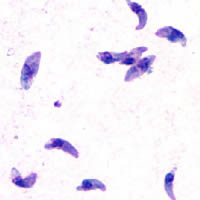
File:Toxoplasma_gondii_tachy.jpg · Wikimedia Commons · See Wikimedia Commons
toxoplasmosis
Sign in to saveAlso known as disseminated toxoplasmosis
I appreciate your question, but I don't have any context provided for me to base an overview of toxoplasmosis on. You've included a "Context:" section that's empty. Could you please provide the source material you'd like me to use to write the overview?
AI-generated from the Wikipedia summary — may contain errors.
Key facts
- Medical condition.name
- Toxoplasmosis
- Medical condition.image
- Toxoplasma gondii tachy.jpg
- Medical condition.caption
- T. gondii tachyzoites
- Medical condition.field
- Infectious disease
- Medical condition.symptoms
- Often none, during pregnancy (birth defects)
- Medical condition.causes
- Toxoplasma gondii
- Medical condition.risks
- Eating poorly cooked food, exposure to infected cat feces
- Medical condition.diagnosis
- Blood test, amniotic fluid test
- Medical condition.treatment
- During pregnancy spiramycin or pyrimethamine/sulfadiazine and folinic acid
- Medical condition.frequency
- Up to 50% of people, 100,000 cases of congenital toxoplasmosis a year
via Wikipedia infobox
Research
28,285 papers- Toxoplasmosis.ReviewThe Veterinary clinics of North America. Small animal practice · 2000Davidson MGDOI: 10.1016/s0195-5616(00)05006-3
- Toxoplasmosis.ReviewSeminars in perinatology · 1998Beazley DM, Egerman RSDOI: 10.1016/s0146-0005(98)80022-0
- Toxoplasmosis.ReviewPediatrics in review · 2007Tamma PDOI: 10.1542/pir.28-12-470
- Toxoplasmosis.British medical journal (Clinical research ed.) · 1981
- Toxoplasmosis.ReviewPediatric clinics of North America · 1985Frenkel JKDOI: 10.1016/s0031-3955(16)34862-3
- Toxoplasmosis.ReviewThe Veterinary clinics of North America. Small animal practice · 1987August JR, Chase TMDOI: 10.1016/s0195-5616(87)50605-2
- Toxoplasmosis.ReviewPediatrics in review · 1997Lynfield R, Guerina NGDOI: 10.1542/pir.18-3-75
- Toxoplasmosis.ReviewThe New England journal of medicine · 1968Feldman HADOI: 10.1056/NEJM196812262792606
via PubMed
Wikidata facts
- Subclass of
- disease
- Image
- Toxoplasma gondii tachy.jpg
Show 12 more facts
- symptoms and signs
- hepatosplenomegaly
- medical examination
- immunofluorescence microscopy
- on focus list of Wikimedia project
- WikiProject Medicine
- has natural reservoir
- Felidae
- disease transmission process
- fecal–oral route
- Commons category
- Toxoplasmosis
- NCI Thesaurus ID
- C3418
- health specialty
- obstetrics and gynaecology
- drug or therapy used for treatment
- chloroquine
- exact match
- identifiers.org/doid/DOID:9965
- has cause
- Toxoplasma gondii
- ICD-9-CM
- 130.7
Sources (6)
via Wikidata · CC0
~53 min read
Encyclopedic overview
39 sectionsContents
- Signs and symptoms
- Acute
- Latent
- Skin
- Cause
- Parasitology
- Transmission
- Pregnancy precautions
- Diagnosis
- Congenital
- Treatment
- Acute
- Latent
- Congenital
- Epidemiology
- History
- Society and culture
- "Crazy cat-lady"
- Notable cases
- Other animals
- Livestock
- Pigs
- Sheep
- Chickens
- Cattle
- Horses
- Domestic cats
- Rodents
- Marine mammals
- Giant panda
- Research
- Mental health
- Neurological disorders
- Traffic accidents
- Climate change
- See also
- References
- Bibliography
- External links
Toxoplasmosis is a parasitic disease caused by Toxoplasma gondii, an apicomplexan. Infections with toxoplasmosis are associated with a variety of neuropsychiatric and behavioral conditions. Occasionally, people may have a few weeks or months of mild, flu-like illness such as muscle aches and tender lymph nodes. In a small number of people, eye problems may develop. In those with a weakened immune system, severe symptoms such as seizures and poor coordination may occur. If a woman becomes infected during pregnancy, a condition known as congenital toxoplasmosis may affect the child.
Toxoplasmosis is usually spread by eating poorly cooked food that contains cysts, by exposure to infected cat feces, or from an infected woman to her baby during pregnancy. Rarely, the disease may be spread by blood transfusion or other organ transplant. It is thought to not otherwise spread between people, but broader transmissibility remains a matter of scientific debate. Studies have reported the presence of T. gondii in human semen and have proposed sexual transmission as a possible route, though this has not been established as a primary mode of spread. The parasite is only known to reproduce sexually in the cat family. It can infect most types of warm-blooded animals, including humans. Diagnosis is typically by testing blood for antibodies or by testing the amniotic fluid in a pregnant patient for the parasite's DNA.
Excerpted from Wikipedia’s “toxoplasmosis” article, available under the CC BY-SA 4.0 licence.
Gallery (19)
Available in 57 languages
- Español
- Français
- Deutsch
- 中文
- 日本語
- Русский
- Português
- Italiano
- العربية
- Afrikaans
- Armenian
- Azerbaijani
- Bahasa Indonesia
- Basque
- Belarusian
- Bulgarian
- Catalan
- Central Kurdish
Show 38 more
via Wikidata sitelinks · CC0