Category
page 1Demulcents

maize
Maize (; Zea mays), also known as corn in North American English, is a tall stout grass that produces cereal grain. The leafy stalk of the plant gives rise to male inflorescences or tassels which produce pollen, and female inflorescences called ears. The ears yield grain, known as kernels or seeds. In modern commercial varieties, these are usually yellow or white; other varieties can be of many colors. Maize was domesticated by indigenous peoples in southern Mexico about 9,000 years ago from wild teosinte. Native Americans planted it alongside beans and squashes in the Three Sisters polycultur

honey
Honey is a sweet and viscous substance made by several species of bees, the best-known of which are honey bees. Honey is made and stored to nourish bee colonies. Bees produce honey by gathering and then refining the sugary secretions of plants (primarily floral nectar) or the secretions of other insects, like the honeydew of aphids. This refinement takes place both within individual bees, through regurgitation and enzymatic activity, and during storage in the hive, through water evaporation that concentrates the honey's sugars until it is thick and viscous.

Avena sativa
The oat (Avena sativa), sometimes called the common oat, is a species of cereal grass (Avena) grown for fodder and for its seed, which is known by the same name (usually in the plural). Oats appear to have been domesticated as a secondary crop, as their seeds resembled those of other cereals closely enough for them to be included by early cultivators. Oats tolerate cold winters less well than cereals such as wheat, barley, and rye, but need less summer heat and more rain, making them important in areas such as Northwest Europe that have cool, wet summers. They can tolerate low-nutrient and aci

Linum usitatissimum
Flax, also known as common flax or linseed, is a flowering plant, Linum usitatissimum, in the family Linaceae. It is cultivated as a food and fiber crop in regions of the world with temperate climates.

liquorice
Liquorice (Commonwealth English) or licorice (American English; see spelling differences; ) is the common name of Glycyrrhiza glabra, a flowering plant of the bean family Fabaceae, from the root of which a sweet, aromatic flavouring is extracted.

Tussilago farfara
Tussilago farfara, commonly known as coltsfoot, is a plant in the tribe Senecioneae in the family Asteraceae, native to Europe and parts of western and central Asia. The name "tussilago" is derived from the Latin tussis, meaning cough, and ago, meaning to cast or to act on. It has had uses in traditional medicine, but the discovery of toxic pyrrolizidine alkaloids in the plant has resulted in liver health concerns.

Plantago major
species of plant

glycerol
Glycerol () is a sugar alcohol with chemical formula . It has three carbon atoms and as many hydroxyl groups. It is a colorless, odorless, sweet-tasting, viscous liquid at Standard Ambient Temperature and Pressure (SATP). Because of its three hydroxyl groups, glycerol is miscible with water and is hygroscopic in nature.

syrup
thumb|upright=1.35|Maltose syrup

Althaea officinalis
species of plant

pectin
thumb|Commercially produced powder of pectin, extracted from citrus fruits
Pectin ( : 'congealed' and 'curdled') is a heteropolysaccharide, a structural polymer contained in the cell walls and middle lamellae of terrestrial plants. The principal chemical component of pectin is galacturonic acid (a sugar acid derived from galactose) which was isolated and described by Henri Braconnot in 1825. Commercially produced pectin is a white-to-light-brown powder, produced from citrus fruits for use as an edible gelling agent, especially in jams and jellies, dessert fillings, medications, and sweets; as

Symphytum officinale
perennial species of plant

Malva sylvestris
species of plant

Verbascum thapsus
species of the plant genus Verbascum

Chondrus crispus
species of edible alga

Aphanes
Aphanes (parsley-piert) is a genus of around 20 species in the rose family (Rosaceae), native to Europe, Asia and Australia. A 2003 study indicated that Aphanes may belong to the genus Alchemilla, commonly called lady's-mantle. They are slender, annual prostrate herbs, much-branched with deeply lobed leaves, pilose (covered with soft hair) and on short petioles. The tiny green to yellow flowers without petals grow in clusters in the denticulate leaflike stipules.

Lobaria pulmonaria
species of lichenized fungus

Ulmus rubra
species of plant
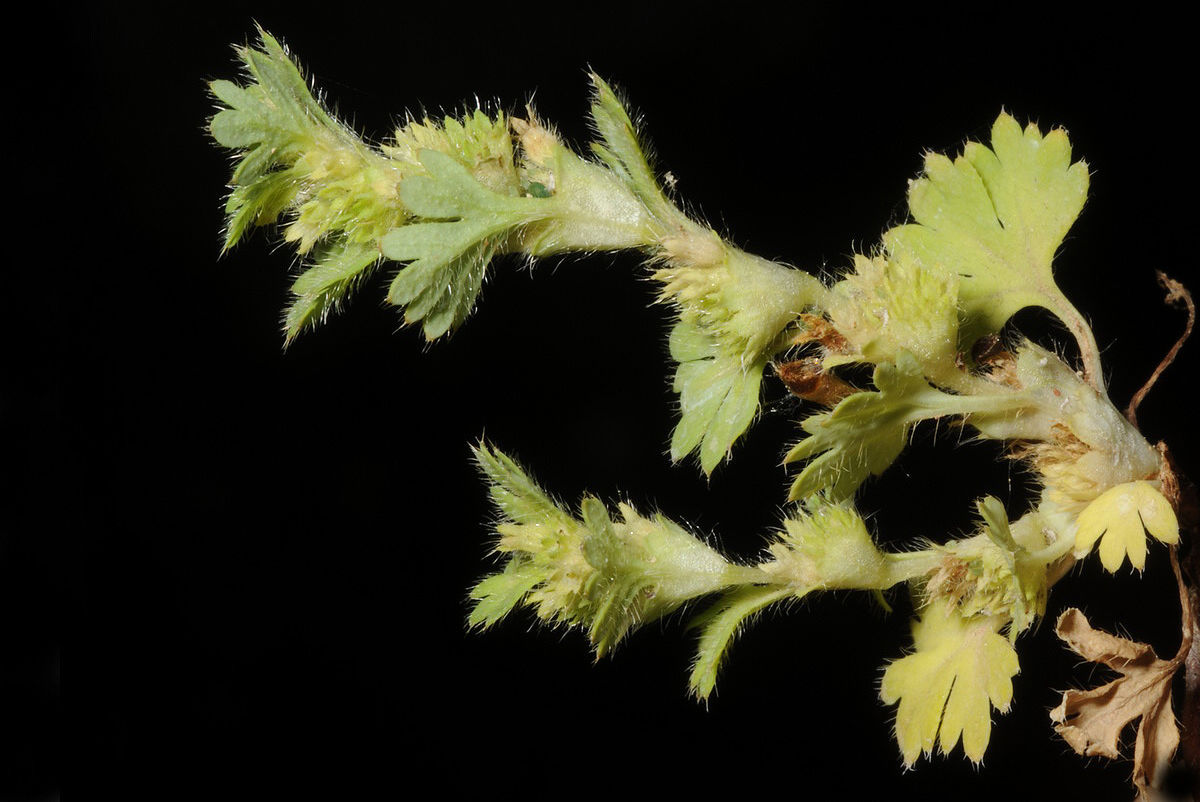
Alchemilla arvensis
species of plant
demulcent
thumb|A demulcent cough drop
A demulcent (derived from the "caress"), sometimes called a mucoprotective agent, is a mucilaginous or oleaginous preparation that forms a soothing protective film over a mucous membrane, relieving minor pain and inflammation of the membrane.
However, they generally help for less than 30 minutes.